


Introduction
Search behavior has changed. Instead of scrolling through ten blue links, most people now get their answer directly from Google AI Overview, the AI-generated summary that sits right at the top of the search results page. If your website isn’t cited in that box, you’re invisible to a growing share of searchers, no matter how well you rank in the traditional listings below it.
This shift is exactly why Google AI Overview SEO has become one of the most important skills for any brand serious about organic visibility in 2026. The good news: AI Overviews still pull from real, indexed web pages which means the sites that follow strong SEO fundamentals, structure their content clearly, and build genuine authority have a real shot at being featured.
In this guide, Social 101, a full-service digital marketing agency in Surat, breaks down 12 proven, practical ways to get your website featured in Google AI Overviews along with the on-page, technical, and authority-building moves that make it possible. This builds on what we’ve already covered in our Organic Growth Strategy for Businesses in 2026 guide and our GEO Guide on getting found on ChatGPT and AI Search.
What Is Google AI Overview, and Why Should You Care?
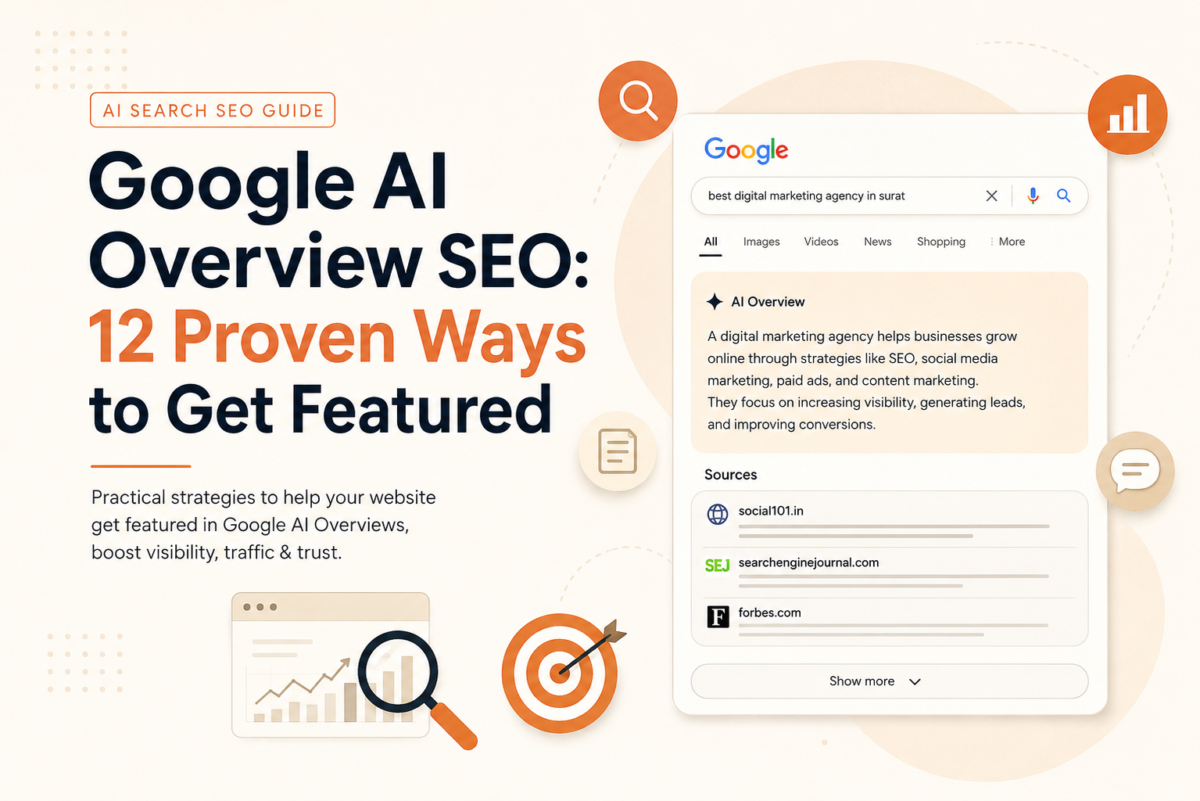
Google AI Overview is an AI-generated answer box, powered by Gemini, that appears above traditional search results for many queries. It synthesizes information from multiple web sources and displays a summarized answer along with citation links back to the original pages.
Getting featured here matters because it puts your brand in front of users at the exact moment they’re searching before they even scroll to position #1. It builds trust, drives qualified clicks, and signals topical authority to Google for future rankings too.
12 Proven Ways to Get Your Website Featured in Google AI Overview
1. Answer the Question Directly in the First 2–3 Sentences
AI Overviews reward content that gets straight to the point. Open every important page or section with a clear, direct answer to the query; the background, context, and detail can follow after.
Think of the opening lines as the exact sentence you’d want Google to lift and cite.
2. Target Question-Based & Conversational Keywords
AI Overviews are triggered mostly by question-style and long-tail searches (“how,” “what,” “why,” “best way to”). Research the real questions your audience is asking and build dedicated headings around them, rather than only chasing short head-term keywords.
3. Structure Content with Clear Headings (H1, H2, H3)
A logical heading hierarchy helps Google’s AI parse your page and extract the right chunk of content for the right query. Each H2/H3 should read almost like its own mini-question, with the answer immediately below it.
4. Use Schema Markup (FAQ, HowTo, Article)
Structured data doesn’t guarantee an AI overview placement, but it makes your content far easier for Google to understand and trust. Add FAQPage, HowTo, and Article schema wherever relevant, and keep your schema in sync with the visible on-page content.
5. Build Topical Authority with Content Clusters
Instead of one isolated blog post, build a cluster: a comprehensive pillar page supported by several related articles, all interlinked. This is exactly the approach we used in our own organic growth strategy for businesses in 2026 pillar, which links out to supporting guides on SEO, content, and AI search.
6. Win the Featured Snippet First
Pages that already rank in a Featured Snippet or the top 3 organic positions are far more likely to be pulled into an AI Overview. Optimize for snippet-style formatting, concise definitions, numbered steps, and comparison tables as a stepping stone.
7. Add Original Data, Statistics & Expert Insight
Generic, reworded content rarely gets cited. Original research, first-party data, case studies, and expert commentary give the AI something unique and citation-worthy that it can’t find on ten other sites.
8. Keep Content Concise, Skimmable & Fact-Dense
Short paragraphs, bullet points, comparison tables, and bolded key terms make it easier for both users and AI models to extract facts quickly. Avoid fluff; every sentence should earn its place.
9. Strengthen Your E-E-A-T Signals
Experience, expertise, authoritativeness, and Trust remain central to what Google surfaces in AI Overviews. Add real author bios, credentials, published dates, sources, and an accessible About/Contact page details you’ll find on our own About and Contact pages.
10. Earn High-Quality Backlinks & Brand Mentions
Citations and backlinks from reputable, relevant sites still tell Google’s AI systems that your content is trustworthy enough to reference. Prioritise digital PR, guest contributions, and partnerships over volume-based link building.
11. Optimise for Voice, Local & Multimodal Search
Many AI Overview queries mirror how people speak, not how they type. Optimize for natural-language phrasing and local intent (“near me,” city names), and add descriptive alt text and captions to images and videos so multimodal AI models can understand your visual content too.
12. Monitor, Measure & Iterate
Track which of your pages already appear in AI Overviews using Search Console’s new AI search reporting, and keep refining based on what’s working. AI Overview: SEO isn’t a one-time setup; it’s an ongoing discipline, the same way we approach it for our own clients through Social 101’s growth marketing services.
Final Thoughts
Getting featured in Google AI Overview isn’t about gaming a new algorithm; it’s about doing SEO right: answering real questions clearly, structuring content the way both humans and AI models can parse it, and building the kind of authority that earns citations. Brands that invest in this now will have a significant visibility advantage as AI-powered search continues to grow.
Want help auditing your website and building an AI Overview-ready content strategy? Talk to Social 101 or explore more insights on our blog.