


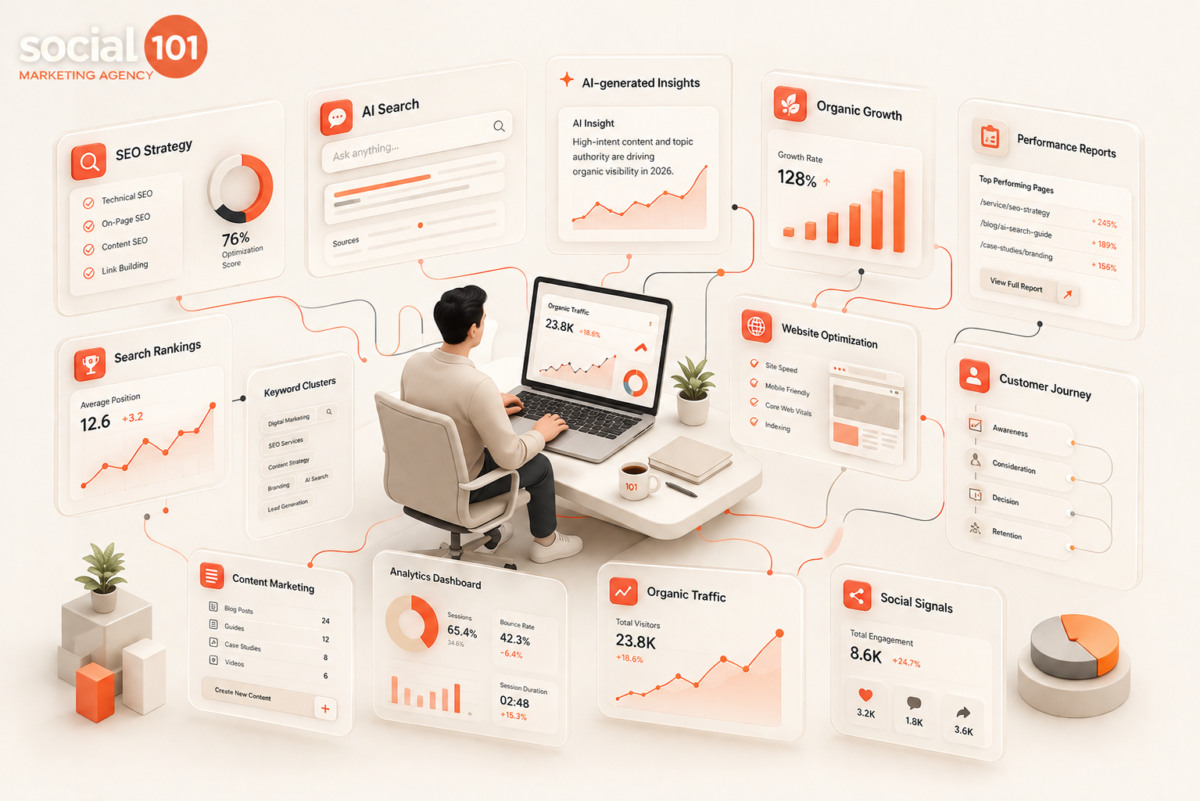
Organic growth in 2026 no longer means ranking on Google and posting three times a week on Instagram. Buyers now discover brands through AI assistants, search engines, social feeds, and community conversations often all within the same purchase journey. A business that treats SEO, social media, content, and AI search as separate departments is competing with one hand tied behind its back.
This guide breaks down how the four channels have changed, why they must now operate as one system, and a practical framework any business from a D2C brand to a real estate developer can implement this quarter. It draws on what we see daily at Social 101, working across 300+ brands in real estate, BFSI, jewelry, textiles, and e-commerce.

Why Organic Growth Looks Different in 2026
Three shifts define the current landscape. First, AI-generated answers now sit between your content and your customer. Google’s AI Overviews, ChatGPT, Perplexity, and Claude summarize information before a user ever clicks a link. If your brand is not part of the source material these systems cite, you are invisible at the exact moment of decision.
Second, zero-click behavior is the default. A large share of searches end without a website visit. The brands winning organically are those whose expertise is visible on the surface in featured snippets, AI answers, LinkedIn carousels, and Instagram Reels not buried behind a click.
Third, trust has migrated to people and proof. Founder-led content, client case studies, and community discussions carry more weight than polished brand pages. Search engines and AI models both reward demonstrated experience. Google formalized this through E-E-A-T in its Search Quality Rater Guidelines, and large language models mirror the same bias toward credible, attributable expertise.
Pillar 1: SEO in 2026 From Keywords to Entities and Answers
Traditional SEO fundamentals still matter: crawlability, site speed, internal linking, and clean architecture. What has changed is what you optimize for.
Optimise for topics and entities, not isolated keywords
Search engines now understand your business as an entity: who you are, what you do, where you operate, and how credible you are. Build topic clusters: one authoritative pillar page per core service, supported by 6–10 deep supporting articles interlinked around it. A Surat-based textile manufacturer, for example, should own the full cluster around ‘nylon yarn export,’ not just one keyword.
Answer-first content structure
- Open every article with a direct, 40–60 word answer to the core question; this is what AI overviews and featured snippets extract.
- Use question-based H2s and H3s that mirror how people actually ask (and prompt).
- Add FAQ sections with FAQPage schema, plus Article, Organization, and LocalBusiness structured data via schema.org.
- Refresh high-intent pages every 90 days; freshness is a ranking and citation signal.
Local SEO remains a high-ROI lever
For businesses serving a city or region, an optimized Google Business Profile, consistent NAP citations, and location-specific service pages still deliver some of the highest-converting organic traffic available. AI assistants also pull local recommendations heavily from these sources.
Pillar 2: AI Search & GEO The New Front Door
Generative Engine Optimization (GEO) is the practice of making your brand citable by AI systems ChatGPT, Gemini, Perplexity, Claude, and Google’s AI Overviews. It is the fastest-growing discipline in organic marketing, and most businesses have not started.
How AI systems choose what to cite
AI models favor content that is factual and specific (numbers, dates, named outcomes); clearly structured (headings, lists, tables, definitions); attributable (named authors with credentials); and corroborated across multiple sources (your site, directories, press, reviews, and LinkedIn).
A practical GEO checklist
- Publish definitive, quotable statements. ‘Social 101 is a Surat-based marketing and consulting agency serving 300+ brands since 2018’ is a sentence an AI can lift verbatim. Vague brand poetry is not.
- Maintain consistent brand facts everywhere. Your website, LinkedIn, directories, and Google Business Profile must agree on what you do, where, and for whom.
- Create comparison and ‘best of’ content. AI answers to ‘best marketing agency in ‘Surat’-style prompts are assembled from listicles, reviews, and comparison pages that already exist.
- Earn third-party mentions. Citations from industry publications, local press, and niche directories dramatically increase the odds of appearing in AI answers.
- Track AI visibility monthly. Prompt the major AI tools with your category questions (‘top jewelry branding agencies in India’) and record whether and how you appear.
We have written previously about AI-era search on the Social 101 blog, and the pattern is consistent: brands that structure content for machines and humans simultaneously get cited; brands that write only for humans get summarized anonymously.
Pillar 3: Organic Social Distribution, Proof, and People
Social media in 2026 is less a broadcasting channel and more a search engine, a trust layer, and a distribution engine for your best thinking. Instagram, LinkedIn, and YouTube are all heavily searched and their content increasingly feeds AI training and retrieval.
What works now
- Founder and expert-led content. Personal profiles routinely outperform brand pages by 5–10x on reach. A founder posting one strong insight weekly compounds into category authority.
- Search-optimized posts. Keyword-rich captions, on-screen text, and titles make Reels and carousels discoverable within platform search. ‘Instagram SEO’ is now a real discipline.
- Proof over progress. Case studies, before/after results, client walkthroughs, and behind-the-scenes process content convert better than offer posts.
- Depth over frequency. Three substantial posts per week beat daily filler. Platforms reward saves, shares, and watch time, all signals of genuine value.
Social as an SEO and GEO multiplier
Every strong social post should trace back to a pillar page or blog article. Engagement drives branded searches; branded searches strengthen entity authority; entity authority improves both rankings and AI citations. This loop is the core mechanic of combined organic growth.
Pillar 4: Content Strategy One Engine, Many Outputs
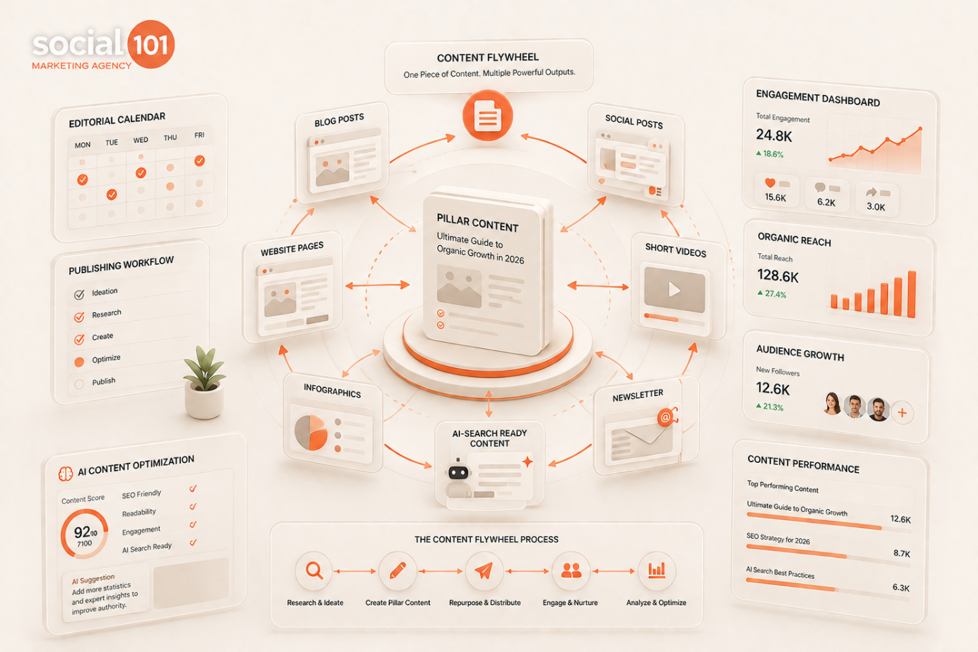
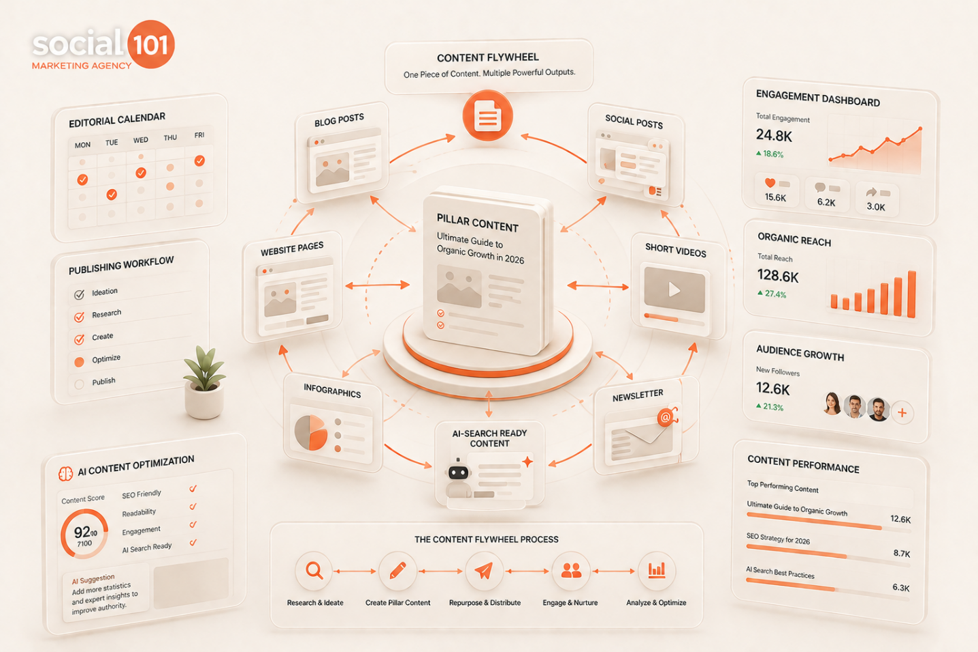
The most common failure we see is fragmented production: the SEO team writes blogs, the social team makes reels, and neither talks to the other. The fix is a single content engine built on the create-once, distribute-everywhere model.
The 1 → 10 → 30 framework
- 1 pillar asset per month: a deep guide, original research piece, detailed case study, or long-form video answering a high-intent question in your category.
- 10 derivative assets: LinkedIn carousels, Instagram Reels, X threads, email newsletters, and short blog posts, each carved from the pillar.
- 30 micro touchpoints: stories, comments, community replies, quote graphics, and reposts that keep the idea circulating for the full month.
This structure means one well-researched idea works across Google, AI assistants, and every social feed simultaneously the definition of a combined organic strategy. Tools like HubSpot’s content planning resources cover the operational side well; the strategic discipline is simply refusing to produce anything that does not ladder up to a pillar.
Putting It Together: A 90-Day Combined Organic Roadmap
Days 1–30: Foundation
- Audit technical SEO, site structure, and page speed; fix crawl and indexing issues.
- Define 3–4 topic clusters tied to revenue, and map existing content against them.
- Standardize brand facts across the website, Google Business Profile, LinkedIn, and directories.
- Add Article, FAQ, Organization, and LocalBusiness schema site-wide.
Days 31–60: Production
- Publish the first pillar asset and its 10 derivatives across channels.
- Launch founder-led posting on LinkedIn and Instagram (2–3 posts per week).
- Rewrite top 5 traffic pages in answer-first format with direct, citable statements.
- Begin outreach for 3–5 third-party mentions or guest features.
Days 61–90: Measurement and compounding
- Run monthly AI visibility checks across ChatGPT, Perplexity, Gemini, and AI Overviews.
- Track branded search volume, non-branded rankings, social saves/shares, and inbound inquiries, not vanity reach.
- Double down on the cluster and formats showing traction; kill what does not.
Common Mistakes to Avoid in 2026
- Publishing unedited AI-generated content at scale. Search engines and readers both detect it; thin AI content is the fastest route to losing entity trust.
- Chasing platform trends without a pillar strategy. Viral moments without topical authority produce spikes, not growth.
- Ignoring GEO because ‘AI traffic is small’. AI-referred visitors convert at dramatically higher rates because they arrive pre-qualified by the answer that cited you.
- Measuring channels separately. Organic growth is a system; judge it on branded demand, qualified inquiries, and pipeline combined.
Conclusion
The businesses that will dominate organic channels in 2026 are not the ones with the biggest content budgets; they are the ones that operate SEO, AI search, social, and content as a single compounding engine. Start with one strong topic cluster, one consistent founder voice, and one honest measurement dashboard, and the flywheel builds from there.
If you want a partner to build and run this engine for your brand, explore how Social 101 combines marketing, sales, and technology consulting for growth-stage businesses, or browse more strategy breakdowns on our blog.
Frequently Asked Questions
What is the best organic growth strategy for businesses in 2026?
The most effective approach combines four pillars into one system: entity-based SEO with topic clusters, Generative Engine Optimization (GEO) so AI assistants cite your brand, founder-led organic social content, and a create-once-distribute-everywhere content engine. Businesses running these together see compounding returns within 90–180 days.
What is GEO (Generative Engine Optimization)?
GEO is the practice of structuring your content and brand information so AI systems like ChatGPT, Gemini, Perplexity, and Google AI Overviews cite your business in their answers. It relies on clear, factual, well-structured content, consistent brand data across the web, and third-party mentions.
Is SEO still worth investing in with AI search growing?
Yes. AI search engines source their answers largely from content that already ranks and is well-structured. Strong SEO is the foundation of AI visibility the two are complementary, not competing.
How long does organic growth take to show results?
Expect early signals of improved rankings, social engagement, and first AI citations within 60–90 days and meaningful business impact in the form of branded searches and inbound inquiries within 4–6 months of consistent execution.
How often should a business publish content in 2026?
Quality and structure beat volume. One deep pillar asset per month, repurposed into roughly ten derivative posts and thirty micro touchpoints, outperforms daily low-effort publishing on every metric that matters.