


If you run marketing for a real estate developer, you already know the uncomfortable truth: a full inbox of leads means nothing if your sales team is chasing people who were never going to buy. Thousands of clicks, hundreds of form fills, a CPL that looks great on a dashboard, and still, empty site-visit slots. This is the single biggest gap between a real estate marketing agency that just “runs ads” and one that actually understands the property buying funnel.
At Social 101, we’ve worked with residential and commercial developers across Surat long enough to know that the real KPI isn’t cost-per-click or even cost-per-lead. It’s cost-per-qualified-site-visit because that’s the number that actually moves bookings. Here’s how a real estate marketing agency builds a system around that number instead of vanity metrics.
Why Clicks and Form Fills Aren’t the Same as Leads
A click tells you someone was curious for three seconds. A form fill tells you someone typed their number, sometimes just to download a brochure or check a price range out of idle interest. Neither tells you whether that person has the budget, the intent, or the timeline to actually walk into your sales office.
Real estate has a longer, higher-stakes decision cycle than almost any other category; a buyer is committing lakhs or crores, often with family input, home loan approval, and comparison shopping across 4-5 projects. Optimizing only for cheap clicks fills your CRM with names that never pick up the phone, and it quietly damages the metric that actually matters to a developer: cost per site visit and cost per booking.
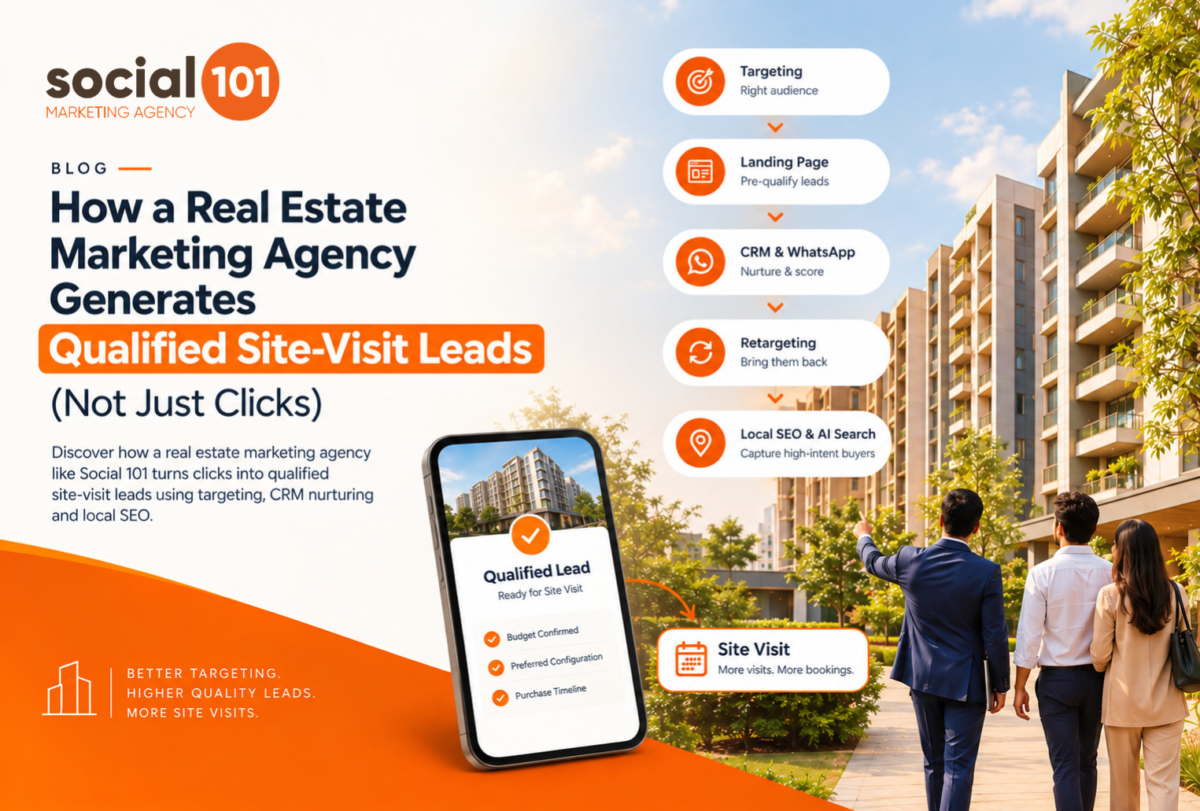
The Funnel a Real Estate Marketing Agency Actually Builds
Instead of a flat “ad to form” setup, a proper real estate lead generation funnel has distinct stages, each with its own targeting and messaging:
- Awareness: Reaching people actively searching for property in a specific micro-market, not a broad city-wide audience.
- Interest: Retargeting website visitors and video viewers with project-specific content amenities, floor plans, price ranges, RERA details.
- Qualified Lead: Using budget-qualifying questions, loan pre-check tools, or WhatsApp conversations to filter serious buyers from browsers.
- Site Visit: Scheduling tools, reminder sequences, and incentives (transport pickup, exclusive previews) that convert a warm lead into a confirmed visit.
- Booking: Sales-team handoff with full lead context, so no one starts the conversation from zero.
Each of these stages needs a different creative, a different targeting layer, and a different measurement. Treating them as one funnel is where most in-house teams and generalist agencies fall short.
1. Intent-Based Targeting Over Broad Reach
Broad targeting (“everyone in Surat aged 25-55”) maximizes impressions but tanks lead quality. A real estate marketing agency instead builds layered audiences: people searching Google for “2 BHK flats near [location]” or “property in [micro-market] price,” past website visitors who viewed a floor plan page for more than 30 seconds, lookalike audiences modeled on your last quarter’s actual site-visit converters (not just leads), and custom audiences uploaded from your CRM of loan-approved or NRI buyer segments. This is the difference between running Google Ads and Meta Ads generically versus running them with a property-specific intent layer. The second approach costs more per click but far less per qualified visit.
2. Landing Pages Built to Qualify, Not Just Collect
Most builder websites send every ad to the same generic “Enquire Now” form. A better approach uses project-specific landing pages that pre-qualify the visitor before they ever talk to a sales executive asking about configuration preference (2 BHK / 3 BHK / Villa), budget range, and purchase timeline (immediate / 3 months / just exploring) right in the form. This single change alone typically improves lead-to-site-visit conversion because your telecalling team can prioritize instantly instead of cold-calling every entry equally.
3. CRM and WhatsApp Nurturing Where Most Leads Are Actually Lost
A lead that isn’t followed up within minutes goes cold fast, and real estate has one of the highest first-response-time sensitivities of any industry. A real estate marketing agency worth its retainer connects ad platforms directly to a CRM, triggers instant WhatsApp confirmation and follow-up sequences, scores leads automatically based on engagement (opened brochure, replied to WhatsApp, clicked pricing PDF), and routes hot leads to the sales team in real time while cooler leads go into a longer nurture sequence with project updates, video walkthroughs, and festive offers. This nurturing layer is often what separates an agency generating clicks from one generating actual site visits.
4. Retargeting Site Visitors Who Didn’t Convert the First Time
Most property buyers research a project multiple times before visiting. Retargeting campaigns using dynamic creative showing the exact unit type or price point a visitor browsed bring back warm prospects at a much lower cost than fresh acquisition. This is especially effective combined with urgency-based messaging: limited inventory in a specific tower, price escalation notices, or festive-period previews.
5. Aligning Marketing With the Sales Team’s Reality
A lead handed to a sales executive with zero context, no budget preference, no configuration interest, and no prior interaction history is far less likely to convert into a scheduled visit. Agencies that treat marketing and sales as one continuous pipeline pass full lead context automatically agree on a shared definition of a “qualified lead” with the developer’s sales head and report on site-visit and booking numbers, not just leads generated. This alignment is often the single biggest lever for improving visit conversion rates without spending an extra rupee on media.
6. Local SEO and AI Search Visibility for High-Intent Buyers
Not every serious buyer comes from a paid ad. A growing share now searches directly “best projects near [location] Surat” or asks AI tools like ChatGPT and Google AI Overviews for recommendations. Ranking a project website organically and optimizing content for these AI-driven answers (a discipline now often called AEO or GEO) captures a segment of highly motivated buyers who are already close to a decision at a fraction of the cost of paid acquisition.
The Metrics That Actually Matter
A results-driven real estate marketing agency reports on a different scorecard than a generalist agency. Instead of leading with cost-per-click or total leads, the numbers that matter are:
- Cost per qualified lead (not just cost per lead)
- Lead-to-site-visit conversion rate
- Cost per confirmed site visit
- Site-visit-to-booking conversion rate
- Channel-wise quality comparison (Google vs Meta vs organic vs referral)
When these are tracked and optimized together, media spend naturally shifts toward the channels and audiences producing bookings not just form fills.
How Social 101 Approaches This for Developers in Surat
At Social 101, our real estate campaigns are built around this exact philosophy every project we work on starts with defining what a “qualified lead” means for that specific developer, not a generic template. We combine intent-based Google and Meta campaigns, CRM-integrated WhatsApp nurturing, project-specific landing pages, and local SEO to build a pipeline that sales teams can actually work with, rather than a spreadsheet of unresponsive numbers. For Surat’s competitive real estate market where buyers routinely compare multiple projects before visiting even one this qualification-first approach is what consistently turns marketing spend into filled site-visit calendars.
Conclusion
Clicks are easy to buy. Qualified site visits are earned through better targeting, smarter qualification, faster follow-up, and a genuine alignment between marketing and sales goals. If your current campaigns are generating leads but not visits, the fix usually isn’t more budget it’s a better funnel. That’s the core job of a real estate marketing agency, and it’s the standard Social 101 builds every campaign against.
Looking to fix your site-visit numbers, not just your lead count? Get in touch with Social 101’s real estate marketing team today.