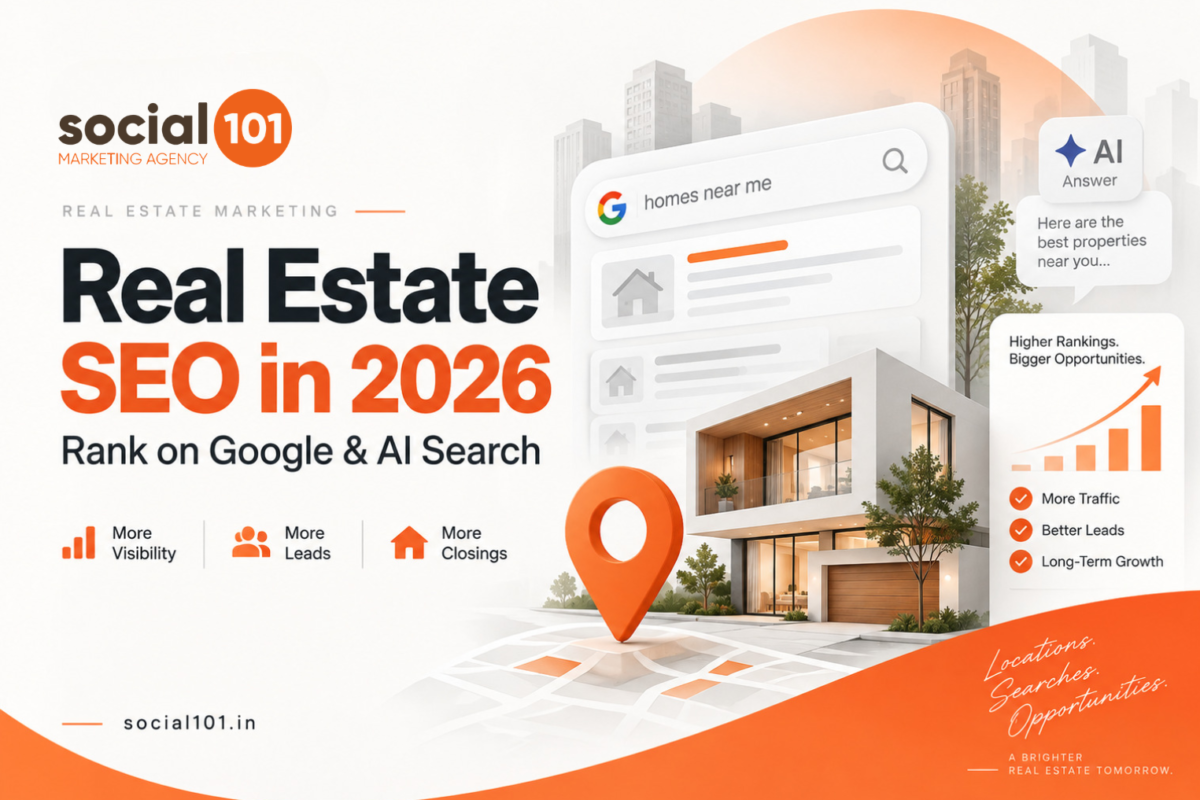
For years, real estate SEO meant one thing: rank a project page on Google’s first ten blue links and wait for organic traffic to turn into inquiries. That’s no longer the whole story. In 2026, a growing share of property research happens inside AI tools ChatGPT, Google’s AI Overviews, Gemini, and Perplexity before a buyer ever clicks into a traditional search result. A real estate marketing agency that still optimizes only for classic Google rankings is leaving an entire buyer segment untouched.
At Social 101, we’ve spent the last year rebuilding how we approach SEO for developer and broker websites, combining traditional search optimization with what’s now called AEO (Answer Engine Optimization) and GEO (Generative Engine Optimization). Here’s what actually works for real estate websites right now.
Why Real Estate SEO Looks Different in 2026
Property search has fragmented. A buyer might still type “3 BHK flats in Vesu” into Google, but increasingly they’re also asking an AI assistant, “Which are the best upcoming residential projects in Surat under 80 lakhs?” and getting a synthesized answer with no need to click through to any single website. If your project isn’t structured in a way AI tools can read, extract, and trust, you simply don’t exist in that answer no matter how well you rank on classic Google.
This means real estate SEO in 2026 has two parallel goals: rank well in traditional search results and get cited or referenced inside AI-generated answers. Both rely on many of the same fundamentals, but AI search adds a few new requirements on top.
1. Get the On-Page Fundamentals Right (Still Non-Negotiable)
Before chasing AI visibility, your project website needs the basics locked in because AI tools largely pull from well-optimized web content in the first place:
- Unique, keyword-rich title tags and meta descriptions for every project, tower, and configuration page (not one generic template repeated everywhere)
- Fast page load speed: property sites loaded with unoptimized images and heavy sliders lose both rankings and buyer patience
- Mobile-first design, since the overwhelming majority of property searches now happen on phones
- Clean URL structures and internal linking between project pages, amenities pages, and location pages
- Schema markup for RealEstateListing, FAQPage, and LocalBusiness so search engines and AI crawlers can parse project data accurately
2. Structure Content the Way AI Search Actually Reads It
AI answer engines favor content that directly answers a specific question in a clear, extractable format not long, decorative paragraphs. For a project page or blog, this means leading with a direct answer in the first two lines, using FAQ sections with real buyer questions (“What is the starting price at [project name]?”, “Is [project name] RERA registered?”), and using structured data bullet points, comparison tables, and clearly labeled headings instead of burying facts in prose. Content written this way tends to perform well in both Google’s featured snippets and AI-generated summaries, because the underlying skill is the same: making facts easy to lift out cleanly.
3. Local SEO Is Still the Backbone for Developers
Most property buyers search hyper-locally by micro-market, landmark, or locality name rather than city alone. A strong local SEO foundation includes a fully optimized Google Business Profile for the project site office, location-specific landing pages for each micro-market a developer operates in, consistent NAP (name, address, phone) details across property portals like 99acres, Housing.com, and MagicBricks, and genuine local backlinks from Surat business directories, news coverage, and real estate portals. AI tools frequently pull local business and location data directly from these structured local sources, so weak local SEO now hurts AI visibility as well as classic rankings.
4. Build Topical Authority, Not Just Landing Pages
A single project page rarely ranks well or gets cited by AI tools in isolation. Google and AI models both weigh how much genuine authority a website has built around a topic. For developers, this means publishing supporting content around the project area guides, price trend articles, RERA and home-loan explainer content, and comparison content (“[Project] vs [Competitor Project]”) that a genuinely useful real estate website would have. This is exactly the kind of content architecture we build at Social 101 for our developer clients: a project page is never an island, it sits inside a content cluster that reinforces relevance for both search engines and AI models.
5. Reviews, Mentions, and Third-Party Signals Matter More Now
AI search tools weigh trust signals heavily, since they’re trying to avoid recommending something unreliable. This makes genuine Google reviews on your business profile, coverage or mentions on real estate news and portal sites, and consistent presence across property listing platforms far more influential than they were a few years ago. A project with strong third-party validation across the web is simply more likely to be surfaced when someone asks an AI assistant for a recommendation.
6. Track a Broader Set of Visibility Metrics
Classic SEO reporting rankings and organic traffic are no longer the full picture. A modern real estate SEO strategy also tracks whether the project is being cited in AI overviews and chatbot answers, branded search volume growth (people searching the project name directly after seeing it elsewhere), and enquiry quality from organic and AI-referred traffic, not just volume. Agencies still reporting only keyword rank position are measuring half the funnel.
How Social 101 Approaches Real Estate SEO for 2026
For our developer clients across Surat, we run SEO as a combined Google-plus-AI-search strategy from day one technical optimization and schema markup, location-specific content clusters, FAQ-driven content structured for both snippets and AI answers, and ongoing authority building through reviews, PR, and portal presence. The goal isn’t a vanity keyword ranking; it’s making sure that whether a buyer searches on Google or asks ChatGPT for the best project in their budget, your development is the one that shows up.
Conclusion
Real estate SEO in 2026 isn’t about choosing between Google and AI search it’s about building a website and content strategy that performs in both. The fundamentals of technical SEO, local optimization, and topical authority haven’t disappeared; they’ve simply become the foundation on which AI visibility is built. Developers who invest in this now will be the ones showing up in buyer conversations for years to come.
Want your project website ranking on Google and getting recommended by AI search tools? Talk to Social 101’s real estate SEO team today.