


Every business owner we meet at Social 101 eventually arrives at the same crossroads. One voice says, “Run ads that bring in sales today.” The other says, “Build a brand people remember tomorrow.” Both feel right, both cost money, and almost nobody explains how to divide your budget between them without it becoming a guessing game.
This is the heart of the performance marketing versus branding debate, and in our experience it is one of the most expensive misunderstandings in marketing. When a business pours everything into performance, it becomes a name nobody recognises, dependent on ad platforms for every rupee of revenue. When it pours everything into branding, it ends up with a beautiful identity and an empty order book.
The answer, as we have seen across the hundreds of brands we have worked with, lies in the balance. In this guide we will walk through what each approach actually does, when to lean on one over the other, and how to think about your ad budget so it serves both today’s sales and tomorrow’s growth.


Understanding Performance Marketing
Performance marketing is exactly what the name suggests: marketing you pay for based on measurable results. Clicks, leads, sales, sign-ups. Every rupee is tracked, and you know precisely what came back.
This is the world of Meta ads, Google ads, search campaigns, and retargeting. You set a goal, the campaign chases it, and a dashboard tells you whether it worked. It is fast, accountable, and easy to justify because the numbers sit right in front of you. If you want to see how we structure campaigns like these at Social 101, our breakdown of running a successful PPC campaign covers the practical side in detail.
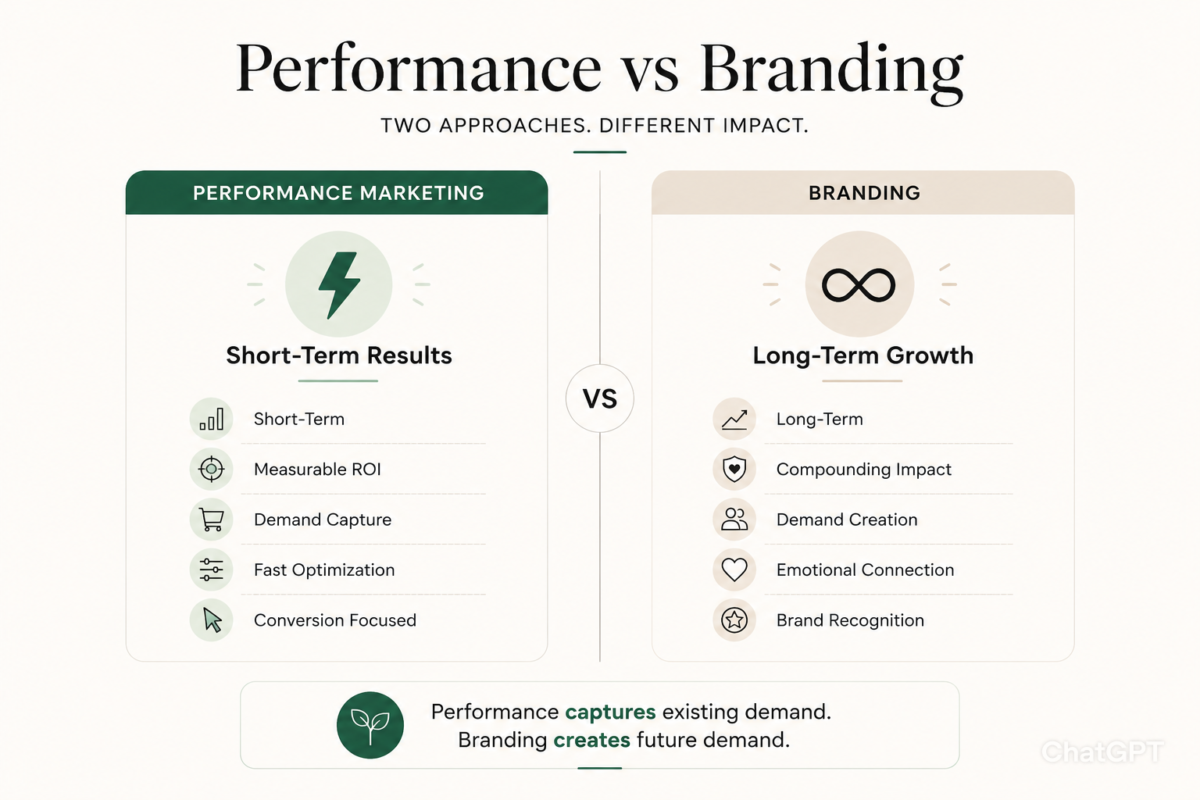
The strength of performance marketing is obvious when you need immediate, trackable sales, a return you can measure campaign by campaign, and the flexibility to scale up or pause overnight. The catch is just as important to understand: performance marketing captures demand that already exists. It is brilliant at converting people who are ready to buy, but it does very little to make people want your brand in the first place. The moment you stop paying, the traffic stops with you.


Understanding Branding
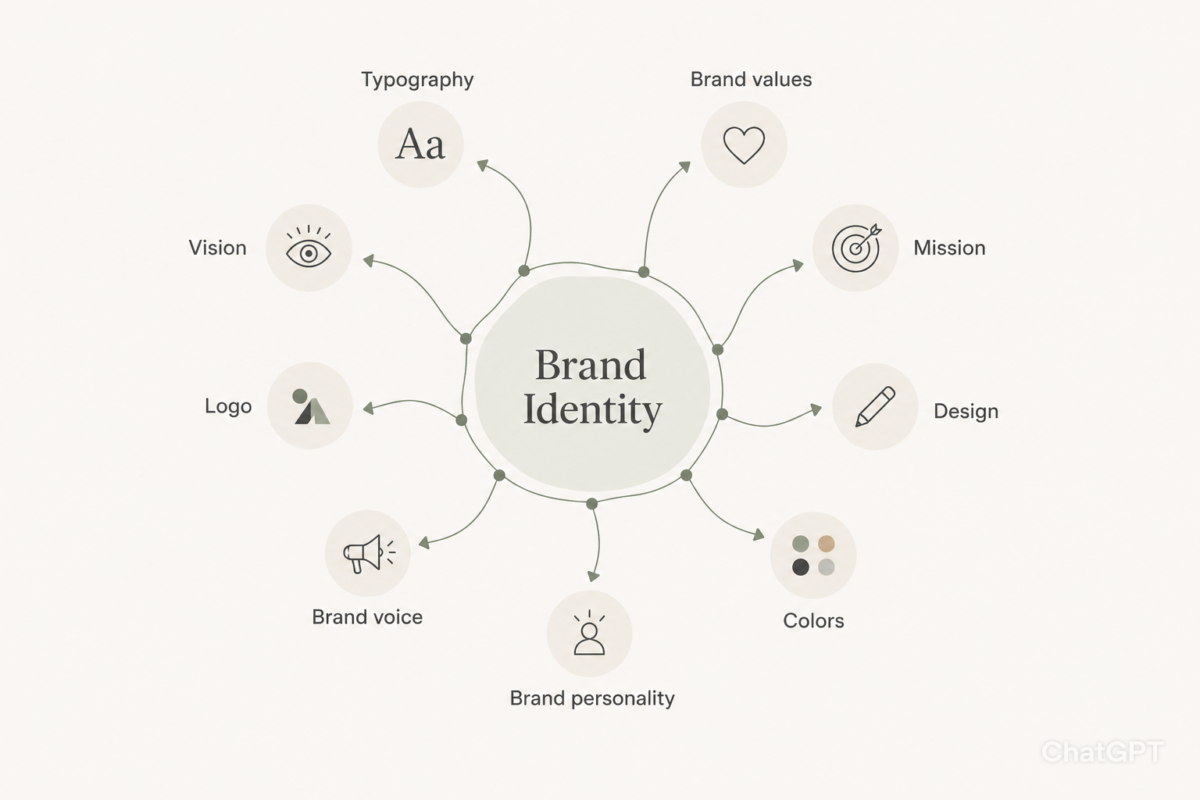
Branding is the long game. It is everything that shapes how people feel about your business before they ever click “buy” your visual identity, your tone, your story, and the consistency with which you show up. We explored this foundation in our piece on creating a strong brand identity through digital marketing, and the principle holds across every industry we work in.
Branding rarely produces a sale you can trace back to a single ad. Instead it builds something more durable: recognition, preference, and trust. It is the reason someone chooses your jewellery brand over a cheaper one, or recommends your agency without being asked. Done well, it earns you customers who stay, who buy again, and who do not flinch at your price.
The challenge with branding is patience. It does not hand you a neat weekly report. Its returns compound quietly, which is precisely why it is the first thing cut when budgets tighten and often the hidden reason growth stalls later.

The Core Difference, and Why It Matters
Here is the simplest way we explain it to clients: performance marketing harvests demand, while branding creates it.
Performance marketing reaches into a pool of people who already want what you sell and pulls them to checkout. Branding fills that pool in the first place. If you only ever harvest and never refill, the pool eventually runs dry and your cost per sale climbs higher every quarter.
This is why businesses that rely purely on performance ads often feel like they are sprinting just to stay in place. Their costs keep rising because they are competing for the same shrinking pool of ready-to-buy customers, while never building the recognition that would make new customers come looking for them.
So Where Should Your Ad Budget Actually Go?
There is no single split that works for everyone, but there is a smart way to think it through based on your stage and goals.
If you are a new business or launching something, we usually advise leaning a little heavier on branding early to establish recognition, while keeping a meaningful performance budget running to generate immediate cash flow and learn what messaging converts. You need sales to survive, but you also need people to remember you when they are ready.
If you are an established business with steady sales, this is where the classic balance applies. A commonly referenced starting point is roughly sixty percent performance and forty percent branding, then adjusting based on what your own data reveals. The aim is to keep the sales engine running while consistently investing in long-term recall.
And if your performance costs keep climbing, take it as a signal that you have under-invested in branding. When too few people recognise you, every sale has to be bought through ads. Shifting more budget toward brand building lowers those performance costs over time, because warm, familiar audiences convert far more cheaply than cold ones.
The real shift in thinking is this: stop seeing branding and performance as rivals competing for the same budget. They are two halves of the same machine. Branding makes your performance ads cheaper and more effective, and performance marketing funds the patience that branding demands.
The Mistakes We See Most Often
The most common error is chasing only what is measurable. Because performance marketing reports clean numbers and branding does not, owners over-fund the trackable and starve the brand. But easy to measure is not the same as more important.
Closely related is expecting branding to behave like performance. Branding will not show you a sale within forty-eight hours, and judging it by performance metrics almost guarantees disappointment and premature budget cuts.
We also see inconsistency quietly undo good work. Branding only compounds when it is consistent sporadic, off-tone, or constantly changing messaging resets the very trust you are trying to build. Our guide on creating a social media strategy for your business is a useful starting point for keeping that consistency in place.
Finally, too many businesses ignore the loop between the two. The brands that win treat branding and performance as a single system: strong branding lowers acquisition costs, and strong performance funds continued brand investment. Run them in isolation, and both underperform.
How Surat Businesses Should Approach This
For businesses in Surat whether you are in textiles, jewellery, real estate, or D2C there is a local nuance worth weighing. Word of mouth, reputation, and recognition carry enormous weight in this market. A brand people already trust converts dramatically better, both online and off.
That makes the case for branding even stronger here. Yet many local businesses still funnel their entire budget into performance ads because the results feel immediate. The ones who pull ahead are those who pair sharp, well-targeted performance campaigns with consistent brand building, so that when a customer is finally ready to buy, the business is already a name they know and trust. You can see how this plays out industry by industry in our complete playbook on social media marketing for jewellery brands and our ideas for marketing real estate businesses.
The Final Verdict
So, where should your ad budget go? The honest answer is both but with intention.
Performance marketing keeps the lights on. Branding builds the house. Fund only the first and you remain forever dependent on ad platforms, paying more each year for the same results. Fund only the second and you may never see the sales needed to sustain it.
The businesses that grow consistently are the ones that stop treating this as an either-or decision. They build a brand worth choosing, and they run sharp performance campaigns to convert the demand that brand creates. Get that balance right, and your marketing stops being a cost you justify every month and becomes an engine that compounds.
If you are trying to find the right balance for your business, that is exactly the kind of strategic thinking we do every day at Social 101. Get in touch with our team, and let’s build a marketing approach that works for today and tomorrow.