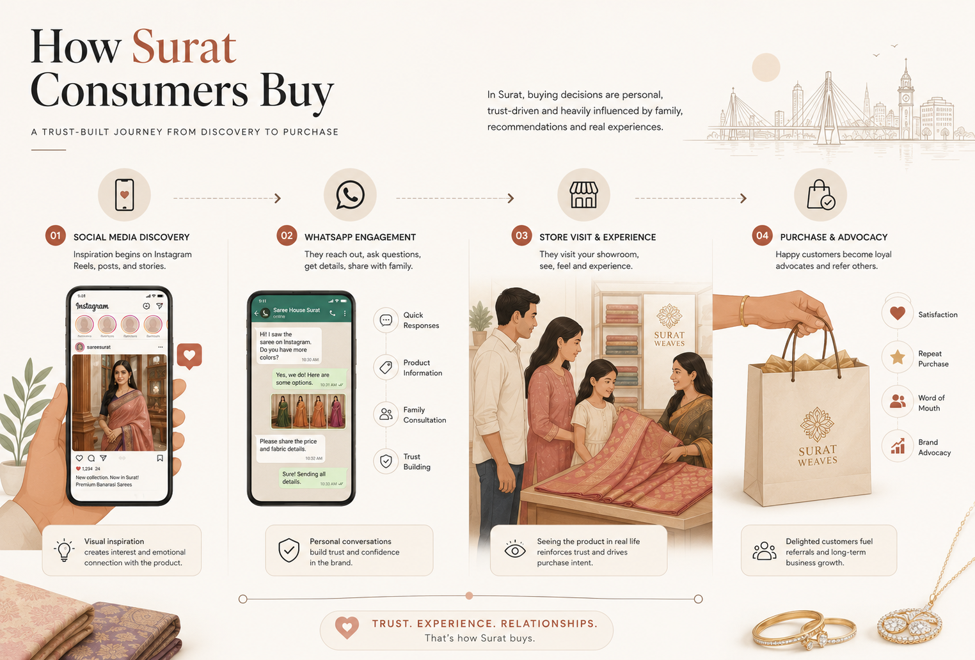
Surat moves more fabric in a day than most cities see in a month. It is the engine room of India’s man-made textile industry, with over 65,000 looms, the country’s largest saree market, and a supply chain that dresses half the weddings in India. And yet, walk through any textile market on Ring Road and you’ll find world-class products being sold with marketing that stops at a WhatsApp broadcast.
That gap is the opportunity. For textile manufacturers, wholesalers, and saree brands in Surat, social media marketing is no longer the “nice to have” it was five years ago. It is where your next distributor discovers you, where a bride saves your design to her wedding board, and where a retailer in Hyderabad decides to place a first order without ever visiting your office.
This guide breaks down exactly how to make social media work for a textile or saree business not in theory, but in the language of margins, MOQs, and festive calendars.
Why Surat’s Textile Businesses Can’t Ignore Social Media Anymore
The buyer has changed. A retailer sourcing sarees today scrolls Instagram before they pick up the phone. A bride in Pune browses Reels before she walks into a store. Even B2B distributors now shortlist suppliers based on how credible and active a brand looks online.
A few things make this shift especially sharp for Surat:
• Visual product, visual platforms. Sarees and fabrics are inherently photogenic. Drape, fall, shine, weave these are things people want to see, and Instagram and Pinterest are built for exactly that.
• A pan-India and export buyer base. Your customer isn’t only in Gujarat. Social platforms let a Surat manufacturer reach a boutique in Chennai or an importer in Dubai at near-zero cost.
• Trust before transaction. In a market crowded with thousands of sellers, a consistent, well-presented social presence signals reliability, which matters enormously when someone is placing a bulk order on credit.
The businesses winning right now aren’t the ones with the biggest looms. They’re the ones whose brand shows up, clearly and confidently, where buyers are already looking.
B2B vs B2C: Two Different Games on the Same Platforms
Most textile businesses in Surat sit somewhere on a spectrum between wholesale (B2B) and direct-to-consumer (B2C). Your social media strategy must reflect where you sit, because the two play very differently.
If you’re B2B (manufacturer / wholesaler): Your audience is retailers, distributors, and boutique owners. They care about catalogue depth, consistency of supply, MOQs, pricing tiers, and how fast you ship. Your content should signal scale and reliability production capability, new catalog drops, dispatch volumes, and testimonials from existing trade buyers. LinkedIn and a tightly run Instagram catalog work hardest here.
If you’re B2C (own saree label / D2C brand): Your audience is the end customer, often a woman shopping for a wedding, festival, or gifting occasion. She cares about how the saree looks on a real body, styling, occasion fit, and price. Emotion and aspiration sell. Reels, influencer drapes, and Pinterest boards do the heavy lifting.
Knowing which game you’re playing prevents the most common mistake: a wholesaler posting bridal-emotion content to an audience that just wants a rate list or a D2C brand drowning beautiful drapes in technical fabric specs.
Choosing the Right Platforms
You don’t need to be everywhere. You need to be where your buyer is, done well.
Instagram: your non-negotiable
This is the center of gravity for any saree or textile brand. Use the feed as a curated catalog, Reels for reach and discovery, and Stories for daily restocks, behind-the-scenes, and limited drops. Instagram’s shopping features also let D2C brands tag products directly.
WhatsApp Business: your conversion engine
Surat already lives on WhatsApp, so use it properly. Catalogues, broadcast lists segmented by buyer type, and quick order confirmation turn casual interest into dispatched orders. Pair it with social discovery on Instagram and conversion on WhatsApp.
Pinterest: quietly powerful for sarees
Hugely underused by Surat brands. Brides and shoppers plan on Pinterest, and saree pins have a long shelf life, driving traffic for months. Excellent for B2C and bridal-focused labels.
Facebook: still relevant for reach and trade
Facebook groups and marketplace activity remain active in the wholesale textile community, and Facebook’s ad platform (shared with Instagram) is essential for paid campaigns.
LinkedIn: for the serious B2B player
If you’re targeting large retail chains, exporters, or institutional buyers, LinkedIn builds the kind of credibility a catalog can’t.
YouTube: for depth
Long-form catalogue walkthroughs, factory tours, and styling videos build trust and rank on search. A solid complement, not a starting point.

Content That Actually Sells Fabric
Here’s where most textile brands stall they post product photos and wonder why nothing moves. Great textile content tells a story around the product. Some formats that consistently work:
• The drape reel. A static saree photo says little. A 10-second reel showing the same saree falling, moving, and catching light says everything. This single video marketing format drives more saree discovery than any other.
• Behind the loom. Footage from the production floor weaving, dyeing, quality checks turns a faceless manufacturer into a credible brand. Buyers love seeing the making.
• Catalogue drops. Treat each new design batch like a launch. A carousel or reel announcing “New collection live” trains your audience to expect and anticipate fresh stocks.
• Occasion-led content. Tie collections to the calendar: Navratri, wedding season, Diwali, and Raksha Bandhan. A “Navratri 9-color saree edit” almost markets itself.
• Styling and how-to. Different draping styles, blouse pairing, and mix-and-match. Educational content earns saves and shares, which platforms reward with reach.
• Customer and trade proof. Repost a retailer’s store display or a customer wearing your saree. Social proof closes deals quietly.
A practical rule: for every three product posts, publish one piece of story, education, or proof. Pure catalog feeds get ignored; mixed feeds get followed.

The Festive Calendar Is Your Marketing Calendar
For Indian textile businesses, demand is seasonal and predictable which is a gift if you plan for it. Wedding season, Navratri, Diwali, and the summer cotton cycle each have a buildup window. The brands that win don’t start posting during the festival; they start weeks before, building anticipation, running teasers, and capturing buyers while competitors are still loading their catalogs.
Build a 12-month content calendar anchored to these peaks. Plan collections, shoots, teasers, and ad budgets backward from each festival date. This single habit separates brands that ride the season from brands that miss it.

Paid Ads: Spending Smart, Not Big
Organic reach builds your brand slowly; paid ads accelerate it. The good news for Surat businesses is that textile ads can be remarkably cost-effective when targeted well.
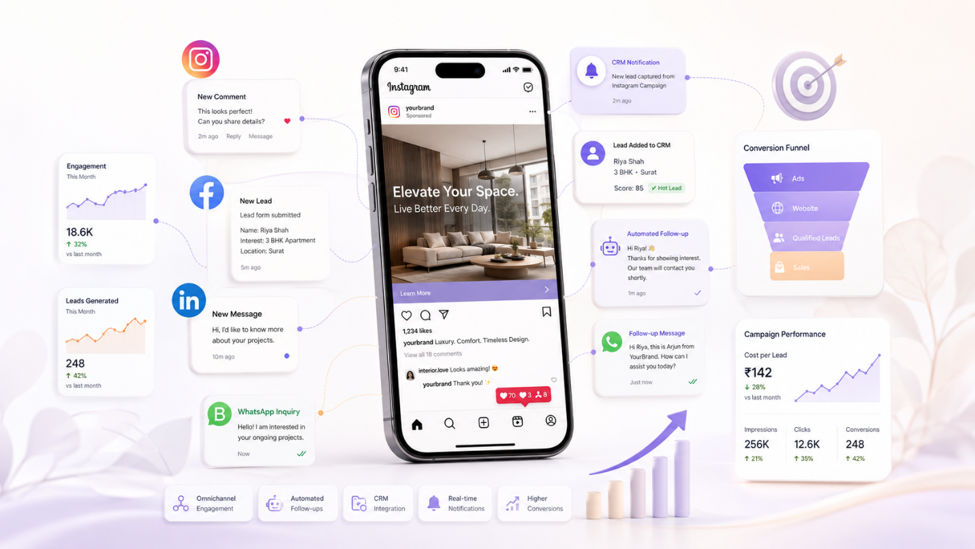
• For B2B: Target by interest and behaviour retailers, boutique owners, and reseller audiences across India. Lead-form ads that capture WhatsApp numbers work especially well.
• For B2C: Use Instagram and Facebook ads with strong creative (always lead with a drape reel), targeting by location, occasion intent, and lookalike audiences built from your existing buyers.
• Retargeting: Anyone who viewed your catalog or visited your site is your warmest audience. Retargeting them is the highest-ROI spend you can make.
Start small, measure cost per lead and per order, and double down on what works. You don’t need a Mumbai-sized budget; you need disciplined targeting.
Measuring What Matters
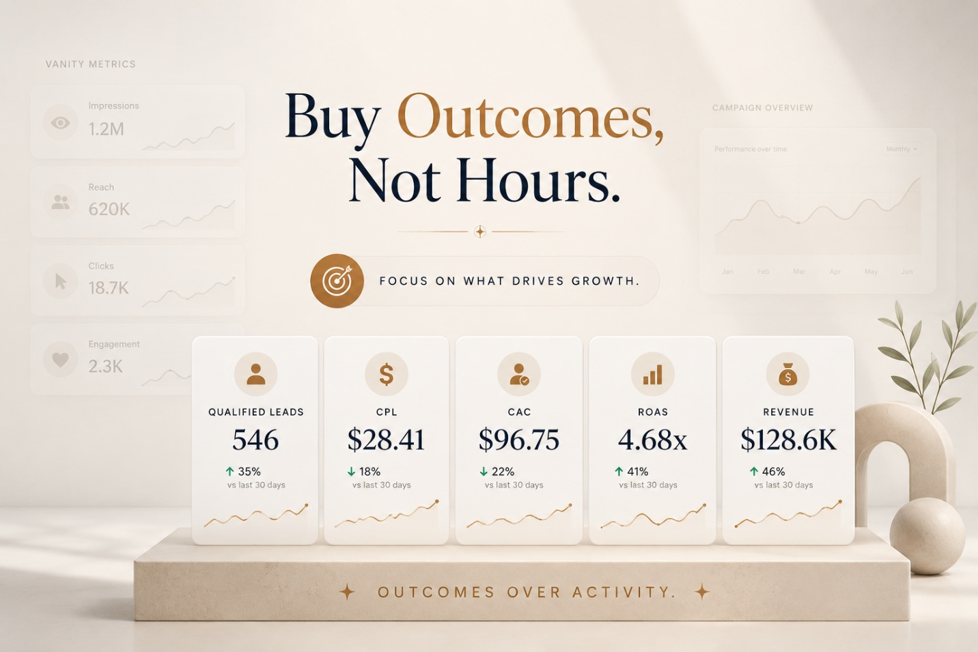
Followers are a vanity metric. For a textile business, track the numbers that connect to revenue:
• Reach and saves on Reels (saves signal genuine buying interest)
• Profile visits to WhatsApp / website clicks (the discovery-to-conversion bridge)
• Cost per qualified lead from paid campaigns
• Enquiries and orders attributable to social
If a piece of content gets 50,000 views but zero inquiries, it entertained; it didn’t sell. Optimize for the metrics that fill your dispatch register.
Common Mistakes Surat Textile Brands Make
• Posting only product images with no story, styling, or context
• Treating Instagram as a dumping ground for the same images sent on WhatsApp
• Ignoring Reels the single biggest discovery engine available today
• No consistency: a burst of posts during one festival, then silence
• Beautiful content with no clear path to enquire or order
• Trying to be on every platform instead of being excellent on two
Where Social 101 Comes In
We’re based in Surat, and the textile industry is in our DNA. Over six years and 500+ projects, we’ve built brands across sarees, fashion, jewelry, real estate, and BFSI and we understand the specific rhythm of a textile business: the catalog cycles, the festive peaks, and the B2B-and-B2C balancing act.
We don’t post for the sake of posting. We build social media strategies anchored to your business goals, whether that’s distributor reach, D2C sales, or brand authority. From content and video marketing to performance campaigns, our team handles the full stack so you can focus on what you do best: making products the rest of India wants to wear.
Curious what this could look like for your brand? See our work, read more on the Social 101 blog, or get in touch; first coffee’s on us.
Frequently Asked Questions
Which is the best social media platform for a saree business in Surat?
Instagram is the priority for almost every saree brand, paired with WhatsApp Business for conversion. B2C brands should add Pinterest; B2B players should layer in LinkedIn for credibility with large buyers.
How much should a Surat textile business spend on social media marketing?
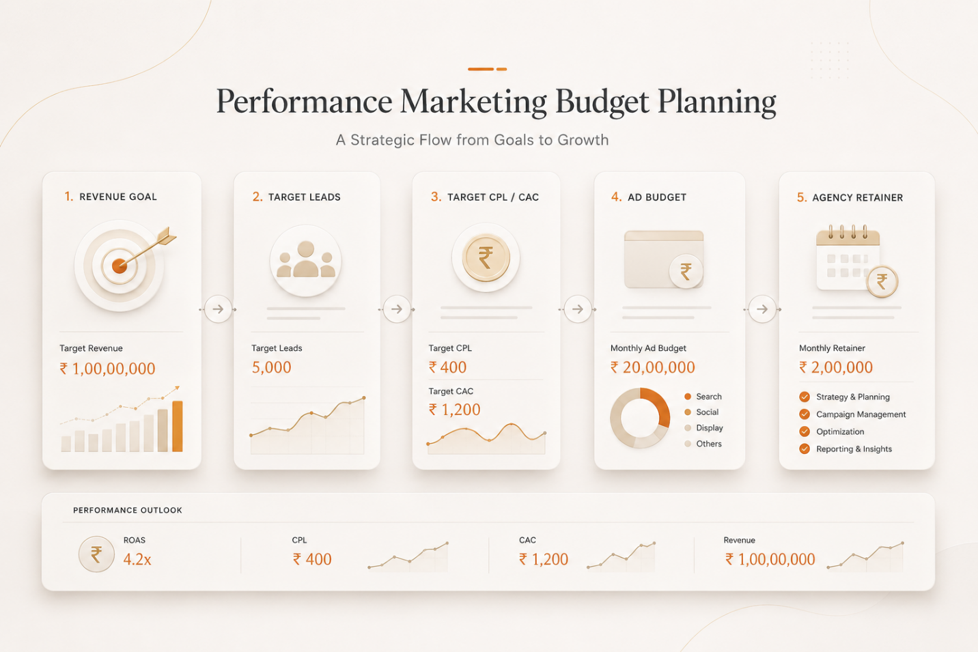
There’s no fixed number — it depends on goals and margins. Start with a modest, disciplined ad budget focused on retargeting and lead generation, measure cost per enquiry, and scale what works. Strategy and consistency matter more than budget size.
Does social media marketing work for B2B textile wholesalers, not just D2C brands?
Yes. Retailers and distributors now research suppliers on Instagram and LinkedIn before ordering. A consistent, professional presence signals reliability and directly drives trade enquiries.
How long before social media marketing shows results for a textile brand?
Paid campaigns can generate leads within weeks. Organic brand building typically takes three to six months of consistent, strategic content to compound into meaningful reach and enquiries.