


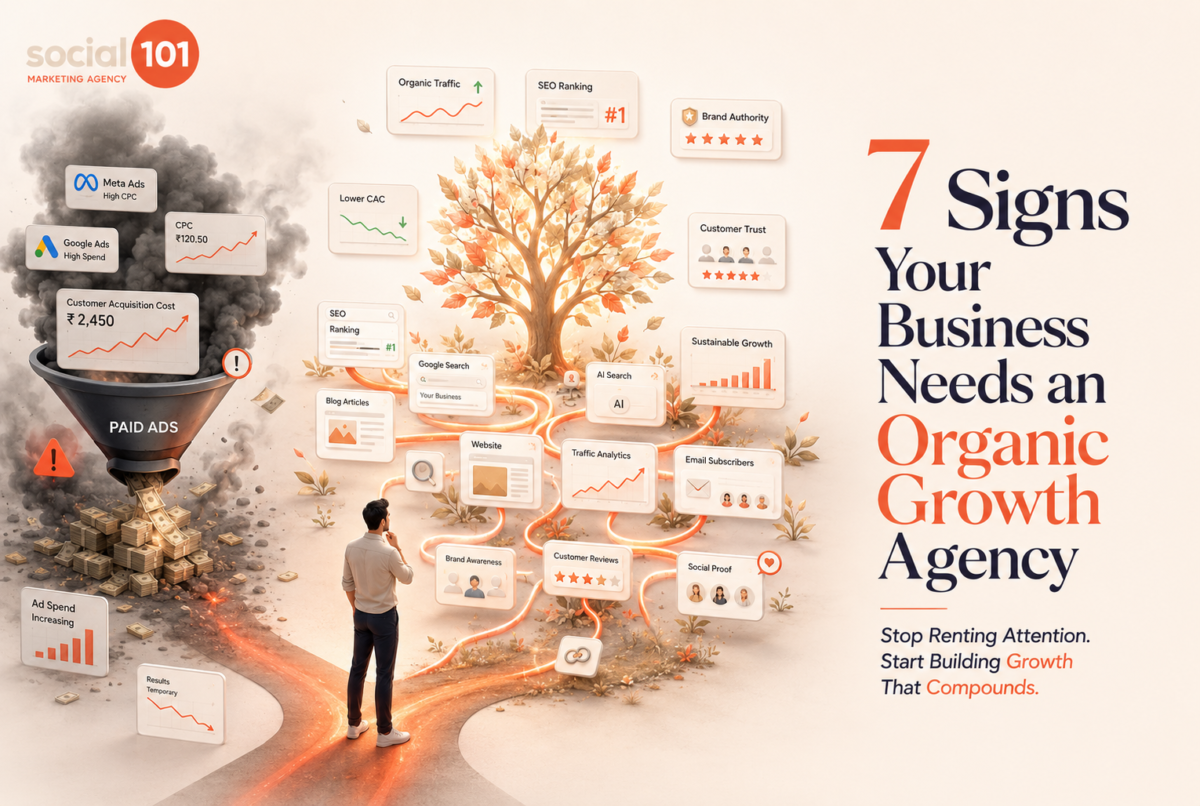
Every quarter, the same conversation happens in boardrooms across India. Revenue is flat, so the marketing team asks for a bigger ad budget. The budget increases, results improve for a month, and then the numbers slide back to where they started. If this cycle sounds familiar, the problem is not your ad spend. It is your growth model.
Paid advertising rents attention. An organic growth agency helps you own it. The difference decides whether your customer acquisition costs rise every year or fall as your brand compounds.
At Social 101, we have worked with over 300 brands across real estate, BFSI, manufacturing, jewelry, and e-commerce, and we see the same pattern repeatedly: businesses over-invested in paid channels and under-invested in the assets that generate demand without a daily bill. Here are the seven signs it is happening to you.

1. Your Customer Acquisition Cost Rises Every Quarter
The clearest warning sign is in your own dashboard. If your cost per lead or cost per acquisition has increased for three or more consecutive quarters while your targeting and creative quality stayed constant, you are experiencing paid media inflation. Ad platforms are auctions, and every year more advertisers bid for the same audience. An organic growth agency attacks this problem from the other side. Search-optimized content, a strong brand presence, and owned audiences bring in leads whose marginal cost approaches zero over time. The first blog post costs money to produce. The five hundredth lead it generates costs nothing.
2. Traffic Stops the Moment You Pause Campaigns
Run a simple test: pause your ad campaigns for one week and watch your website traffic. If it drops by 70 to 90 percent, your business does not have a marketing engine. It has a marketing faucet, and the platform controls the tap.
Healthy businesses have a base layer of organic traffic from search, direct visits, referrals, and social discovery that continues whether or not ads are running. Building that base layer is precisely what an organic growth agency in Surat or anywhere else is structured to do: SEO, content systems, and brand-led distribution that keep working while you sleep.
3. You Rank Nowhere for the Searches Your Buyers Actually Make
Open an incognito window and search for your core product or service the way a customer would. If your competitors, marketplaces, and directories fill page one while your website appears nowhere, you are surrendering the highest-intent traffic on the internet.
People searching for a solution are already in buying mode. Ads can intercept them, but organic rankings capture them at a fraction of the long-term cost, and with higher trust. Buyers know the difference between a sponsored result and an earned one. With AI-driven search results now answering queries directly, brands that are absent from organic results are also absent from AI recommendations, which makes the gap even more expensive.
4. Your Brand Generates No Demand of Its Own
Check your search console data for branded searches, meaning people typing your company name directly. If branded search volume is negligible, your brand is not creating demand. You are only capturing demand that platforms serve to you, at auction prices.
Strong brands enjoy a structural advantage: customers seek them out, referrals arrive unprompted, and conversion rates on every channel improve because familiarity does half the selling. Building this kind of brand gravity through consistent content, thought leadership, and community is slow work, and it is exactly the work an organic growth agency is built for.
5. Your Content Is a Calendar, Not a System
Many businesses technically “do content.” They post three times a week, publish an occasional blog, and share festival greetings. But when asked what business outcome any of it drives, there is silence.
Content without strategy is decoration. A proper organic growth system connects every piece of content to a stage of the buyer journey: awareness content that ranks and gets discovered, consideration content that builds trust, and decision content that converts. Each piece is mapped to keywords, distribution channels, and measurable outcomes. If your content plan is just a posting schedule, you are spending effort without building an asset.
6. You Depend on One Channel for More Than Half Your Revenue
Concentration risk is not just an investing concept. If Meta ads, Google ads, or a single marketplace drives the majority of your revenue, one policy change, algorithm update, or account suspension can cut your business in half overnight. Businesses across India experienced exactly this when ad accounts were flagged during festive seasons or when organic reach on a platform collapsed.
Organic growth diversifies you by default. Search traffic, an email list, a strong LinkedIn presence, referral systems, and direct traffic each act as independent revenue streams. No single company can switch them off.
7. Your Competitors Are Winning Deals Before You Even Enter the Room
The most painful sign is the quietest one. Prospects arrive at sales conversations having already read your competitor’s case studies, watched their founder’s videos, and seen their name ranked first on Google. The deal is 70 percent decided before your pitch begins.
This is what organic dominance looks like from the losing side. Your competitor is not necessarily outspending you on ads. They invested early in visibility assets that now shape buyer perception at scale. The only response is to start building your own, and the best time to start was two years ago. The second-best time is now.

Ads and Organic Are Not Enemies, But the Ratio Matters
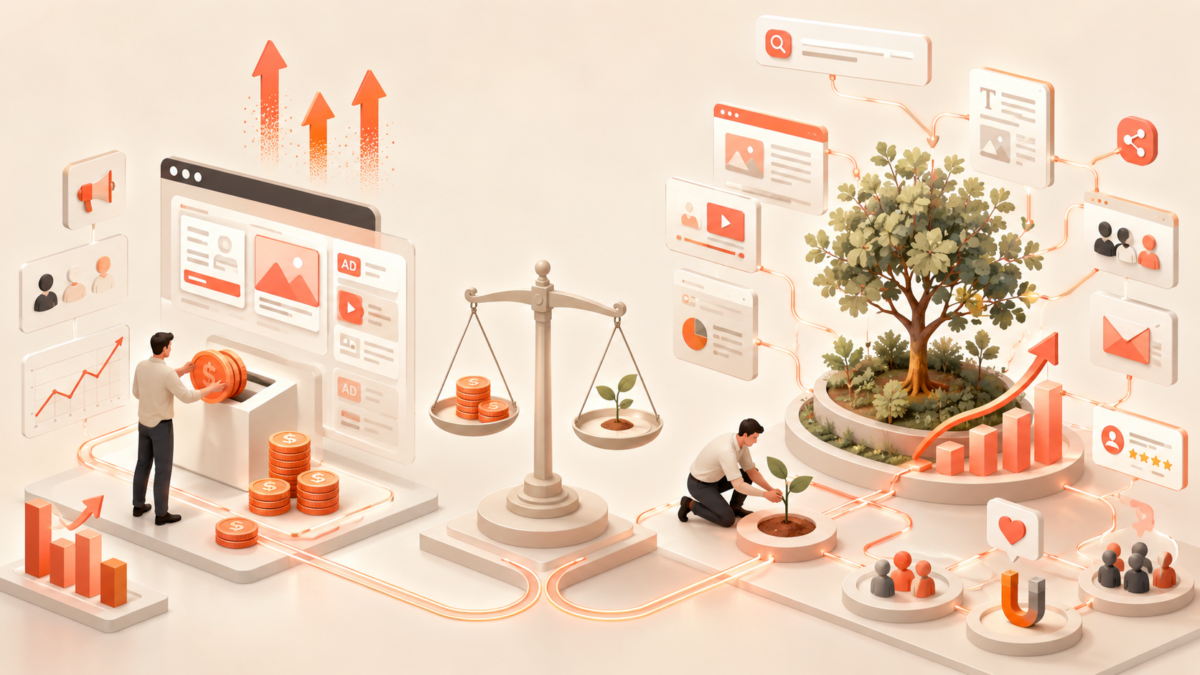
None of this means paid advertising is wrong. Ads are excellent for testing offers, scaling proven messages, and driving time-sensitive campaigns. The problem is a portfolio that is 90 percent rented attention and 10 percent owned assets. Mature businesses gradually invert that ratio, using organic growth to lower acquisition costs and paid media to amplify what already works.
Why Businesses Choose an Organic Growth Agency in Surat
For businesses in Gujarat’s fastest-growing commercial hub, working with an organic growth agency in Surat brings an added advantage: local market understanding. Consumer behaviour in textiles, diamonds, jewellery, real estate, and manufacturing here follows patterns that a generic playbook misses. An agency that knows the region can build organic strategies around local search intent, regional language content, and the trust dynamics that drive B2B and D2C buying in this market.
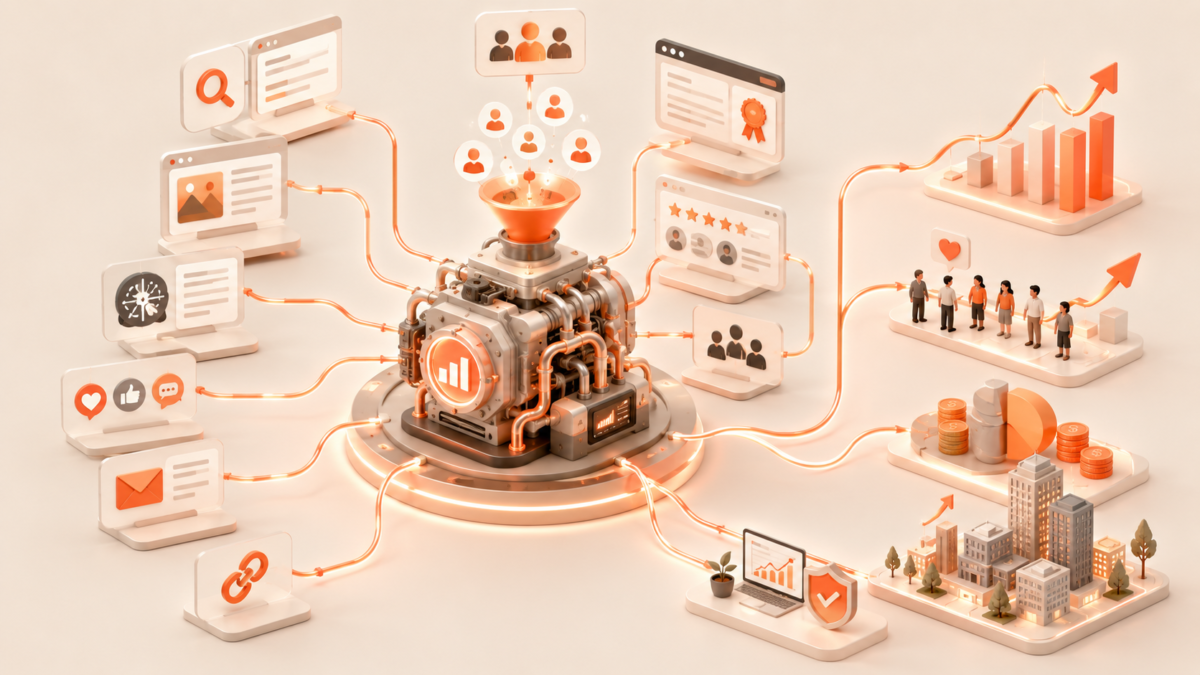
Social 101 has spent over seven years building organic growth systems for brands across these exact verticals, combining SEO, content strategy, brand building, and AI search optimization into one integrated engine.
The Bottom Line
If three or more of these signs describe your business, the answer is not a bigger ad budget. It is a structural shift toward growth you own. Audit your channel mix, measure your organic baseline, and start building the assets that compound.
Ready to see where your organic gaps are? Get in touch with our team for a growth audit, or explore more insights on our blog.
FAQ
What does an organic growth agency do?
An organic growth agency builds marketing systems that generate leads and revenue without continuous ad spend, using SEO, content strategy, brand building, social media, and owned audience channels like email.
How is organic growth different from paid advertising?
Paid advertising delivers instant but temporary traffic that stops when spending stops. Organic growth builds compounding assets such as search rankings, content libraries, and brand recognition that continue producing results long after the initial investment.
How long does organic growth take to show results?
Most businesses see early traction within 3 to 6 months and significant results within 9 to 12 months. Unlike ads, results accelerate over time rather than plateau.
Why hire an organic growth agency in Surat?
A local agency understands regional market dynamics, buyer behaviour, and industry verticals specific to Surat and Gujarat, allowing organic strategies that outperform generic national playbooks.