


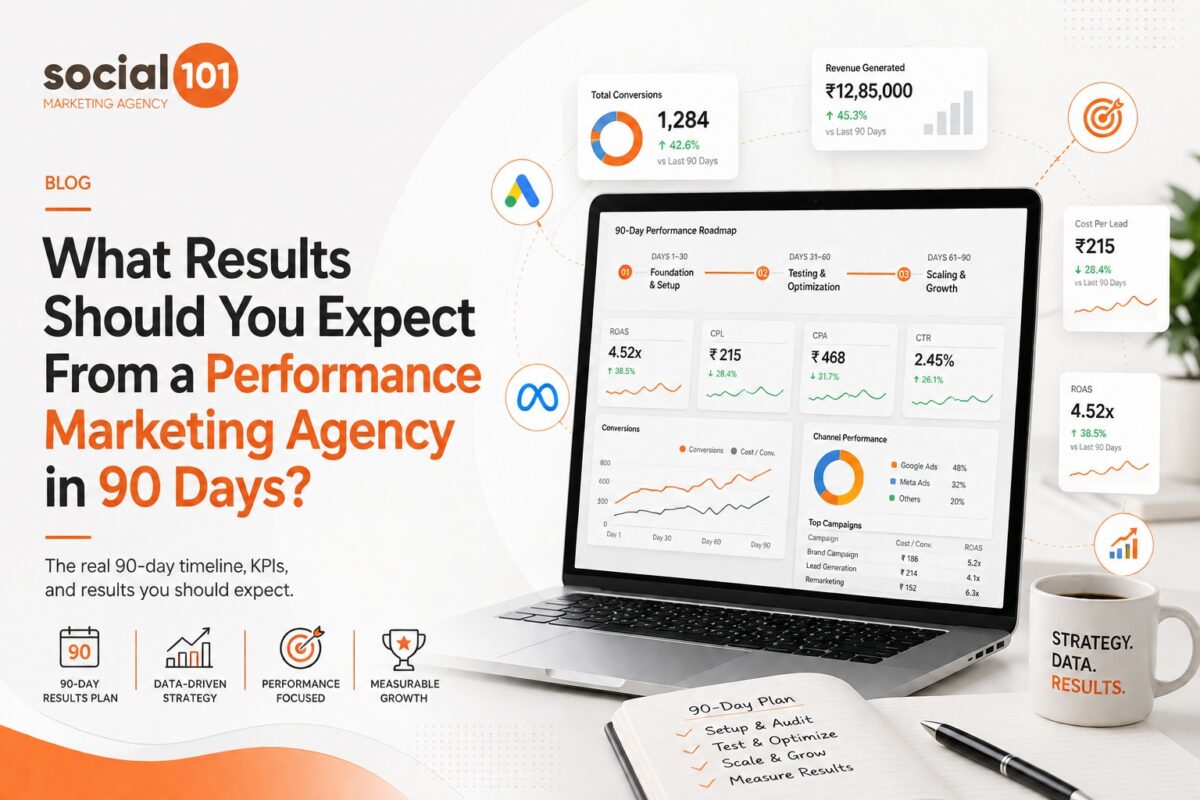
Every business owner who signs on with a performance marketing agency asks some version of the same question in week one: “When will I start seeing results?”
It’s a fair question, and it deserves an honest answer instead of a vague promise. The truth is that a serious performance marketing agency doesn’t deliver a straight line of growth from day one. It moves through distinct phases each with its own goals, metrics, and deliverables. Understanding this timeline is the difference between judging your agency fairly and pulling the plug just as the account starts to compound.
This is the realistic, month-by-month breakdown of what a competent agency should be doing in your first 90 days, what numbers should be moving, and what red flags mean you’re not being managed the way you should be.
Why 90 Days Is the Right Benchmark
Digital ad platforms like Meta and Google run on machine learning. Every campaign needs a learning phase, a period where the algorithm gathers enough conversion data to optimize delivery. Judging performance before this phase completes is like judging a new employee’s output on their first day.
Ninety days is also long enough to move through three distinct stages of a client-agency relationship:
- Foundation and setup (weeks 1–4)
- Testing and data collection (weeks 5–8)
- Optimisation and scaling (weeks 9–12)
Any agency promising dramatic results inside week one, or asking for 90 days without showing you any interim milestones, should raise questions. If you’re still evaluating who to work with, this buyer’s checklist for choosing a performance marketing agency is a good place to start before you sign anything.
Month 1 (Days 1–30): Foundation, Audit, and Setup
The first month is rarely about running ads that generate revenue. It’s about building the infrastructure that everything else depends on. Skipping this stage is the single biggest reason performance marketing campaigns underperform.
What should be happening:
- Account and pixel audit: reviewing existing ad accounts, Google Analytics, Meta Pixel, and conversion tracking for gaps or misfires
- Conversion tracking setup: implementing server-side tracking (Conversions API), UTM structures, and goal tracking so every rupee spent can be attributed correctly
- Competitor and market research: understanding what’s already working in your category, especially useful if you’re comparing Meta Ads and Google Ads as your primary channel
- Creative and copy development: building the first batch of ad creatives, landing pages, and offers to test
- Campaign architecture structuring campaigns, ad sets, and audiences based on your funnel stage, not guesswork
What you should expect to see: Low ad spend, minimal conversions, and a lot of reporting on setup progress rather than sales. This is normal. If your agency is spending your full monthly budget in week one without any tracking infrastructure in place, that’s the actual redflag, not slow results.
Realistic KPIs for Month 1: Tracking accuracy, campaign launch readiness, creative approval rate, and cost-per-click benchmarks against industry averages.


Month 2 (Days 31–60): Testing, Data Collection, and Early Signals
This is where the account starts generating real data and real learning. A good agency treats this month as a controlled experiment, not a scaling sprint.
What should be happening:
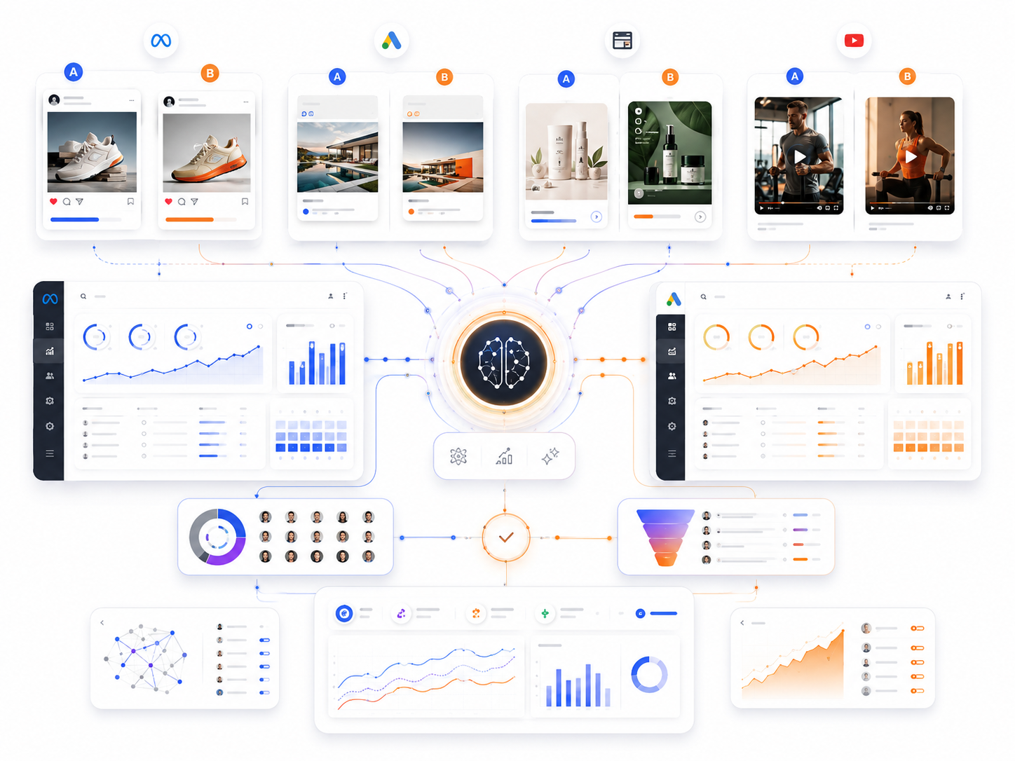
- A/B testing across creatives, audiences, headlines, and offers to identify what actually converts
- Budget reallocation away from underperforming ad sets toward early winners
- Landing page optimisation based on bounce rate and time-on-page data
- Weekly or bi-weekly reporting showing cost-per-lead (CPL), cost-per-acquisition (CPA), and click-through rate (CTR) trends
- First retargeting campaigns to recapture visitors who engaged but didn’t convert
What you should expect to see: Cost-per-lead figures are starting to stabilize, a handful of creatives are clearly outperforming others, and CPA numbers are still higher than your target but trending downward. Lead volume typically starts picking up in weeks 6–8 as the algorithm exits its learning phase.
Realistic KPIs for Month 2: CTR improvement of 15–30% over Month 1 baselines, CPL trending toward target range, and 3–5 validated creative or audience “winners” identified from testing.
If you’re weighing whether this spend is better used on brand-building instead, this comparison of performance marketing vs branding explains how the two actually work together rather than compete for budget.
Month 3 (Days 61–90): Optimisation and Scaling
By month three, the guesswork should be largely gone. The agency now has enough data to make confident, not speculative, decisions.
What should be happening:
- Scaling winning campaigns by increasing budgets on proven ad sets without breaking the algorithm’s learning phase
- Cutting dead weight pausing creatives, audiences, or keywords that never found traction
- Full-funnel campaigns covering awareness, consideration, and conversion stages together
- CRM and sales-team feedback loops to confirm which leads are converting into actual paying customers, not just form fills
- Monthly strategic review presenting cost trends, ROAS (return on ad spend), and a plan for the next quarter
What you should expect to see: CPA at or near your target, a clear ROAS figure you can hold the agency accountable to, and a documented list of what worked so those learnings compound into month four and beyond. This is typically the point where a business can decide whether to keep managing marketing in-house or hand it fully to an agency, a decision covered in more depth in In-House Marketing Team vs Marketing Agency.
Realistic KPIs for Month 3: ROAS benchmarks specific to your industry (typically 3x–5x for e-commerce, lower for high-ticket B2B and real estate), CPA within 10–15% of target, and a repeatable creative testing process the agency can run every month going forward.


A Quick Reference: What “Good” Looks Like by Month
| Timeframe | Primary Focus | Realistic Outcome |
| Days 1–30 | Tracking, setup, creative development | Infrastructure ready, minimal conversions |
| Days 31–60 | Testing, data collection, retargeting | CPL stabilising, early winners identified |
| Days 61–90 | Scaling, full-funnel campaigns | CPA near target, clear ROAS, repeatable process |
Red Flags: Signs Your Agency Isn’t Managing This Timeline Properly
Ninety days is enough time to tell the difference between an agency that’s building something durable and one that’s just spending your budget. Watch for:
- No conversion tracking discussion in Month 1: If nobody mentions pixels, UTMs, or attribution in the first few weeks, the rest of the reporting will be unreliable
- Vanity metrics without context: reach and impressions reported as wins without connecting them to leads or revenue
- No creative testing: running the same one or two ads for the full 90 days instead of iterating
- Reluctance to share raw ad account access: a transparent agency gives you visibility into Meta Ads Manager and Google Ads directly
- No agreed-upon KPIs before campaigns launch: if targets weren’t set at the start, there’s nothing concrete to measure against at day 90
If you’re currently evaluating agencies against these standards, this breakdown of what separates a strong performance marketing partner in Surat covers the questions worth asking before you commit a budget.
How Social 101 Structures the First 90 Days
At Social 101, every performance marketing engagement follows this same three-phase structure: audit and setup, test and learn, and optimize and scale because it’s the only approach that produces numbers you can actually trust by day 90. We report on tracking accuracy and creative testing in month one, not just spend. We share cost-per-lead and CPA trends transparently every two weeks. And by month three, you get a documented playbook of what worked, not just a bill.
If you’re comparing agencies or deciding whether performance marketing is the right next step for your business, get in touch with our team for a straightforward conversation about what a 90-day plan would look like for your category and budget.
Frequently Asked Questions
How much should I budget for the first 90 days with a performance marketing agency?
Budget depends heavily on industry and competition, but most agencies recommend keeping the first month’s ad spend conservative, often 60–70% of your steady-state budget since it’s being used for testing rather than scaling.
Is it normal to see zero sales in the first two weeks?
Yes. Tracking setup, creative approval, and the platform’s learning phase typically mean the first 10–14 days show minimal to no conversions. Sales activity should start appearing from week three onward.
What’s a realistic ROAS to expect by day 90?
This varies by industry e-commerce brands often target 3x–5x, while high-ticket categories like real estate or B2B services may see lower ROAS numbers but higher absolute deal value. Your agency should set an industry-specific benchmark with you before launch, not after.
Should I switch agencies if I don’t see results in 90 days?
Only if the agency can’t show you the underlying data tracking accuracy, testing history, and CPL/CPA trends. If those numbers are moving in the right direction even without a final ROAS win, that’s usually a sign to continue rather than restart the learning phase with a new team.