


Introduction
Search has changed more in the last two years than in the previous two decades. A growing share of searches on Google now surface an AI overview before a single blue link appears, and millions of people are asking ChatGPT, Perplexity, Gemini, and Claude for direct answers instead of typing keywords into a search bar. For brands, this means visibility is no longer just about ranking on page one. It is about being the source an AI system trusts enough to cite, quote, or recommend by name.
This is where AI SEO comes in, a blend of traditional Search Engine Optimization (SEO), Answer Engine Optimization (AEO), and Generative Engine Optimization (GEO). Together, these disciplines determine whether your brand shows up in AI-generated answers or disappears behind a competitor who structured their content better.
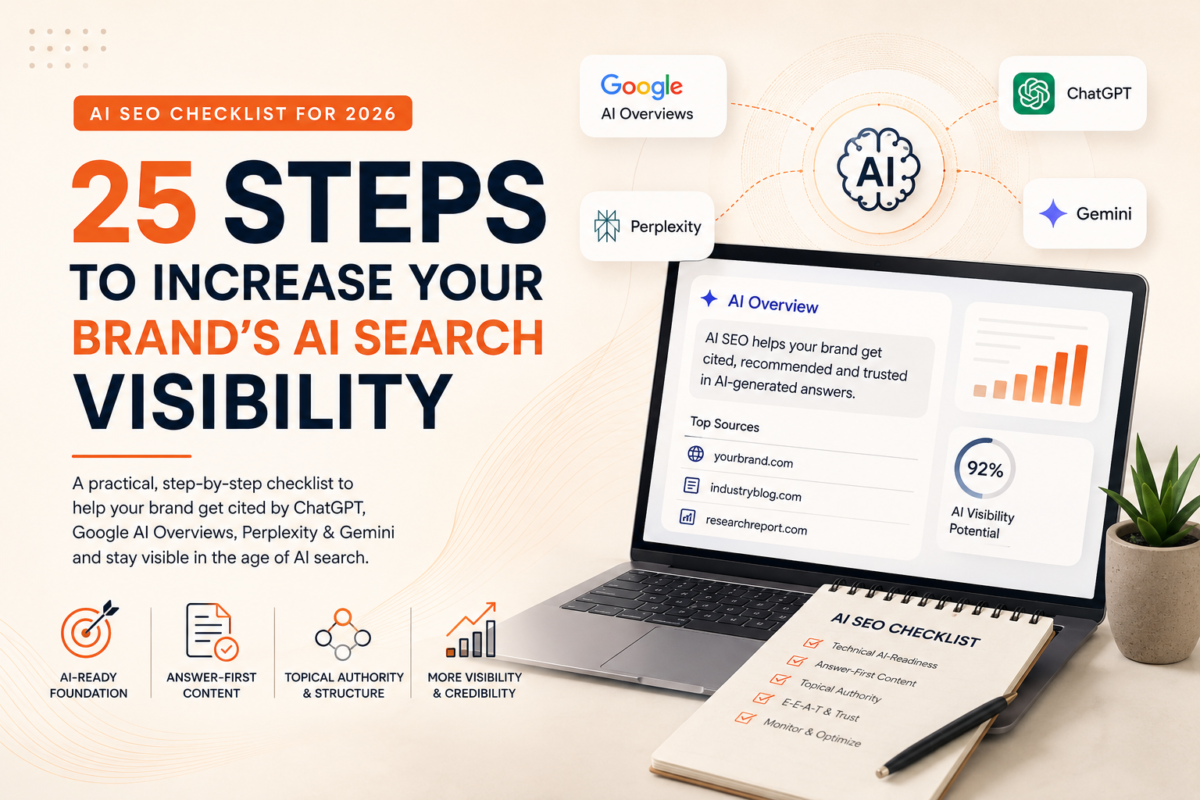
At Social 101, we help brands in Surat and beyond build the kind of content, technical foundation, and digital authority that AI search engines are actively looking for. Below is a practical, 25-step AI SEO checklist you can start using today to increase your brand’s AI search visibility in 2026.
1. Foundation & Technical AI-Readiness
Before AI systems can cite your brand, they need to be able to crawl, read, and trust your website. These first five steps make sure the technical groundwork is solid.
Step 1. Audit crawlability for AI bots
Check your robots.txt and server logs to confirm crawlers such as GPTBot, PerplexityBot, ClaudeBot, and Google-Extended can access your key pages. Blocking AI crawlers by default is one of the fastest ways to become invisible in AI answers.
Step 2. Improve page speed and Core Web Vitals
AI systems and traditional search engines both favor fast, stable pages. Compress images, use lazy loading, and minimize render-blocking scripts so crawlers can index your content efficiently.
Step 3. Make content readable without JavaScript rendering
Many AI crawlers read raw HTML rather than executing JavaScript. Ensure your core text content is present in the initial HTML response, not injected client-side only.
Step 4. Fix duplicate and thin content
Consolidate near-duplicate pages and expand thin ones. AI models favor pages that offer clear, unique value on a topic rather than pages that repeat what is already well covered elsewhere.
2. Content Structure & Answer-First Writing
AI systems extract short, self-contained passages to build their answers. Structuring content so it can be lifted cleanly is central to AI search visibility.
Step 6. Lead with a direct answer
Open each page or section with a concise, two- to three-sentence answer to the core question before expanding with detail. AI overviews and chat answers often pull directly from the first clear statement on a page.
Step 7. Write in question-and-answer format
Use real, conversational questions your audience asks as subheadings, followed immediately by a clear answer. This mirrors how people prompt AI tools and improves your odds of being the source cited.
Step 8. Break content into short, topical sections
Keep sections focused on a single sub-topic, roughly 150 to 300 words each, with a descriptive heading. This makes it easier for AI systems to retrieve and quote the exact passage that answers a query.
Step 9. Support claims with specific data and examples
Concrete numbers, dates, and named examples are more likely to be treated as citable facts than vague statements. Where possible, reference original research, case studies, or first-party data.
Step 10. Add clear summaries and key takeaways
Close long articles with a short bullet summary. This gives AI systems a ready-made, extractable synopsis of your content and improves readability for human visitors too.
3. Entity, Authority & E-E-A-T
AI systems try to answer confidently, which means they lean on sources they can verify as credible. Building recognizable, well-connected authority signals is essential.
Step 11. Strengthen your Experience, Expertise, Authority and Trust (E-E-A-T) signals
Add author bios, credentials, and real case results to your content. Show that a genuine expert or an experienced team stands behind what is published.
Step 12. Build consistent entity information across the web
Make sure your brand name, description, and details match across your website, Google Business Profile, LinkedIn, industry directories, and social profiles. Consistency helps AI systems confirm who you are.
Step 13. Earn mentions on third-party and industry sites
Being mentioned, reviewed, or linked to on respected external sites builds the kind of independent corroboration that AI models weigh heavily when deciding whom to cite.
Step 14. Publish original research, data, or industry insights
Original findings are the content AI systems most want to cite because they cannot be found anywhere else. Even a small annual survey or benchmark report can become a strong citation magnet.
Step 15. Keep content fresh and dated
Update key pages regularly and show a visible last-updated date. Recency is a consistent signal across AI Overviews, AI Mode, and chat-based answer engines.
4. Structured Data & Machine Readability
Structured data gives AI systems an explicit, machine-readable map of your content, reducing the guesswork involved in understanding and trusting your pages.
Step 16. Implement Article, FAQ, and HowTo schema
Mark up blog posts, FAQs, and step-by-step guides with the relevant schema.org types so AI systems and search engines can parse the structure of your content precisely.
Step 17. Add Organization and Person schema
Use structured data to formally define your brand, key team members, logo, and social profiles, reinforcing the entity signals covered in Step 12.
Step 18. Use breadcrumb and sitelinks markup
Breadcrumb schema clarifies where a page sits within your site hierarchy, helping AI systems understand topical relationships between pages.
Step 19. Validate structured data regularly
Run your key pages through Google’s Rich Results Test and Schema Markup Validator after every major update to catch errors before they affect visibility.
Step 20. Create a clear, updated XML sitemap and llms.txt file
An accurate sitemap helps traditional crawlers find your content, while an emerging llms.txt file can guide AI crawlers to your most important, citation-ready pages.
5. Distribution, Monitoring & Optimization
AI search visibility is not a one-time setup. It requires distribution across platforms and ongoing measurement to see what is actually getting cited.
Step 21. Distribute content across multiple platforms
Repurpose key articles into LinkedIn posts, YouTube scripts, and Reddit or Quora answers. AI systems draw on a wide range of sources beyond your own website, so a multi-platform footprint increases your chances of being referenced.
Step 22. Track brand mentions in AI answers
Regularly test how ChatGPT, Perplexity, Gemini, and Google AI Overviews answer questions relevant to your industry, and note whether and how your brand appears.
Step 23. Monitor traditional and AI-referral traffic separately
Use Google Search Console and analytics segmentation to distinguish traffic coming from AI Overviews or chat tools from classic organic search, so you can see what is actually working.
Step 24. Benchmark against competitors in AI answers
Run the same set of queries used in Step 22 and note which competitors are cited instead of you. Identify what their content or structure does differently.
Step 25. Review and refresh your AI SEO checklist quarterly
AI search platforms update their models and ranking behavior frequently. Revisit this checklist every quarter, retire what no longer works, and add new tactics as AI search evolves.
Final Thoughts
AI search visibility rewards brands that combine strong technical foundations, answer-first content, verifiable authority, and consistent measurement. None of these 25 steps work in isolation together, they build the kind of trustworthy, well-structured digital presence that AI systems are designed to find and cite.
If you would like help implementing this checklist, Social 101 is a full-service digital marketing and social media agency based in Surat, offering branding, content marketing, and performance marketing services built for the AI search era. Explore more insights on our blog, see examples of our work in our portfolio, or get in touch with our team to start improving your brand’s AI search visibility today.