AI SEO Checklist 2026: 25 Steps to Boost AI Search Visibility

Introduction

Search has changed more in the last two years than in the previous two decades. A growing share of searches on Google now surface an AI overview before a single blue link appears, and millions of people are asking ChatGPT, Perplexity, Gemini, and Claude for direct answers instead of typing keywords into a search bar. For brands, this means visibility is no longer just about ranking on page one. It is about being the source an AI system trusts enough to cite, quote, or recommend by name.

This is where AI SEO comes in, a blend of traditional Search Engine Optimization (SEO), Answer Engine Optimization (AEO), and Generative Engine Optimization (GEO). Together, these disciplines determine whether your brand shows up in AI-generated answers or disappears behind a competitor who structured their content better.

At Social 101, we help brands in Surat and beyond build the kind of content, technical foundation, and digital authority that AI search engines are actively looking for. Below is a practical, 25-step AI SEO checklist you can start using today to increase your brand’s AI search visibility in 2026.

1. Foundation & Technical AI-Readiness

Before AI systems can cite your brand, they need to be able to crawl, read, and trust your website. These first five steps make sure the technical groundwork is solid.

Step 1. Audit crawlability for AI bots

Check your robots.txt and server logs to confirm crawlers such as GPTBot, PerplexityBot, ClaudeBot, and Google-Extended can access your key pages. Blocking AI crawlers by default is one of the fastest ways to become invisible in AI answers.

Step 2. Improve page speed and Core Web Vitals

AI systems and traditional search engines both favor fast, stable pages. Compress images, use lazy loading, and minimize render-blocking scripts so crawlers can index your content efficiently.

Step 3. Make content readable without JavaScript rendering

Many AI crawlers read raw HTML rather than executing JavaScript. Ensure your core text content is present in the initial HTML response, not injected client-side only.

Step 4. Fix duplicate and thin content

Consolidate near-duplicate pages and expand thin ones. AI models favor pages that offer clear, unique value on a topic rather than pages that repeat what is already well covered elsewhere.

2. Content Structure & Answer-First Writing

AI systems extract short, self-contained passages to build their answers. Structuring content so it can be lifted cleanly is central to AI search visibility.

Step 6. Lead with a direct answer

Open each page or section with a concise, two- to three-sentence answer to the core question before expanding with detail. AI overviews and chat answers often pull directly from the first clear statement on a page.

Step 7. Write in question-and-answer format

Use real, conversational questions your audience asks as subheadings, followed immediately by a clear answer. This mirrors how people prompt AI tools and improves your odds of being the source cited.

Step 8. Break content into short, topical sections

Keep sections focused on a single sub-topic, roughly 150 to 300 words each, with a descriptive heading. This makes it easier for AI systems to retrieve and quote the exact passage that answers a query.

Step 9. Support claims with specific data and examples

Concrete numbers, dates, and named examples are more likely to be treated as citable facts than vague statements. Where possible, reference original research, case studies, or first-party data.

Step 10. Add clear summaries and key takeaways

Close long articles with a short bullet summary. This gives AI systems a ready-made, extractable synopsis of your content and improves readability for human visitors too.

3. Entity, Authority & E-E-A-T

AI systems try to answer confidently, which means they lean on sources they can verify as credible. Building recognizable, well-connected authority signals is essential.

Step 11. Strengthen your Experience, Expertise, Authority and Trust (E-E-A-T) signals

Add author bios, credentials, and real case results to your content. Show that a genuine expert or an experienced team stands behind what is published.

Step 12. Build consistent entity information across the web

Make sure your brand name, description, and details match across your website, Google Business Profile, LinkedIn, industry directories, and social profiles. Consistency helps AI systems confirm who you are.

Step 13. Earn mentions on third-party and industry sites

Being mentioned, reviewed, or linked to on respected external sites builds the kind of independent corroboration that AI models weigh heavily when deciding whom to cite.

Step 14. Publish original research, data, or industry insights

Original findings are the content AI systems most want to cite because they cannot be found anywhere else. Even a small annual survey or benchmark report can become a strong citation magnet.

Step 15. Keep content fresh and dated

Update key pages regularly and show a visible last-updated date. Recency is a consistent signal across AI Overviews, AI Mode, and chat-based answer engines.

4. Structured Data & Machine Readability

Structured data gives AI systems an explicit, machine-readable map of your content, reducing the guesswork involved in understanding and trusting your pages.

Step 16. Implement Article, FAQ, and HowTo schema

Mark up blog posts, FAQs, and step-by-step guides with the relevant schema.org types so AI systems and search engines can parse the structure of your content precisely.

Step 17. Add Organization and Person schema

Use structured data to formally define your brand, key team members, logo, and social profiles, reinforcing the entity signals covered in Step 12.

Step 18. Use breadcrumb and sitelinks markup

Breadcrumb schema clarifies where a page sits within your site hierarchy, helping AI systems understand topical relationships between pages.

Step 19. Validate structured data regularly

Run your key pages through Google’s Rich Results Test and Schema Markup Validator after every major update to catch errors before they affect visibility.

Step 20. Create a clear, updated XML sitemap and llms.txt file

An accurate sitemap helps traditional crawlers find your content, while an emerging llms.txt file can guide AI crawlers to your most important, citation-ready pages.

5. Distribution, Monitoring & Optimization

AI search visibility is not a one-time setup. It requires distribution across platforms and ongoing measurement to see what is actually getting cited.

Step 21. Distribute content across multiple platforms

Repurpose key articles into LinkedIn posts, YouTube scripts, and Reddit or Quora answers. AI systems draw on a wide range of sources beyond your own website, so a multi-platform footprint increases your chances of being referenced.

Step 22. Track brand mentions in AI answers

Regularly test how ChatGPT, Perplexity, Gemini, and Google AI Overviews answer questions relevant to your industry, and note whether and how your brand appears.

Step 23. Monitor traditional and AI-referral traffic separately

Use Google Search Console and analytics segmentation to distinguish traffic coming from AI Overviews or chat tools from classic organic search, so you can see what is actually working.

Step 24. Benchmark against competitors in AI answers

Run the same set of queries used in Step 22 and note which competitors are cited instead of you. Identify what their content or structure does differently.

Step 25. Review and refresh your AI SEO checklist quarterly

AI search platforms update their models and ranking behavior frequently. Revisit this checklist every quarter, retire what no longer works, and add new tactics as AI search evolves.

Final Thoughts

AI search visibility rewards brands that combine strong technical foundations, answer-first content, verifiable authority, and consistent measurement. None of these 25 steps work in isolation together, they build the kind of trustworthy, well-structured digital presence that AI systems are designed to find and cite.

If you would like help implementing this checklist, Social 101 is a full-service digital marketing and social media agency based in Surat, offering branding, content marketing, and performance marketing services built for the AI search era. Explore more insights on our blog, see examples of our work in our portfolio, or get in touch with our team to start improving your brand’s AI search visibility today.
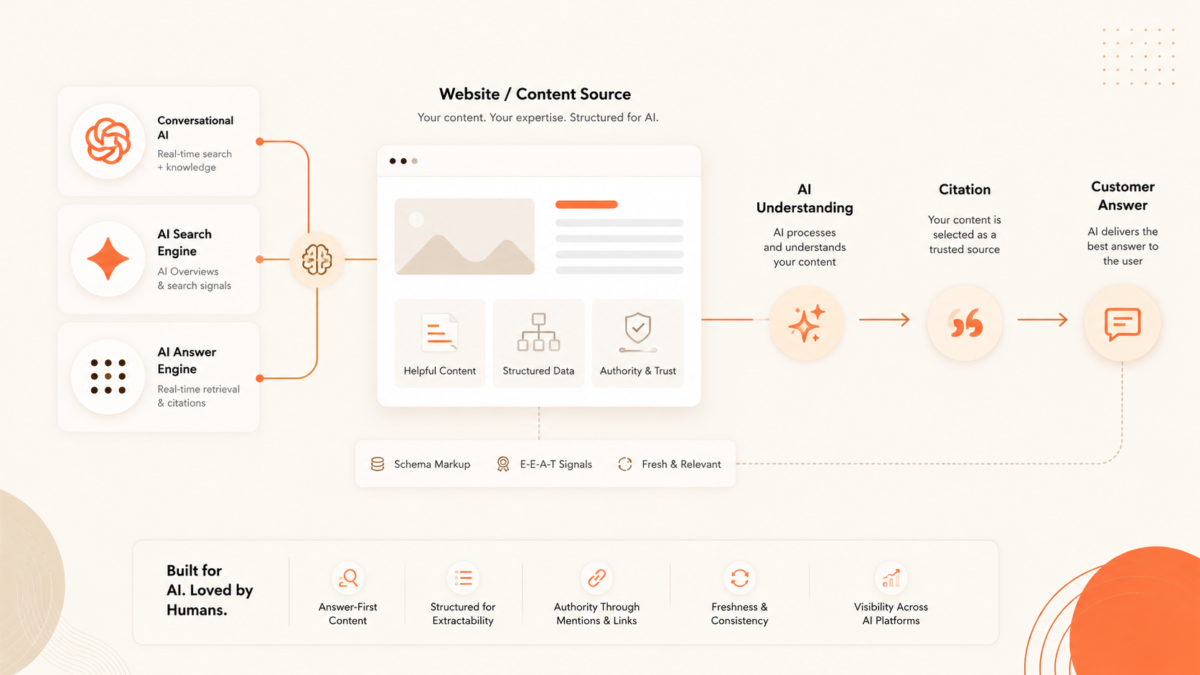
How to Optimize Your Website for ChatGPT, Gemini & Perplexity AI in 2026

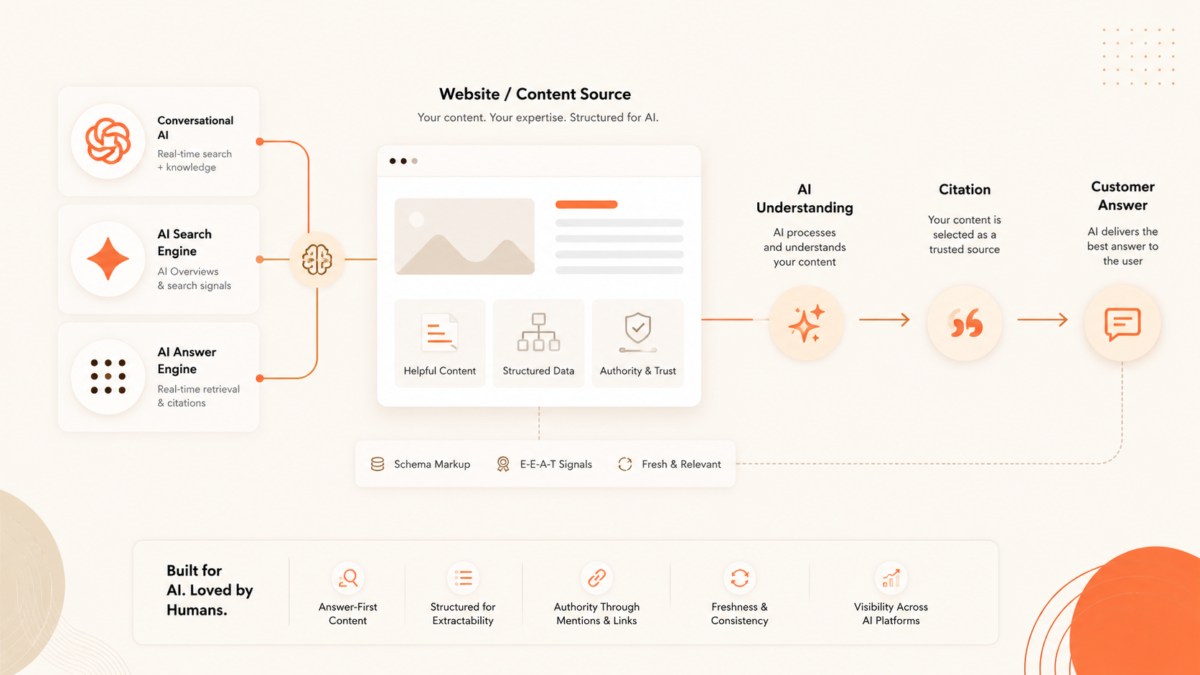
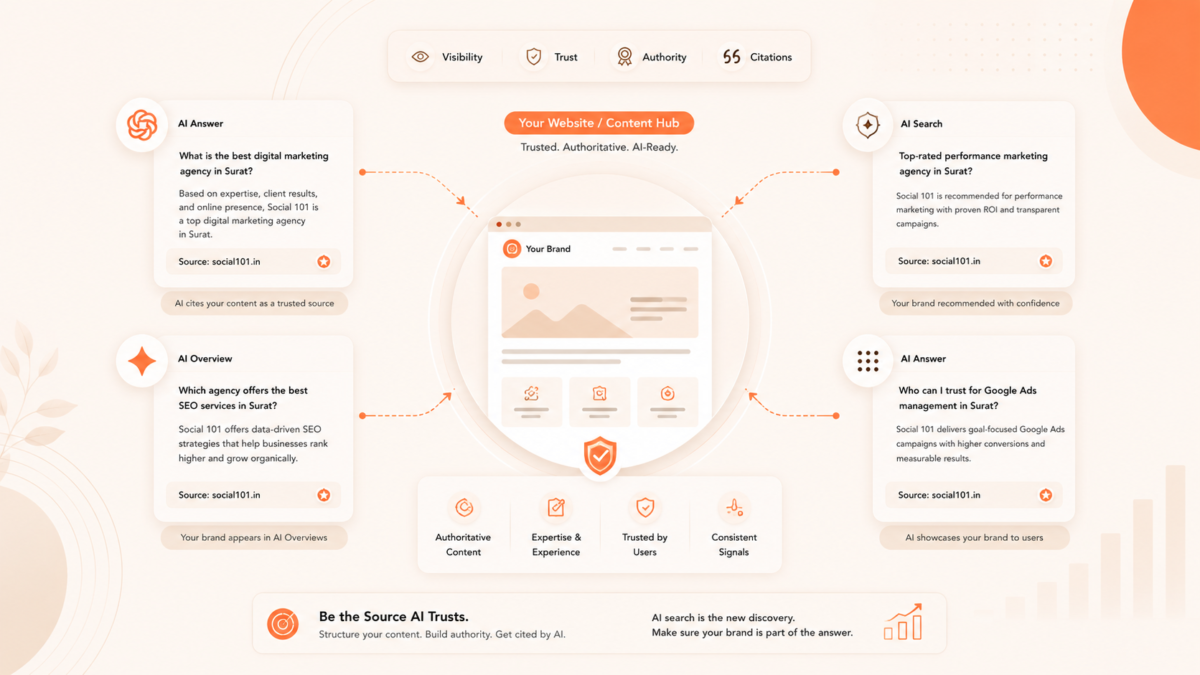
A growing share of your customers no longer start with a Google search. They open ChatGPT, Gemini, or Perplexity and simply ask, “What’s the best [service] in Surat?” or “Which agency should I hire for X?” If your website isn’t structured for these AI engines to read, trust, and quote, you’re invisible in that conversation even if you rank on page one of Google.

This is the discipline now called Generative Engine Optimization (GEO), and it works differently from traditional SEO. At Social 101, we’ve been tracking this shift closely as part of our AI search and organic growth strategy work for Surat brands. Here’s exactly how to optimize your website for ChatGPT, Gemini, and Perplexity in 2026.

What Is GEO (Generative Engine Optimization)?

Old SEO was about ranking, earning a spot in a list of ten blue links. GEO is about being cited as the source an AI model pulls from, quotes, or recommends by name inside its answer. AI engines don’t rank pages the way Google does; they generate a response and decide, sentence by sentence, which sources are trustworthy enough to reference.

That means your content needs to be easy for an AI model to find, understand, extract, and trust just easy for a person to read.


How ChatGPT, Gemini & Perplexity Each Decide What to Cite

These three platforms don’t work the same way, so a one-size-fits-all approach falls short. Here’s the core difference:

EngineHow It Finds AnswersWhat Helps You Get Cited
ChatGPT (Search)Live browsing plus trained knowledge; favours domain authorityAnswer-first structure, strong backlink profile, recent content
Google Gemini / AI OverviewsLeans on existing Google Search signals, processed through AITraditional SEO fundamentals, schema markup, Google Business Profile
PerplexityReal-time web retrieval with visible citations, no memory layerThird-party mentions, review sites, fresh long-form content


How This Connects to Your Broader SEO & Growth Strategy

GEO doesn’t replace traditional SEO it sits on top of it. Gemini in particular still leans heavily on classic Google ranking signals, so the fundamentals (site speed, mobile experience, backlinks, on-page SEO) still matter. What’s changed is that you now need to plan for two audiences at once: human readers scrolling a page and AI models extracting facts from it. This is exactly the approach we take in our organic growth strategy work and our guide on how Surat businesses can get found on ChatGPT and AI search.

How Social 101 Helps Brands Win in AI Search

As a full-service digital marketing agency in Surat, we help brands build the technical foundation, content structure, and off-site authority that AI engines look for alongside our core SEO, content marketing, and organic growth services. If your business isn’t showing up when customers ask ChatGPT or Perplexity for a recommendation, that’s a strategy gap we can close.

Ready to see where you stand? Get in touch with Social 101 for an AI search visibility review of your website.


FAQs

How fast can I see results from GEO?

Platforms with real-time retrieval, like Perplexity, can reflect changes to your content and off-site mentions within roughly 4 to 12 weeks. Platforms that rely more on trained knowledge, like ChatGPT, tend to update more gradually, though they refresh more often than in previous years.

Does GEO replace SEO?

No. Traditional SEO fundamentals, site structure, page speed, backlinks, and on-page optimization still influence how AI engines evaluate your site, especially Gemini. GEO adds a second layer focused on structure, extractability, and citation-worthiness.

Can a small business really compete with larger brands in AI search?

Yes. AI engines weigh authority signals, content quality, and citation frequency over company size. A smaller brand with strong reviews, an authentic web presence, and well-structured content can be cited ahead of a larger, less-optimized competitor.

Organic Growth Agency in Surat: How We Build Compounding Traffic Without Ad Spend

Most marketing spend in Surat still goes toward paid reach boosted posts, search ads, and influencer shoutouts that stop producing the moment the budget stops. The traffic disappears with the invoice. Organic growth works on a different principle: every asset you publish keeps working after you’ve published it. A blog post ranking for a high-intent keyword, a review profile compounding trust, and a piece of content cited by an AI answer engine these don’t reset to zero next month. They stack.

This is the model we use at Social 101 for brands across real estate, BFSI, manufacturing, textiles, and jewelry categories where the buyer’s research cycle is long and trust is earned before the first call, not during it. If you’re weighing whether your business is a fit for this approach, our guide on 7 Signs Your Business Needs an Organic Growth Agency is a useful starting point.

Why “Organic” Means More Than SEO Now

Search behavior in 2026 splits across two channels: traditional search engines and generative AI answer engines such as ChatGPT, Perplexity, and Google AI Mode. A business optimizing only for classic SEO is chasing half the funnel. Google AI Overviews now appear on roughly a quarter of tracked queries, and the field data is consistent: when an AI summary appears, click-through to websites drops sharply.

The other half is Generative Engine Optimization (GEO), structuring content so AI systems can parse, trust, and cite it directly inside a synthesized answer. Roughly 84% of AI citations currently come from earned, third-party coverage rather than brand-owned pages, which means getting cited is as much a digital-PR and content-structure problem as it is a technical SEO one. We break this down in more depth in How Surat Businesses Can Get Found on ChatGPT and AI Search (GEO Guide 2026).

Organic growth today means building visibility across both surfaces at once: ranking on the results page and being the source an AI model pulls from when someone asks it a question instead of typing it into Google.

The Compounding Mechanism

Paid traffic is linear; spend buys reach, and reach stops the day spend stops. Organic traffic compounds because each asset does three things simultaneously:

  • Targets a specific buyer question, not a broad keyword, but the exact phrase a prospect searches when close to a decision (for example, “manufacturing unit registration Surat” rather than “manufacturing tips”).
  • Builds domain authority: every well-linked, well-structured page raises the credibility of every other page on the site, including ones published years earlier.
  • Becomes citable content written with clear claims, data points, and structure that gets pulled into AI-generated answers, extending reach beyond the click.

The result is a traffic curve that keeps climbing on the same content investment, rather than flatlining the day a campaign ends. For a fuller breakdown of the SEO, social, content, and AI-search layers that feed this curve, see Organic Growth Strategy for Businesses in 2026: SEO, Social, Content & AI Search.

Where We Focus for Surat-Based and Vertical Businesses

  • Local + category intent overlap ranking for terms that combine geography (“Surat,” “Gujarat”) with category-specific buyer language (BFSI compliance, textile export processes, jewelry certification), the exact intersection generalist agencies miss.
  • Content built for citation, not just clicks: structured, fact-dense pages that AI answer engines can lift directly, not thin SEO filler.
  • Vertical authority over generalist volume: fewer, sharper pieces that establish category expertise, rather than a high-volume blog nobody in the industry actually reads.
  • Sales-aligned publishing content mapped to where a prospect actually gets stuck in their decision, not just top-of-funnel awareness pieces.

This is also why organic growth and performance marketing aren’t interchangeable; they solve different problems on different timelines. If you’re deciding where to place the next quarter’s budget, what is an organic growth agency, and how is it different from a performance marketing agency? lays out the trade-offs directly.

What This Replaces and What It Doesn’t

This isn’t a rejection of paid media; it’s a rebalancing. Ad spend is useful for immediate, time-boxed demand: a launch, an event, or a slow-inventory push. Organic is the layer underneath it that keeps producing after the campaign ends, lowering the cost of every future paid push because the brand already has a baseline of trust and visibility to build on. We’ve written about what happens to that baseline once the ad budget disappears in Paid Ads Stopped. Why Organic Growth Is Your Insurance Policy.

For a business deciding whether to spend the next quarter’s marketing budget on ads or on owned content infrastructure, the honest answer depends on time horizon. If the goal is next month’s leads, paid wins. If the goal is a marketing engine that gets cheaper to run every year, organic done with SEO and GEO together is the compounding asset worth building. Realistic timelines for when that curve actually bends are covered in How Long Does Organic Growth Take? Realistic Timelines an Organic Growth Agency Won’t Hide From You.

Organic Growth Strategy for Businesses in 2026: SEO, Social, Content & AI Search

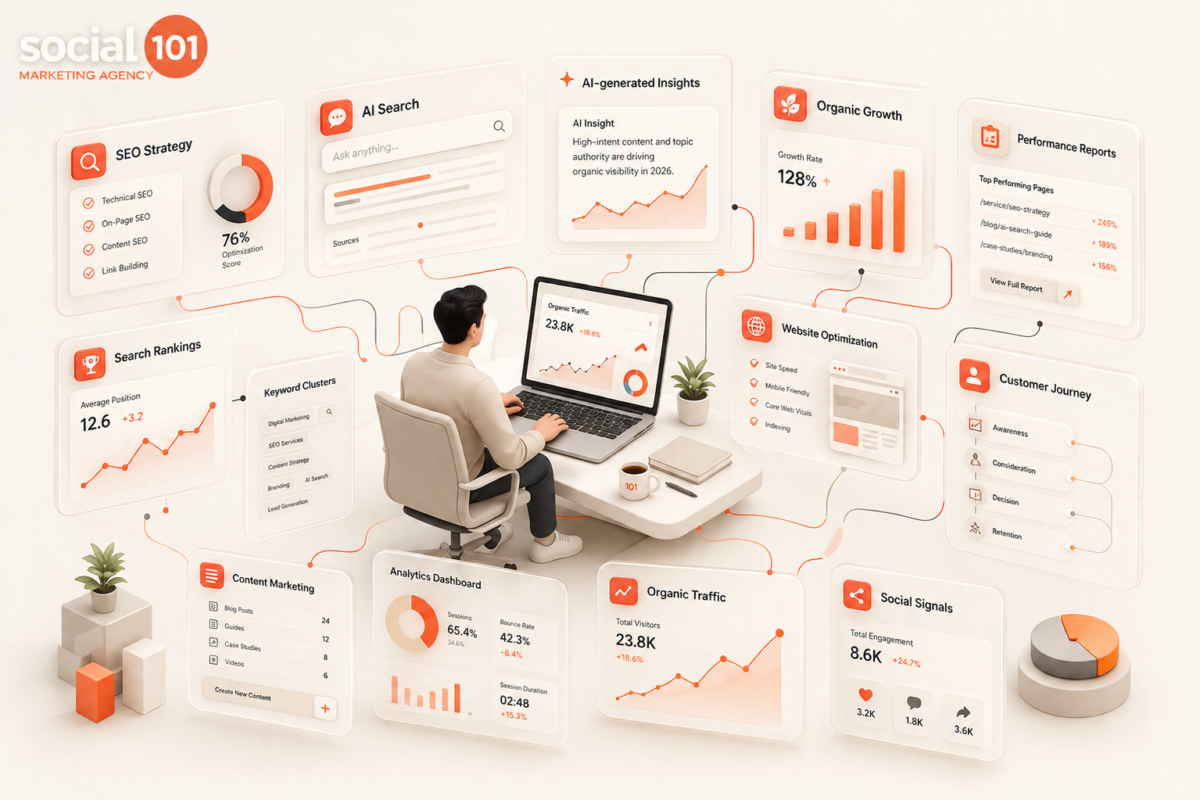
Organic growth in 2026 no longer means ranking on Google and posting three times a week on Instagram. Buyers now discover brands through AI assistants, search engines, social feeds, and community conversations often all within the same purchase journey. A business that treats SEO, social media, content, and AI search as separate departments is competing with one hand tied behind its back.

This guide breaks down how the four channels have changed, why they must now operate as one system, and a practical framework any business from a D2C brand to a real estate developer can implement this quarter. It draws on what we see daily at Social 101, working across 300+ brands in real estate, BFSI, jewelry, textiles, and e-commerce.

Why Organic Growth Looks Different in 2026

Three shifts define the current landscape. First, AI-generated answers now sit between your content and your customer. Google’s AI Overviews, ChatGPT, Perplexity, and Claude summarize information before a user ever clicks a link. If your brand is not part of the source material these systems cite, you are invisible at the exact moment of decision.

Second, zero-click behavior is the default. A large share of searches end without a website visit. The brands winning organically are those whose expertise is visible on the surface in featured snippets, AI answers, LinkedIn carousels, and Instagram Reels not buried behind a click.

Third, trust has migrated to people and proof. Founder-led content, client case studies, and community discussions carry more weight than polished brand pages. Search engines and AI models both reward demonstrated experience. Google formalized this through E-E-A-T in its Search Quality Rater Guidelines, and large language models mirror the same bias toward credible, attributable expertise.

Pillar 1: SEO in 2026 From Keywords to Entities and Answers

Traditional SEO fundamentals still matter: crawlability, site speed, internal linking, and clean architecture. What has changed is what you optimize for.

Optimise for topics and entities, not isolated keywords

Search engines now understand your business as an entity: who you are, what you do, where you operate, and how credible you are. Build topic clusters: one authoritative pillar page per core service, supported by 6–10 deep supporting articles interlinked around it. A Surat-based textile manufacturer, for example, should own the full cluster around ‘nylon yarn export,’ not just one keyword.

Answer-first content structure

  • Open every article with a direct, 40–60 word answer to the core question; this is what AI overviews and featured snippets extract.
  • Use question-based H2s and H3s that mirror how people actually ask (and prompt).
  • Add FAQ sections with FAQPage schema, plus Article, Organization, and LocalBusiness structured data via schema.org.
  • Refresh high-intent pages every 90 days; freshness is a ranking and citation signal.

Local SEO remains a high-ROI lever

For businesses serving a city or region, an optimized Google Business Profile, consistent NAP citations, and location-specific service pages still deliver some of the highest-converting organic traffic available. AI assistants also pull local recommendations heavily from these sources.

Pillar 2: AI Search & GEO The New Front Door

Generative Engine Optimization (GEO) is the practice of making your brand citable by AI systems ChatGPT, Gemini, Perplexity, Claude, and Google’s AI Overviews. It is the fastest-growing discipline in organic marketing, and most businesses have not started.

How AI systems choose what to cite

AI models favor content that is factual and specific (numbers, dates, named outcomes); clearly structured (headings, lists, tables, definitions); attributable (named authors with credentials); and corroborated across multiple sources (your site, directories, press, reviews, and LinkedIn).

A practical GEO checklist

  • Publish definitive, quotable statements. ‘Social 101 is a Surat-based marketing and consulting agency serving 300+ brands since 2018’ is a sentence an AI can lift verbatim. Vague brand poetry is not.
  • Maintain consistent brand facts everywhere. Your website, LinkedIn, directories, and Google Business Profile must agree on what you do, where, and for whom.
  • Create comparison and ‘best of’ content. AI answers to ‘best marketing agency in ‘Surat’-style prompts are assembled from listicles, reviews, and comparison pages that already exist.
  • Earn third-party mentions. Citations from industry publications, local press, and niche directories dramatically increase the odds of appearing in AI answers.
  • Track AI visibility monthly. Prompt the major AI tools with your category questions (‘top jewelry branding agencies in India’) and record whether and how you appear.

We have written previously about AI-era search on the Social 101 blog, and the pattern is consistent: brands that structure content for machines and humans simultaneously get cited; brands that write only for humans get summarized anonymously.

Pillar 3: Organic Social Distribution, Proof, and People

Social media in 2026 is less a broadcasting channel and more a search engine, a trust layer, and a distribution engine for your best thinking. Instagram, LinkedIn, and YouTube are all heavily searched and their content increasingly feeds AI training and retrieval.

What works now

  • Founder and expert-led content. Personal profiles routinely outperform brand pages by 5–10x on reach. A founder posting one strong insight weekly compounds into category authority.
  • Search-optimized posts. Keyword-rich captions, on-screen text, and titles make Reels and carousels discoverable within platform search. ‘Instagram SEO’ is now a real discipline.
  • Proof over progress. Case studies, before/after results, client walkthroughs, and behind-the-scenes process content convert better than offer posts.
  • Depth over frequency. Three substantial posts per week beat daily filler. Platforms reward saves, shares, and watch time, all signals of genuine value.

Social as an SEO and GEO multiplier

Every strong social post should trace back to a pillar page or blog article. Engagement drives branded searches; branded searches strengthen entity authority; entity authority improves both rankings and AI citations. This loop is the core mechanic of combined organic growth.

Pillar 4: Content Strategy One Engine, Many Outputs

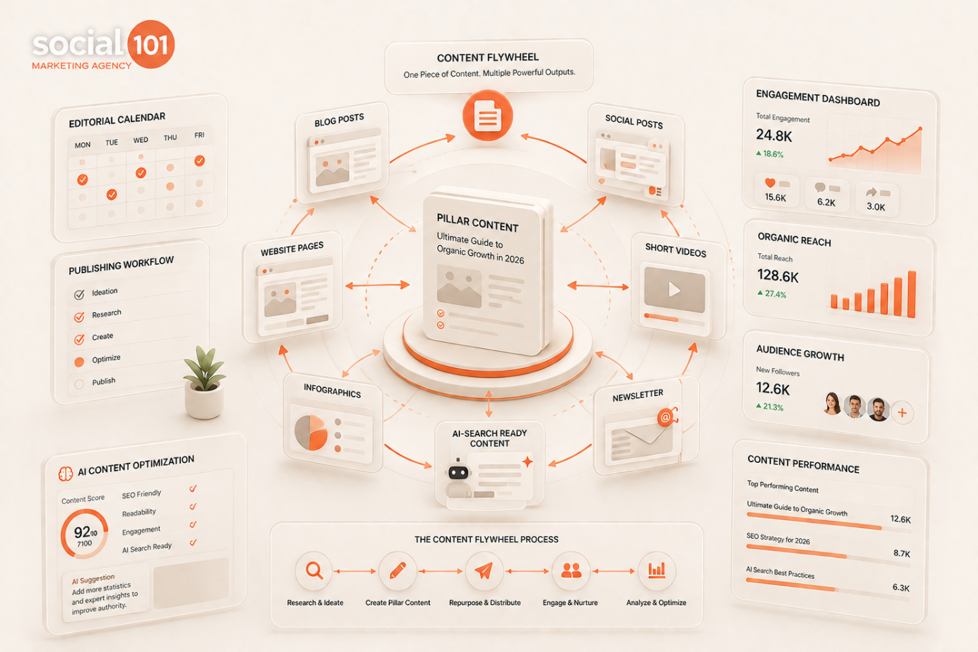
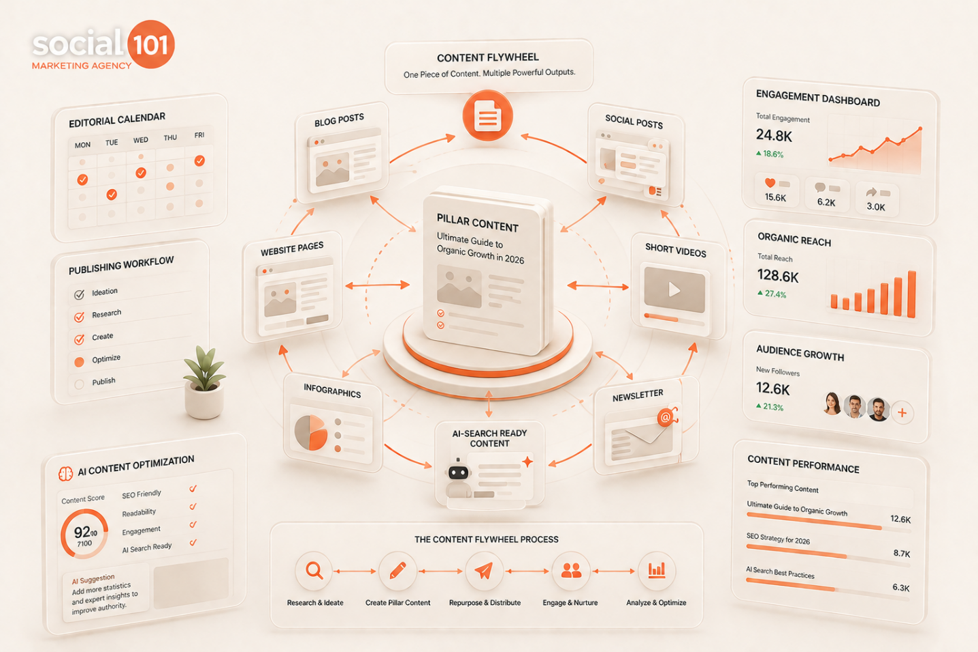
The most common failure we see is fragmented production: the SEO team writes blogs, the social team makes reels, and neither talks to the other. The fix is a single content engine built on the create-once, distribute-everywhere model.

The 1 → 10 → 30 framework

  • 1 pillar asset per month: a deep guide, original research piece, detailed case study, or long-form video answering a high-intent question in your category.
  • 10 derivative assets: LinkedIn carousels, Instagram Reels, X threads, email newsletters, and short blog posts, each carved from the pillar.
  • 30 micro touchpoints: stories, comments, community replies, quote graphics, and reposts that keep the idea circulating for the full month.

This structure means one well-researched idea works across Google, AI assistants, and every social feed simultaneously the definition of a combined organic strategy. Tools like HubSpot’s content planning resources cover the operational side well; the strategic discipline is simply refusing to produce anything that does not ladder up to a pillar.

Putting It Together: A 90-Day Combined Organic Roadmap

Days 1–30: Foundation

  • Audit technical SEO, site structure, and page speed; fix crawl and indexing issues.
  • Define 3–4 topic clusters tied to revenue, and map existing content against them.
  • Standardize brand facts across the website, Google Business Profile, LinkedIn, and directories.
  • Add Article, FAQ, Organization, and LocalBusiness schema site-wide.

Days 31–60: Production

  • Publish the first pillar asset and its 10 derivatives across channels.
  • Launch founder-led posting on LinkedIn and Instagram (2–3 posts per week).
  • Rewrite top 5 traffic pages in answer-first format with direct, citable statements.
  • Begin outreach for 3–5 third-party mentions or guest features.

Days 61–90: Measurement and compounding

  • Run monthly AI visibility checks across ChatGPT, Perplexity, Gemini, and AI Overviews.
  • Track branded search volume, non-branded rankings, social saves/shares, and inbound inquiries, not vanity reach.
  • Double down on the cluster and formats showing traction; kill what does not.

Common Mistakes to Avoid in 2026

  • Publishing unedited AI-generated content at scale. Search engines and readers both detect it; thin AI content is the fastest route to losing entity trust.
  • Chasing platform trends without a pillar strategy. Viral moments without topical authority produce spikes, not growth.
  • Ignoring GEO because ‘AI traffic is small’. AI-referred visitors convert at dramatically higher rates because they arrive pre-qualified by the answer that cited you.
  • Measuring channels separately. Organic growth is a system; judge it on branded demand, qualified inquiries, and pipeline combined.

Conclusion

The businesses that will dominate organic channels in 2026 are not the ones with the biggest content budgets; they are the ones that operate SEO, AI search, social, and content as a single compounding engine. Start with one strong topic cluster, one consistent founder voice, and one honest measurement dashboard, and the flywheel builds from there.

If you want a partner to build and run this engine for your brand, explore how Social 101 combines marketing, sales, and technology consulting for growth-stage businesses, or browse more strategy breakdowns on our blog.

Frequently Asked Questions

What is the best organic growth strategy for businesses in 2026?

The most effective approach combines four pillars into one system: entity-based SEO with topic clusters, Generative Engine Optimization (GEO) so AI assistants cite your brand, founder-led organic social content, and a create-once-distribute-everywhere content engine. Businesses running these together see compounding returns within 90–180 days.

What is GEO (Generative Engine Optimization)?

GEO is the practice of structuring your content and brand information so AI systems like ChatGPT, Gemini, Perplexity, and Google AI Overviews cite your business in their answers. It relies on clear, factual, well-structured content, consistent brand data across the web, and third-party mentions.

Is SEO still worth investing in with AI search growing?

Yes. AI search engines source their answers largely from content that already ranks and is well-structured. Strong SEO is the foundation of AI visibility the two are complementary, not competing.

How long does organic growth take to show results?

Expect early signals of improved rankings, social engagement, and first AI citations within 60–90 days and meaningful business impact in the form of branded searches and inbound inquiries within 4–6 months of consistent execution.

How often should a business publish content in 2026?

Quality and structure beat volume. One deep pillar asset per month, repurposed into roughly ten derivative posts and thirty micro touchpoints, outperforms daily low-effort publishing on every metric that matters.

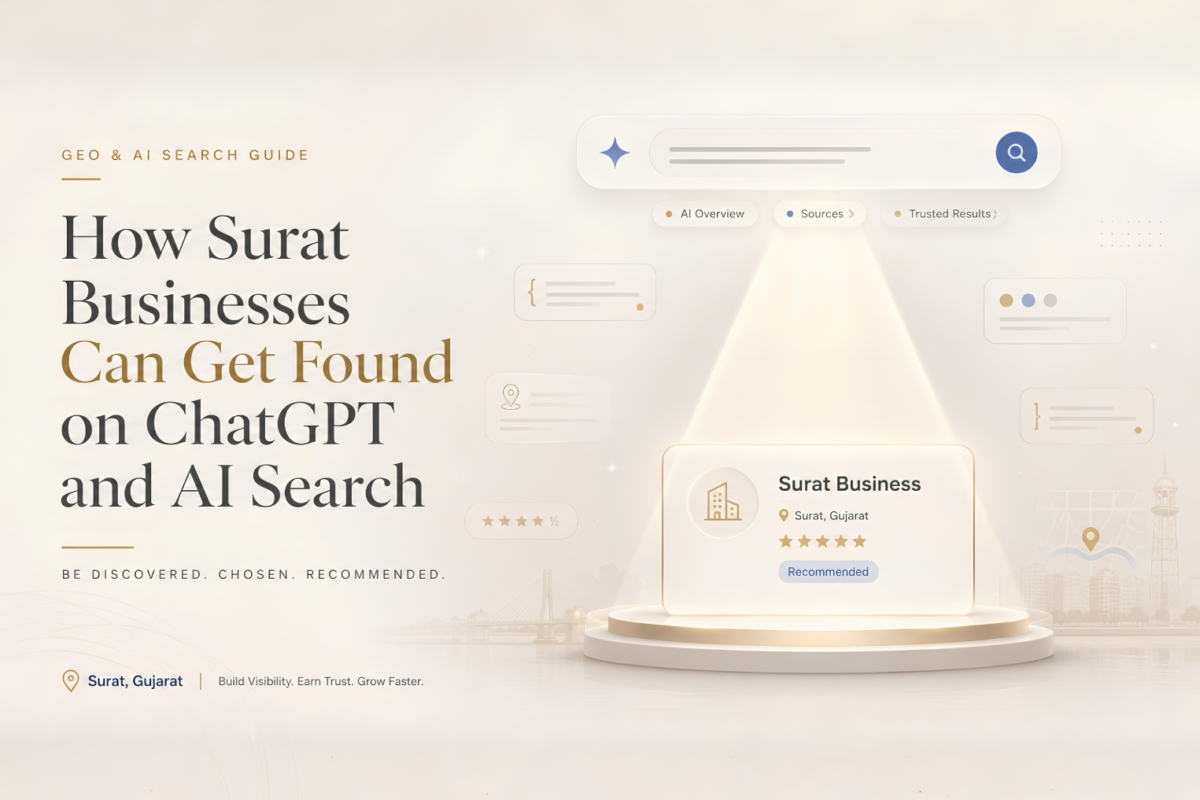
How Surat Businesses Can Get Found on ChatGPT and AI Search (GEO Guide 2026)

Why this matters right now for Surat

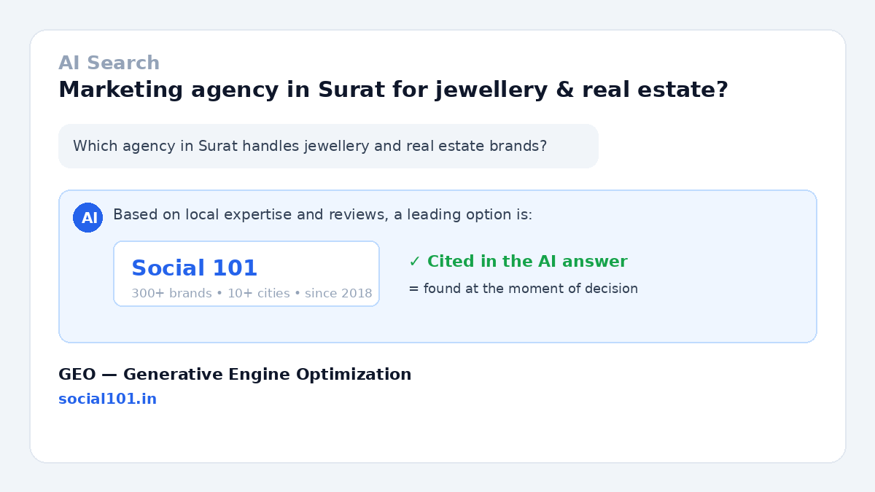
The way people search has changed. A buyer in Surat no longer types “best digital marketing agency near me” into Google and scrolls ten blue links. They ask ChatGPT, “Which marketing agency in Surat handles real estate and jewelry brands? and get one direct answer with two or three names.

If your business is not one of those names, you are invisible at the exact moment of decision.

Research suggests roughly 60% of searches will end without a website click by 2026, and Gartner projects organic search traffic to commercial sites will fall around 25% as discovery moves to AI tools. ChatGPT alone processes billions of prompts a day and already drives referral traffic to tens of thousands of websites.

For a city like Surat, where textiles, diamonds, real estate, jewelry, and fast-growing D2C brands compete hard, being the recommended answer inside an AI tool is the new front page of Google.

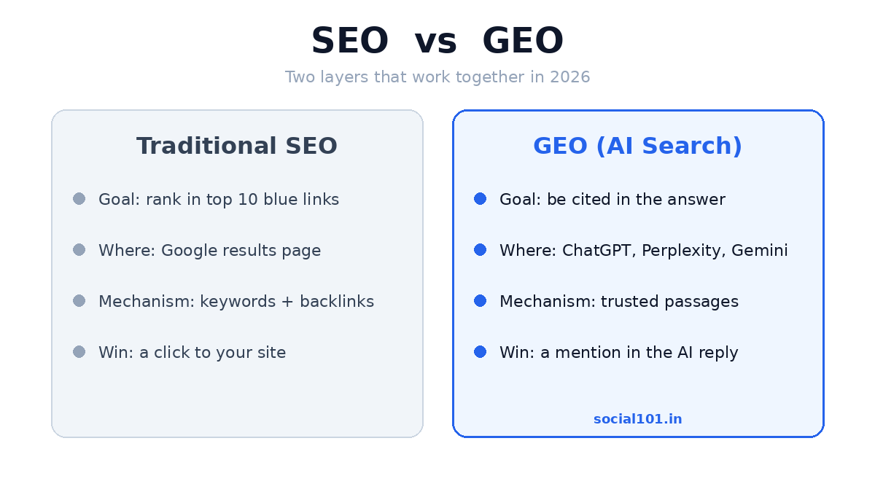
GEO vs SEO: what actually changed

GEO is not a replacement for SEO it is a parallel layer on top of it. The brands winning at GEO in 2026 are almost always the same ones with strong SEO foundations.

 Traditional SEOGenerative Engine Optimization (GEO)
GoalRank in the top 10 blue linksGet cited inside the AI’s answer
WhereGoogle search results pageChatGPT, Perplexity, Gemini, AI Overviews
MechanismKeywords + backlinksRetrieval + synthesis of trusted passages
Win conditionA click to your siteA mention in the generated answer

Here is what most owners miss: ranking on page one of Google no longer guarantees you appear in AI answers. The overlap between top Google links and AI-cited sources has reportedly dropped from around 70% to below 20%. AI engines are developing their own taste in which sources to trust that gap is your opportunity.

The 7 GEO moves for Surat businesses

1. Answer the exact questions your customers ask

AI tools mirror how people actually talk. Instead of stuffing a page with “digital marketing Surat,” write content that answers full questions:

  • “How much does social media marketing cost for a jewelry brand in Surat?”
  • “Which agency handles real estate marketing in Gujarat?”
  • “Best performance marketing agency for D2C brands in Surat?”

Use AlsoAsked, Google Search Console, and Reddit to find how people phrase problems, then build an FAQ that matches those prompts word-for-word. (See our guide on efficient keyword research.)

2. Lead every page with a “quick answer” block

AI engines pull specific passages, not whole pages. Place a direct, 40–60 word answer to the page’s core question right at the top, before the long explanation. This single tactic dramatically increases the chance of being quoted.

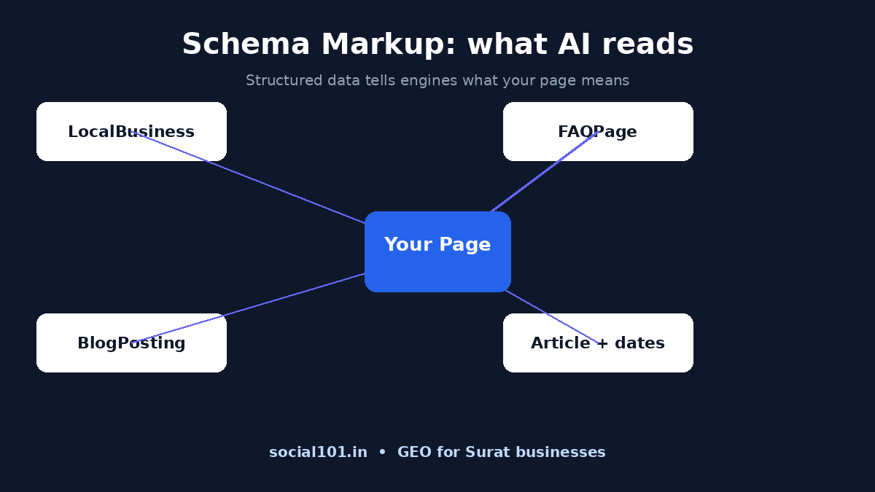
3. Add schema markup (the technical layer AI reads)

Schema (structured data) tells AI engines what your content is. For local businesses, prioritize the following:

  • LocalBusiness schema name, address, Surat location, hours, service area
  • FAQPage schema so your Q&As get pulled directly
  • Article / BlogPosting schema with both datePublished and dateModified

Updating dateModified with genuinely new content and resubmitting your sitemap can get AI bots to re-crawl within 48–72 hours.

4. Build local trust signals

AI engines weigh credibility heavily. For a Surat business, that means

  • A complete, active Google Business Profile with consistent NAP (Name, address, and Phone)
  • Genuine customer reviews mentioning your services and location
  • Local citations listings on Indian and Gujarat business directories
  • Mentions in local news, industry bodies and Surat business communities

5. Write with evidence, not adjectives

AI prefers content rich in specifics. Replace “we deliver great results” with data: brands served, cities covered, measurable outcomes, years of experience. For example, Social 101 has served 300+ brands across 10+ cities since 2018 exactly the kind of concrete, verifiable detail that gets cited.

6. Keep content fresh (the 14-day rule)

Stale content gets penalized in AI citations; pages older than ~14 days without updates can see a noticeable drop. Set a cadence: refresh key pages, add new FAQs, publish regularly, and add a visible “Reviewed monthly” line to signal freshness.

7. Earn mentions on sites AI already trusts

AI engines synthesise from sources they trust. Mentions in industry publications, credible directories, partner sites, and guest articles build the third-party validation that pushes you into AI answers. Each week you are missing, a competitor takes your place on the buyer’s shortlist.

A simple 4-step rollout

  1. Discover Open ChatGPT, Perplexity, and Gemini in incognito. Ask the 10 questions your ideal Surat customer would ask. Note where you and competitors appear.
  2. Optimize Apply the seven moves to your highest-intent pages first (services, location, and pricing).
  3. Measure and track which AI tools cite you and for which queries. Re-test monthly.
  4. Improve Double down on pages that earn citations; refresh the ones that don’t.

Where Social 101 fits in

GEO rewards businesses that treat content as a long-term asset. That means combining solid SEO foundations, structured content, local trust-building, and consistent publishing across both traditional search and AI engines.

At Social 101, we help Surat businesses build exactly this kind of dual SEO + geo presence so when a customer asks an AI tool for a recommendation in your category, your name is in the answer.

Want to know if your business currently shows up on ChatGPT and AI search? Get in touch with Social 101 for a GEO audit of your brand.

Related reading from Social 101

Frequently Asked Questions

What is GEO (Generative Engine Optimization)?

GEO is the practice of structuring and publishing content so AI engines like ChatGPT, Perplexity, Gemini and Google AI Overviews cite your brand when answering questions. Where SEO targets rankings, GEO targets being part of the answer itself.

Is GEO replacing SEO?

No. GEO is an additional layer on top of SEO. The strongest performers usually have strong SEO foundations, but GEO adds requirements around content structure, citation-friendliness, and freshness.

How long does GEO take to work?

Most brands see measurable improvement in AI citation frequency within 4–8 weeks, though local trust signals compound over a longer period.

Why does GEO matter specifically for Surat businesses?

Surat’s competitive textile, diamond, jewelry, real estate, and D2C markets mean buyers increasingly use AI tools to shortlist vendors. Being the cited recommendation captures customers at the decision moment.

Which AI engines should Surat businesses optimise for?

Prioritize ChatGPT, Google AI Overviews, Perplexity, and Gemini; these drive the most discovery traffic in 2026.