Real Estate Marketing Agency: Get Qualified Site-Visit Leads

If you run marketing for a real estate developer, you already know the uncomfortable truth: a full inbox of leads means nothing if your sales team is chasing people who were never going to buy. Thousands of clicks, hundreds of form fills, a CPL that looks great on a dashboard, and still, empty site-visit slots. This is the single biggest gap between a real estate marketing agency that just “runs ads” and one that actually understands the property buying funnel.

At Social 101, we’ve worked with residential and commercial developers across Surat long enough to know that the real KPI isn’t cost-per-click or even cost-per-lead. It’s cost-per-qualified-site-visit because that’s the number that actually moves bookings. Here’s how a real estate marketing agency builds a system around that number instead of vanity metrics.

Why Clicks and Form Fills Aren’t the Same as Leads

A click tells you someone was curious for three seconds. A form fill tells you someone typed their number, sometimes just to download a brochure or check a price range out of idle interest. Neither tells you whether that person has the budget, the intent, or the timeline to actually walk into your sales office.

Real estate has a longer, higher-stakes decision cycle than almost any other category; a buyer is committing lakhs or crores, often with family input, home loan approval, and comparison shopping across 4-5 projects. Optimizing only for cheap clicks fills your CRM with names that never pick up the phone, and it quietly damages the metric that actually matters to a developer: cost per site visit and cost per booking.

The Funnel a Real Estate Marketing Agency Actually Builds

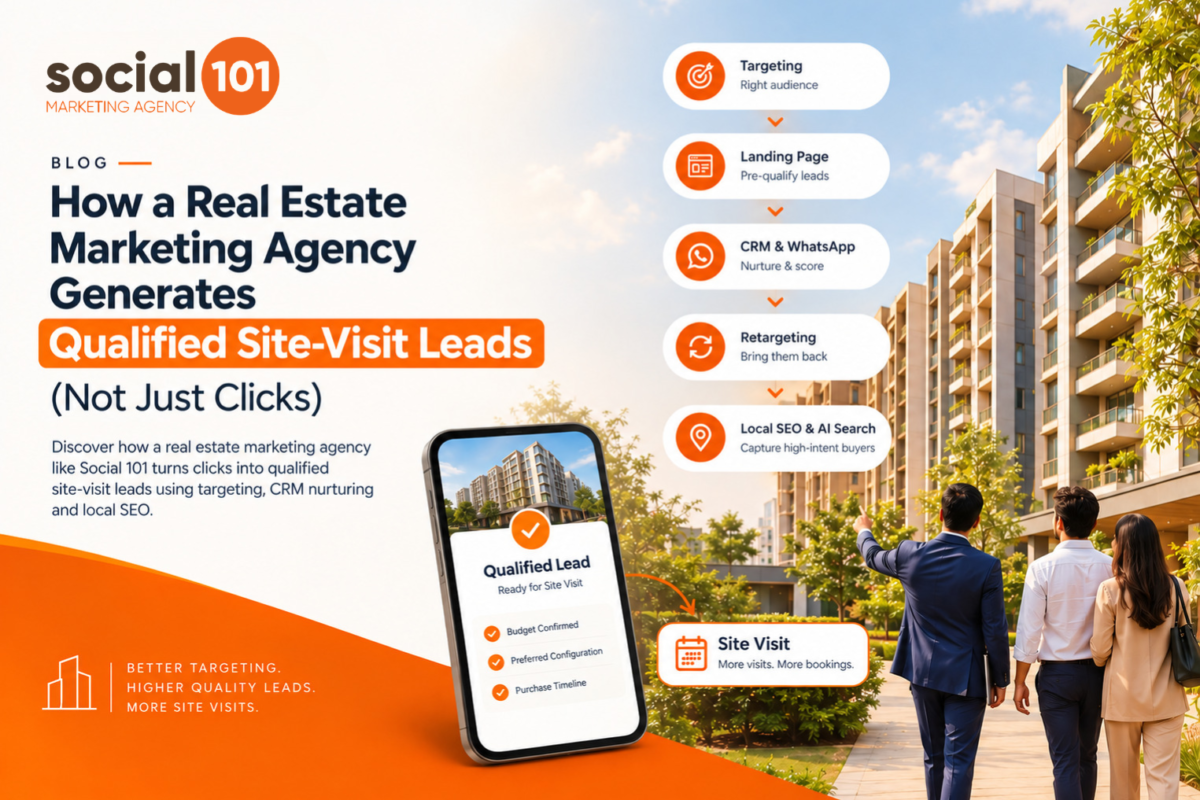
Instead of a flat “ad to form” setup, a proper real estate lead generation funnel has distinct stages, each with its own targeting and messaging:

  • Awareness: Reaching people actively searching for property in a specific micro-market, not a broad city-wide audience.
  • Interest: Retargeting website visitors and video viewers with project-specific content amenities, floor plans, price ranges, RERA details.
  • Qualified Lead: Using budget-qualifying questions, loan pre-check tools, or WhatsApp conversations to filter serious buyers from browsers.
  • Site Visit: Scheduling tools, reminder sequences, and incentives (transport pickup, exclusive previews) that convert a warm lead into a confirmed visit.
  • Booking: Sales-team handoff with full lead context, so no one starts the conversation from zero.

Each of these stages needs a different creative, a different targeting layer, and a different measurement. Treating them as one funnel is where most in-house teams and generalist agencies fall short.

1. Intent-Based Targeting Over Broad Reach

Broad targeting (“everyone in Surat aged 25-55”) maximizes impressions but tanks lead quality. A real estate marketing agency instead builds layered audiences: people searching Google for “2 BHK flats near [location]” or “property in [micro-market] price,” past website visitors who viewed a floor plan page for more than 30 seconds, lookalike audiences modeled on your last quarter’s actual site-visit converters (not just leads), and custom audiences uploaded from your CRM of loan-approved or NRI buyer segments. This is the difference between running Google Ads and Meta Ads generically versus running them with a property-specific intent layer. The second approach costs more per click but far less per qualified visit.

2. Landing Pages Built to Qualify, Not Just Collect

Most builder websites send every ad to the same generic “Enquire Now” form. A better approach uses project-specific landing pages that pre-qualify the visitor before they ever talk to a sales executive asking about configuration preference (2 BHK / 3 BHK / Villa), budget range, and purchase timeline (immediate / 3 months / just exploring) right in the form. This single change alone typically improves lead-to-site-visit conversion because your telecalling team can prioritize instantly instead of cold-calling every entry equally.

3. CRM and WhatsApp Nurturing Where Most Leads Are Actually Lost

A lead that isn’t followed up within minutes goes cold fast, and real estate has one of the highest first-response-time sensitivities of any industry. A real estate marketing agency worth its retainer connects ad platforms directly to a CRM, triggers instant WhatsApp confirmation and follow-up sequences, scores leads automatically based on engagement (opened brochure, replied to WhatsApp, clicked pricing PDF), and routes hot leads to the sales team in real time while cooler leads go into a longer nurture sequence with project updates, video walkthroughs, and festive offers. This nurturing layer is often what separates an agency generating clicks from one generating actual site visits.

4. Retargeting Site Visitors Who Didn’t Convert the First Time

Most property buyers research a project multiple times before visiting. Retargeting campaigns using dynamic creative showing the exact unit type or price point a visitor browsed bring back warm prospects at a much lower cost than fresh acquisition. This is especially effective combined with urgency-based messaging: limited inventory in a specific tower, price escalation notices, or festive-period previews.

5. Aligning Marketing With the Sales Team’s Reality

A lead handed to a sales executive with zero context, no budget preference, no configuration interest, and no prior interaction history is far less likely to convert into a scheduled visit. Agencies that treat marketing and sales as one continuous pipeline pass full lead context automatically agree on a shared definition of a “qualified lead” with the developer’s sales head and report on site-visit and booking numbers, not just leads generated. This alignment is often the single biggest lever for improving visit conversion rates without spending an extra rupee on media.

6. Local SEO and AI Search Visibility for High-Intent Buyers

Not every serious buyer comes from a paid ad. A growing share now searches directly “best projects near [location] Surat” or asks AI tools like ChatGPT and Google AI Overviews for recommendations. Ranking a project website organically and optimizing content for these AI-driven answers (a discipline now often called AEO or GEO) captures a segment of highly motivated buyers who are already close to a decision at a fraction of the cost of paid acquisition.

The Metrics That Actually Matter

A results-driven real estate marketing agency reports on a different scorecard than a generalist agency. Instead of leading with cost-per-click or total leads, the numbers that matter are:

  • Cost per qualified lead (not just cost per lead)
  • Lead-to-site-visit conversion rate
  • Cost per confirmed site visit
  • Site-visit-to-booking conversion rate
  • Channel-wise quality comparison (Google vs Meta vs organic vs referral)

When these are tracked and optimized together, media spend naturally shifts toward the channels and audiences producing bookings not just form fills.

How Social 101 Approaches This for Developers in Surat

At Social 101, our real estate campaigns are built around this exact philosophy every project we work on starts with defining what a “qualified lead” means for that specific developer, not a generic template. We combine intent-based Google and Meta campaigns, CRM-integrated WhatsApp nurturing, project-specific landing pages, and local SEO to build a pipeline that sales teams can actually work with, rather than a spreadsheet of unresponsive numbers. For Surat’s competitive real estate market where buyers routinely compare multiple projects before visiting even one this qualification-first approach is what consistently turns marketing spend into filled site-visit calendars.

Conclusion

Clicks are easy to buy. Qualified site visits are earned through better targeting, smarter qualification, faster follow-up, and a genuine alignment between marketing and sales goals. If your current campaigns are generating leads but not visits, the fix usually isn’t more budget it’s a better funnel. That’s the core job of a real estate marketing agency, and it’s the standard Social 101 builds every campaign against.

Looking to fix your site-visit numbers, not just your lead count? Get in touch with Social 101’s real estate marketing team today.
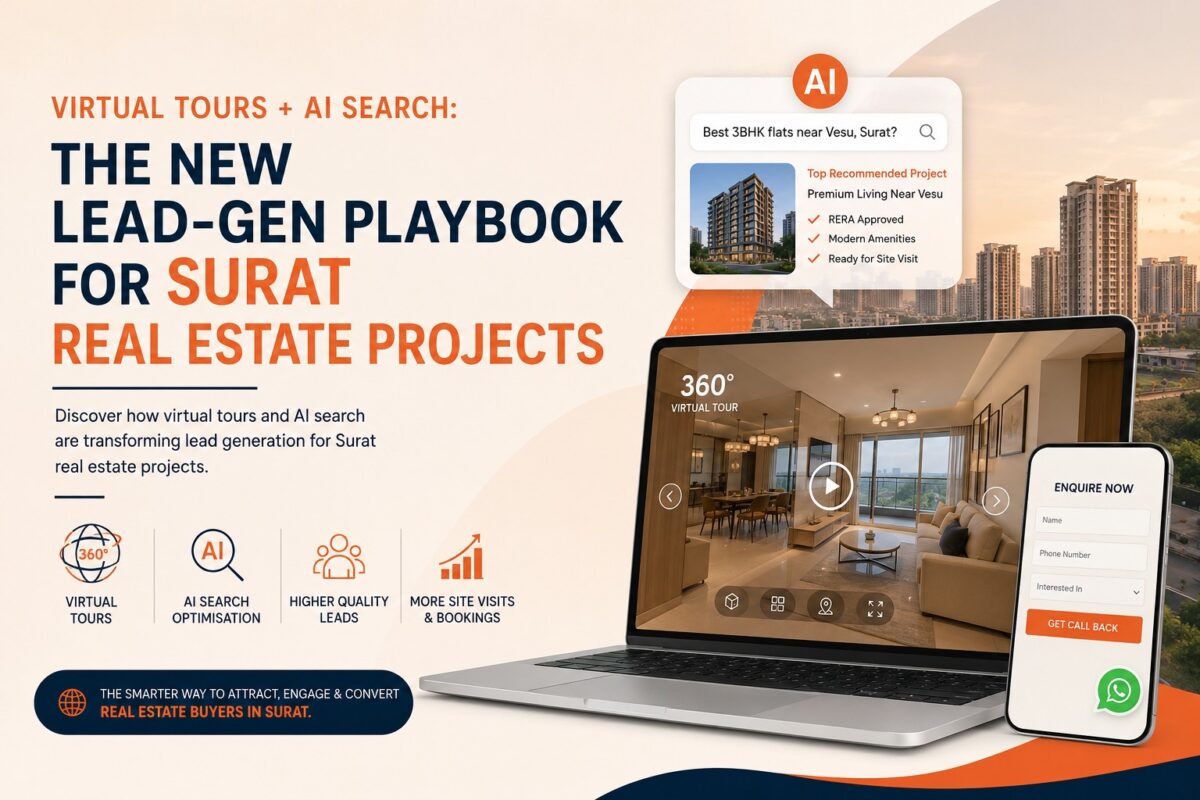
Virtual Tours + AI Search: Lead-Gen Playbook for Surat Real Estate

Surat’s skyline is changing fast. From Vesu to Adajan, Palanpor to Dumas Road, new residential towers and commercial complexes are launching every quarter, and so is the competition for buyer attention. The old playbook of newspaper ads, hoardings, and a static website with a photo gallery simply isn’t converting the way it used to.

Today’s homebuyer researches a project on their phone before they ever call a sales office. They ask AI assistants questions like “best 3BHK under 80 lakhs near Vesu” or “which Surat builder has RERA-approved projects near VR Mall.” If your project isn’t showing up in those answers and isn’t letting them “walk through” the flat from their couch, you’re losing the lead before your sales team even gets a chance.

This is where virtual tours and AI search optimization come together to form the new lead-generation playbook for Surat’s real estate market.

Why the Old Real Estate Marketing Playbook Is Breaking Down

For years, real estate marketing in Surat relied on:

  • Print ads and hoardings for awareness
  • A brochure-style website with static images
  • Walk-in site visits to “sell the dream”
  • Word-of-mouth and broker networks

None of this is dead, but all of it is less efficient than before. Buyers, especially NRIs, out-of-city investors, and busy professionals in Surat’s textile and diamond trade, want to shortlist projects before they spend a Saturday driving across the city. If your digital presence doesn’t let them do that, they simply move to the next builder’s website that does.

What Is Changing: Two Forces Reshaping Property Search

1. Virtual Tours Have Gone from “Nice to Have” to Expected

A 360° virtual tour lets a prospective buyer explore a flat, sample villa, or clubhouse from any device, at any hour no appointment needed. For Surat developers, this is especially powerful because:

  • NRI and outstation buyers can shortlist a unit without booking a flight.
  • Serious leads self-qualify. Someone who spends 6 minutes exploring your virtual tour is a warmer lead than someone who scrolled past a photo.
  • Sales teams save time by only scheduling physical site visits with buyers who are already convinced by the tour.
  • Trust increases because buyers feel there’s nothing hidden; they can “see” the actual layout, ceiling height, and natural light before committing.

2. AI Search Is Replacing the Traditional Google Search Bar

Buyers are no longer typing “Surat 2BHK flats” into Google and scrolling through ten blue links. They’re asking conversational questions on AI-powered search tools, voice assistants, and chat-based platforms and expecting a direct, well-reasoned answer.

To be recommended by AI search, your project’s digital footprint needs:

  • Clear, structured content that answers real buyer questions (budget, location, amenities, possession date, RERA number)
  • Consistent business information (NAP name, address, phone) across your website and directories
  • Genuine reviews and testimonials that AI tools can reference
  • Fast, mobile-first website performance
  • Rich media (like virtual tours and videos) that signal a credible, well-documented project

In short: if your project’s website and content aren’t built to be read and understood by AI systems, you won’t appear when a buyer asks, “Which builder in Surat has the best 2BHK options near Adajan?”

The New Lead-Gen Playbook: How Virtual Tours + AI Search Work Together

Here’s how the two strategies combine into a single, high-converting funnel for Surat real estate projects:

  • 1. A buyer asks an AI search tool or Google a question about property in Surat.
  • 2. Your project appears because your website content, reviews, and listings are optimized for how AI tools read and rank information.
  • 3. The buyer clicks through and lands on a virtual tour, not just static photos, instantly engaging with the space.
  • 4. Interest is captured through a simple enquiry form, WhatsApp chat, or callback request embedded right into the tour experience.
  • 5. Your sales team follows up with a warm, pre-qualified lead who has already “seen” the project and is closer to booking a site visit.

This is fundamentally different from the old model, where marketing generated awareness and sales teams had to do all the convincing from scratch. Now, marketing does both awareness and a large part of the convincing before a human ever picks up the phone.

Practical Steps for Surat Developers to Get Started

  • Invest in a professional 360° virtual tour of your sample flat, clubhouse, and amenities not just a video walkthrough, but an interactive tour buyers can control themselves.
  • Rewrite your website copy in a question-answer format that matches how buyers actually search: “Is [Project Name] RERA registered?”, “What is the possession date for [Project Name]?”, “Which amenities does [Project Name] in [Locality] offer?”
  • Optimize your Google Business Profile with accurate details, high-quality photos, and a steady stream of reviews from happy homeowners.
  • Publish locality-specific content: buyers searching “flats near Vesu” or “commercial shops on Ring Road” want hyper-local answers, not generic city-wide content.
  • Track engagement on your virtual tour: time spent, sections explored, and drop-off points to understand exactly what buyers care about most.
  • Make enquiry as frictionless as possible: a WhatsApp button or one-field form directly inside the tour converts far better than a long contact page.

Why This Matters More in Surat Specifically

Surat’s real estate buyers are a unique mix: established local families upgrading their homes, diamond and textile business owners investing surplus capital, and a growing NRI population from Gujarat’s diaspora. Many of these buyers are comparing projects remotely and value transparency and convenience over a flashy showroom visit. A builder who makes it easy to explore, compare, and inquire online and who shows up when buyers ask AI tools for recommendations has a real edge over one who is still relying on hoardings and cold calls alone.

Bringing It All Together

Virtual tours and AI search aren’t separate marketing tactics; they’re two halves of the same modern lead-generation engine. One makes your project impossible to ignore when buyers are searching. The other makes it impossible to forget once they’ve found you.

If your Surat real estate project’s digital marketing still looks like it did five years ago, it’s time for a rework from your website’s content structure to the way buyers experience your property online.

At Social 101, we help Surat businesses, including real estate developers, build the website design and development, content, and digital strategy needed to show up in modern search and convert online interest into real site visits and bookings. Explore more insights on our blog, or get in touch with our team to discuss a lead-generation strategy for your next Surat project launch.

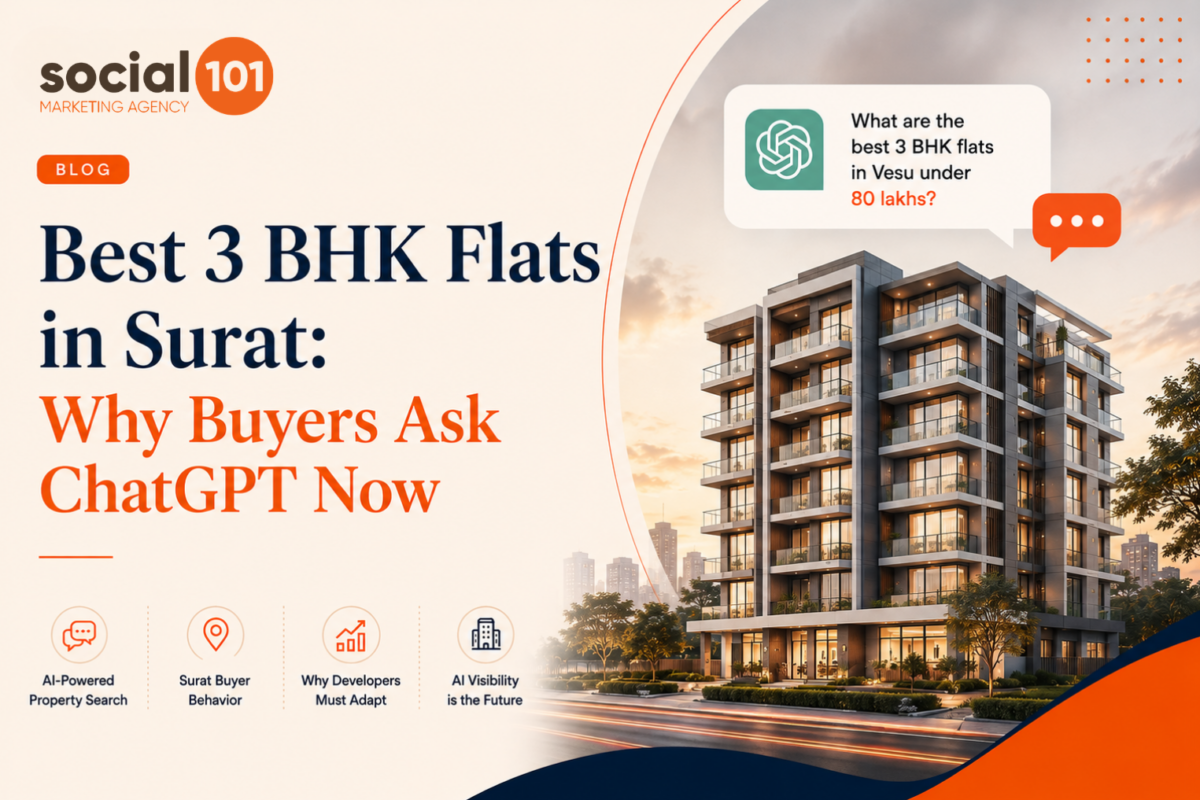
Best 3 BHK Flats in Surat: Why Buyers Ask ChatGPT Now

A few years ago, a homebuyer in Surat looking for a 3 BHK flat in Vesu or Pal would open Google, type in a query, and scroll through ten blue links before picking up the phone. Today, that same buyer is far more likely to open ChatGPT and simply ask, “What are the best 3 BHK flats in Vesu under 80 lakhs?”

This shift isn’t a small trend. It’s a fundamental change in how property discovery happens, and most real estate developers and brokers in Surat haven’t noticed it yet.

Why Surat Buyers Are Switching to AI Chatbots for Property Search

The reasons are simple, and they mirror exactly why AI assistants have exploded in popularity everywhere else:

  • Conversational, specific answers instead of a list of links. A buyer can say, “Family of four, near VNSGU, budget 70–90 lakhs, wants a clubhouse,” and get a direct, synthesized answer instead of ten separate listing pages to compare.
  • No ads, no SEO spam. Google’s top results are often paid listings or portal aggregators. ChatGPT strips that away and gives what feels like an honest recommendation.
  • Faster shortlisting. Instead of visiting five portals, buyers get a shortlist in one prompt, then go verify it themselves.
  • Trust in “neutral” AI advice. Many buyers assume an AI chatbot has no commercial bias, so they treat its suggestions as more credible than a builder’s own website.

This pattern is strongest among younger, tech-comfortable buyers, the exact segment driving demand in fast-growing Surat micro-markets like Vesu, Pal, Adajan, Dumas Road, and City Light.

The Problem: Most Developers Are Invisible to AI Search

Here’s the uncomfortable truth. When a buyer asks ChatGPT or a similar assistant for the “best 3 BHK flats in Surat,” the answer isn’t generated from a live property portal. It’s built from whatever the AI has read and understood about your project, your website content, press coverage, reviews, and how clearly your project is described across the web.

If your project doesn’t have:

  • Clear, structured content about location, configuration, pricing range, and amenities
  • Genuine reviews and mentions across the web
  • A well-optimized website that clearly explains what makes the project worth recommending

…then the AI simply won’t mention you. It will recommend the competitor down the road whose content is easier to understand and more widely referenced even if your project is objectively better.

This is the new competitive battlefield. It’s not just about ranking on Google anymore. It’s about being the answer an AI gives when someone asks a question.

What Real Estate Developers in Surat Must Do Now

1. Build Content That Answers Real Buyer Questions

Buyers don’t just want a brochure. They ask things like “3 BHK vs 2 BHK for a family of four in Surat” or “best areas near Surat airport for investment.” Your website and blog need content answering these exact questions, in plain language, not just listing pages with specifications.

2. Get Structured, Accurate Data Everywhere

Configuration, carpet area, price range, possession date, RERA number, and amenities should be consistent and clearly stated across your website, listings, and third-party mentions. AI systems reward clarity and consistency; they penalize vague or conflicting information.

3. Earn Genuine Digital Reviews and Mentions

AI-generated recommendations lean heavily on what’s said about a project across the web reviews, local news, buyer testimonials, and social proof. A project with a real, positive digital footprint is far more likely to be surfaced than one that’s silent online.

4. Optimize for AI Search, Not Just Google Search

Traditional SEO still matters, but AI search optimization (sometimes called AEO Answer Engine Optimization) is now a separate discipline. It means structuring content so an AI model can easily extract, understand, and confidently recommend your project when asked a direct question.

5. Strengthen Your Brand Presence Beyond the Website

Social media activity, video content, local press, and consistent branding all feed into how AI models “understand” your project. A developer with an active, credible digital presence is simply easier for an AI to recommend with confidence.

The Bigger Shift: From SEO to AI Visibility

This isn’t a passing phase. As more buyers in Surat and across India adopt AI assistants for everyday research, restaurants, doctors, and now real estate developers who ignore this shift risk becoming invisible to an entire generation of buyers, regardless of how good their project actually is.

The developers who invest now in clean digital content, real reviews, and AI-friendly website structure will be the ones AI recommends by default over the next few years. The ones who don’t will keep wondering why their footfall keeps dropping while their marketing spend stays the same.

Final Thought

The question is no longer just “How do we rank on Google?” It’s “What does ChatGPT say about us when someone in Surat asks for the best 3 BHK flat in their area?” Getting ahead of that question today is far cheaper than trying to catch up once every competitor already has.

Want your real estate project to show up when buyers ask AI assistants for the best options in Surat? Talk to Social 101; we help developers build the digital presence, content, and visibility that both Google and AI search engines trust.

Explore our services or check out more insights on our blog.

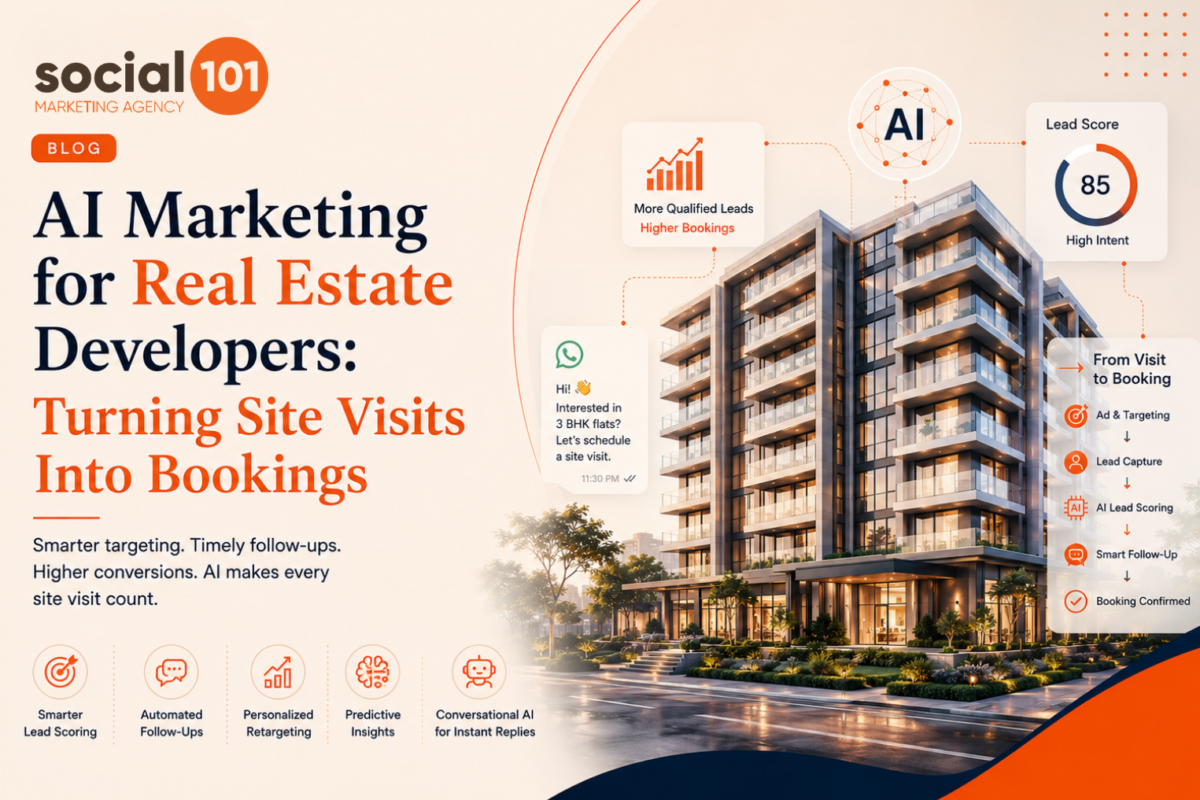
AI Marketing for Real Estate Developers | Site Visits to Bookings

Every real estate developer knows the frustrating gap between interest and income: hundreds of site visits happen every month, yet only a small fraction convert into actual bookings. Buyers walk in, admire the sample flat, take a brochure, and disappear into a black hole of “we’ll think about it.”

The old playbook of more hoardings, more newspaper ads, and more cold calls doesn’t fix this gap. AI marketing does. It doesn’t just bring more people to your site; it helps you understand who is actually ready to buy and nudges them toward a booking at exactly the right moment.

Why So Many Site Visits Never Convert

Before fixing the problem, it helps to understand where developers typically lose buyers:

  • No follow-up system. A visitor leaves contact details, but the next call happens three days later; by then they’ve already visited two competing projects.
  • One-size-fits-all messaging. The same WhatsApp message and brochure go to a first-time homebuyer and a seasoned investor, even though they care about completely different things.
  • No visibility into buyer intent. Sales teams can’t tell which leads are seriously comparing projects versus which are just browsing, so urgent leads get the same attention as cold ones.
  • Generic retargeting. The same ad keeps showing to someone who already booked, while a genuinely interested buyer sees nothing after their first visit.

How AI Marketing Closes the Gap

1. Smarter Lead Scoring

AI models can analyze buyer behavior pages visited, time spent on floor plans, WhatsApp responses, and call duration and score each lead by likelihood to book. This means your sales team spends time on the 20% of leads that are genuinely close to a decision, instead of chasing every inquiry equally.

2. Automated, Timely Follow-Ups

Instead of manual follow-up calls that happen whenever someone gets around to it, AI-driven workflows can trigger a personalized WhatsApp message, email, or call reminder within minutes of a site visit while the experience is still fresh in the buyer’s mind.

3. Personalized Retargeting Ads

AI-powered ad platforms can show a buyer who viewed 3 BHK units a completely different ad than someone who viewed 2 BHK units with pricing, amenities, and messaging tailored to what they actually looked at. This dramatically increases the chance they click back in.

4. Predictive Insights for Sales Teams

AI tools can flag patterns human teams miss: which floor plans get abandoned at the pricing stage, which locations attract more repeat visits, or which lead sources produce buyers who actually close. This turns your sales strategy from guesswork into a data-backed process.

5. Conversational AI for Instant Engagement

A chatbot on your website or WhatsApp can answer pricing, availability, and possession-date questions instantly, at 11 PM on a Sunday, without a buyer having to wait for office hours. Fast answers keep interest alive instead of letting it cool off.

From Site Visit to Booking: What a Modern Funnel Looks Like

A well-built AI marketing funnel for a real estate project typically works like this:

  • A targeted ad brings in a qualified visitor based on budget, location preference, and buyer intent signals.
  • A chatbot or landing page captures their requirement and books a site visit slot instantly.
  • AI scores the lead based on engagement before and after the visit.
  • A personalized follow-up sequence message, call, or retargeting ad keeps the project top of mind.
  • The sales team gets a prioritized list, so the most ready-to-book leads get a human conversation first.

None of this replaces your sales team. It makes them faster, better informed, and focused on the conversations that actually move a booking forward.

Why This Matters More in 2026

Buyers today research extensively before ever calling a developer, comparing projects online, reading reviews, and even asking AI assistants for recommendations. By the time they walk in for a site visit, they’ve already narrowed down their options. Developers who use AI marketing to stay relevant at every one of those research and follow-up moments simply convert more of the visits they’re already paying to generate.

Final Thought

Getting more people to your site is only half the job. The real ROI in real estate marketing today comes from what happens after the visit: how fast you follow up, how relevant your messaging is, and how well you understand buyer intent. AI marketing isn’t a buzzword here; it’s the difference between a full sample flat and an empty booking register.

Want to turn more of your site visits into confirmed bookings? Talk to Social 101: we build AI-driven marketing systems for real estate developers, from lead scoring to personalized follow-ups and retargeting.