Is AI-Written Content Bad for SEO? What Google Says

If you use ChatGPT, Gemini, or any AI tool to write blogs, product descriptions, or website pages, you’ve probably wondered, “Will Google penalize me for it?”

It’s a fair worry. Google has released several spam updates in 2026, and it updated its AI content guidance as recently as October 1. This guide explains what Google actually says, what puts your site at risk, and how to use AI for content without hurting your rankings.

The Short Answer

No, AI-written content is not automatically bad for SEO. Google’s published guidance says AI can be useful for researching a topic and adding structure to original content. What Google targets is using AI (or any automation) to produce large amounts of low-value content mainly to manipulate rankings.

In other words, Google doesn’t penalize AI. It penalizes content that doesn’t help people. A thin, copied, or inaccurate page is a problem whether a human or a machine wrote it.

What Google Actually Says About AI Content

Here are the main points from Google’s guidance and spam policies:

  • AI isn’t banned. Google has said for years that it rewards quality content, however it is produced, and that not all use of automation, including AI, is spam.
  • Quality matters more than method. Google asks you to focus on accuracy, quality, and relevance, especially when content is generated automatically.
  • Scaled content abuse is the real risk. Google’s spam policy covers generating many pages without adding value for users, whether the content comes from AI, humans, or a mix of both.
  • Fact-checking is critical. In its October 2026 update to its AI content guidance, Google says AI tools predict words rather than look up facts, so their output can contain errors, and that all AI-generated content should be manually fact-checked and reviewed before publishing.
  • Spam rules cover AI search too. In May 2026, Google clarified that its existing spam policies also apply to attempts to manipulate AI Overviews and AI Mode.
  • Telling readers can help. Google suggests that sharing how content was created can give readers helpful context, especially when they would reasonably wonder.

What Is Scaled Content Abuse?

Scaled content abuse is the spam policy most relevant to AI writing. Google introduced it in March 2024. It targets publishing lots of pages mainly to rank, rather than to help the people who land on them.

Examples that raise risk:

  • Publishing hundreds of near-identical pages from one template, such as one page for every area or keyword with only the name changed
  • Mass-producing blog posts with AI with no editing, fact-checking, or original input
  • Rewording or combining other websites’ content without adding anything new
  • Creating many websites to hide how much content is being mass-produced

Notice what’s missing from that list: a single, well-edited blog post that you drafted with AI and improved with your own expertise. That sits outside the policy.

Recent Google Changes You Should Know About

DateWhat happened?
March 2024Google introduced the scaled content abuse policy, which applies whether content is made by AI, humans, or both.
May 15, 2026Google clarified that its spam policies also apply to generative AI responses in Search, including AI Overviews and AI Mode.
September 24, 2026Google began rolling out its September 2026 spam update worldwide. Google hasn’t said it specifically targets AI content, and it covers spam in general. Check Google’s Search Status Dashboard to see whether the rollout has finished.
October 1, 2026Google updated its generative AI content guidance to stress manual fact-checking of all AI-generated content before publishing. The spam policies themselves were not changed.

The direction is consistent: Google isn’t against AI, but it is getting stricter about low-effort, unchecked, and mass-produced pages.

When AI Content Hurts Your SEO

  • It’s generic. It says what every other page says, with nothing new.
  • It contains mistakes. AI can invent statistics, quotes, prices, laws, or product details.
  • It’s mass-produced. Dozens of similar pages published quickly without review.
  • It has no real author or experience behind it. There’s no proof that anyone with knowledge was involved.
  • It doesn’t match what people want. It’s long but doesn’t answer the question or help the reader decide.
  • It sounds off-brand. Visitors notice, leave quickly, and don’t trust you.

When AI Content Works Well

  • A draft or outline that an expert then rewrites, fact-checks, and improves
  • Research support, such as summarizing sources or suggesting questions to answer
  • Repurposing your own original material, such as turning a webinar or case study into a blog
  • Editing, translating, and simplifying content you’ve already written
  • FAQs and meta descriptions that a human reviews and adjusts

Risky vs Safe: Quick Comparison

Risky approachSafer approach
Publishing raw AI outputUsing AI for a draft, then rewriting and editing it
Hundreds of similar pages from one templateFewer pages that each serve a clear purpose
Trusting facts and numbers from AIChecking every claim against reliable sources
No author or expert inputReal author, real examples, and original insight
Writing for search engines onlyWriting to answer the reader’s question

A Safe Workflow for Using AI in Content

  1. Start with the reader’s question. Decide what the page must help them do or understand.
  2. Do real keyword and competitor research. Look at what already ranks and find what’s missing.
  3. Use AI for an outline or first draft. Treat it as a starting point.
  4. Add what AI can’t: your experience, client examples, local knowledge, original data, photos, and opinions.
  5. Fact-check everything. Verify numbers, names, dates, laws, prices, and claims, including in titles, meta descriptions, and image alt text.
  6. Edit for voice and clarity. Make it sound like your brand and remove filler.
  7. Show who’s behind it. Add a real author name with relevant credentials and a short bio.
  8. Update regularly. Review important pages every few months so they stay accurate.

Extra Care for Health, Finance, and E-commerce

Some content needs more caution than others:

  • Health and medical content: wrong advice can harm people. Have a qualified professional review it. This matters for clinics, skin specialists, and wellness brands.
  • Finance, tax, and legal content: inaccurate AI statements can mislead readers and damage trust, so review it carefully and avoid promises.
  • E-commerce: Google Merchant Center has its own rules for AI-generated content. AI-generated images should carry the right metadata, and AI-generated product titles and descriptions should be labeled as such in your product data. Check the current rules before bulk-generating product content.

Should You Tell Readers a Page Was Written With AI?

Google doesn’t require a label on every AI-assisted page, but it says that explaining how content was made can help readers, especially when they’d reasonably wonder about it, for example, with AI-generated images or video. A short note, such as “drafted with AI assistance and reviewed by our team,” can build trust if you use AI heavily. Always follow the rules of the platform where you publish. Never invent fake authors, because Google’s updated guidance treats misleading author information as a problem.

Pre-Publish Checklist for AI-Assisted Content

  • Does this page answer a real question better than what’s already out there?
  • Have I added original experience, examples, or data?
  • Has a human fact-checked every claim, number, and name?
  • Does it sound like our brand?
  • Is there a real author with a short bio?
  • Is the title and meta description accurate and not exaggerated?
  • Would I be comfortable if Google’s quality reviewers read this page?

How Social 101 Uses AI for SEO Content

At Social 101, we use AI to speed up research, outlines, and first drafts. Every piece is then planned around search intent, fact-checked, edited, and improved with real examples before it goes live. We don’t mass-produce pages. We focus on content that earns trust and leads. This is also how we approach our SEO services in Surat.

Not sure whether your current content is helping or hurting your rankings? Contact Social 101 for a free content and SEO review.

Frequently Asked Questions

1. Does Google penalize AI-generated content?

Not because it’s AI-generated. Google penalizes spam, including mass-produced, low-value content, whether it comes from AI or humans. AI content that is accurate, original, and helpful is not penalized for being AI-assisted.

2. Can Google detect AI content?

Google has said its focus is on content quality, not on how content was produced. Even if text could be detected, a helpful page isn’t a violation. The risk comes from low-quality or scaled content, which Google’s spam systems are built to catch.

3. Is AI content bad for SEO in 2026?

It can be if it’s generic, inaccurate, or mass-produced. Used as a drafting tool with human expertise, editing and fact-checking, it can perform just as well as content written by hand.

4. What is scaled content abuse?

It’s a Google spam policy that covers generating many pages mainly to manipulate rankings instead of helping users. It applies regardless of whether the content was made by AI, people, or a combination.

5. Should I fact-check AI-written content?

Yes, always. Google’s updated guidance says manual fact-checking of all AI-generated content before publishing is critical, because AI tools can state wrong information confidently.

6. How many AI-written blogs can I publish?

There’s no magic number. What matters is that each page is genuinely useful, accurate, and different from what’s already out there. Publishing a large batch of unedited pages quickly is the pattern most likely to cause problems.

7. Do I need to disclose AI use on my website?

Google doesn’t require disclosure on every page, but it says that explaining how content was created can help readers. Disclosure is especially useful for AI-generated images, audio or video, and heavily AI-written pages.
How AI Is Changing Digital Marketing in 2026

Last updated: October 2026

A few years ago, AI in marketing meant a chatbot or a tool that suggested hashtags. In 2026, it sits inside almost everything marketers touch: how customers find you on Google, how ads are targeted and created, how content is written, and how customers get support.

If you run a business in Surat, whether it’s a textile brand, a clinic, a jewelry store, or an online store, this affects you directly. AI in digital marketing is changing where your customers click, what you pay for ads and what your competitors can produce in a day.

This guide explains the biggest changes in plain language and what you can do about each one.

1. Search Is Becoming an Answer Engine

The biggest change is in search. Google’s AI Overviews and AI Mode now give people a written answer at the top of the results page, so fewer people click through to websites. Google has reported that AI Overviews reach billions of people every month, and AI Mode, its more conversational search experience, has passed a billion monthly users.

What does that mean for your website traffic? Studies differ on the exact numbers, but they point the same way. One widely cited study found that organic clicks fell by around 38% on searches where an AI overview appeared and that searches ending without any click rose from 54% to 72%. Other studies report smaller or larger drops depending on the topic.

The impact is uneven. Informational searches, such as “what is…” and “how to…,” lose the most clicks. Searches for a brand name, “near me” searches, and high-intent searches like booking or buying still send customers to businesses.

What to do:

  • Write content that answers the question clearly in the first few lines, then adds depth that a summary can’t replace, such as your own experience, examples, and data.
  • Optimize your Google Business Profile, because local searches still drive real calls, visits, and directions.
  • Build your brand, because people who search for you by name are much harder for AI answers to intercept.
  • Learn about Generative Engine Optimization (GEO): making your content easy for AI tools to understand, trust and cite.
  • Measure more than clicks. Track enquiries, branded searches and leads, not just website visits.

Our guide to SEO services in Surat explains how we approach search in this new environment.

2. Advertising Is Now Automated by Default

On both Google and Meta, AI now runs most of the day-to-day work in advertising. Google’s Performance Max and AI Max for Search, and Meta’s Advantage+, choose who sees your ads, where they appear and how much to bid. In many accounts, automation is switched on from the start. Google has also announced that some older search campaign features will move to AI Max from September 2026.

Platforms are also creating ads for you. Meta’s tools can turn product photos into video ads, and Google can generate text and image assets. Ads are also starting to appear inside AI-generated answers, as both Google and OpenAI test and expand them.

This lowers the cost of getting started, but it changes what makes the difference:

  • Targeting matters less; creative matters more. When every advertiser uses the same AI targeting, your offer, message, and visuals set you apart.
  • Data quality is critical. The AI learns from your conversion tracking, product feeds, and customer lists. Messy data means poor results.
  • Oversight is still needed. Automated campaigns can overspend, target the wrong searches, or show tired creative. Someone has to check them.
  • Fatigue happens faster. If everyone uses AI-generated creative, ads start to look alike. Fresh, original creative stands out.

There’s also a trust issue. One US consumer survey found that around four in ten people view AI-generated ads negatively, so AI creative needs a human check for quality and authenticity.

3. Content Creation Is Faster, and Sameness Is the New Risk

AI can draft a blog post, a product description, or ten ad variations in minutes. That’s useful, but it also means the internet is filling up with similar, generic content.

Google’s position is that it rewards helpful, reliable content however it’s produced, and it targets mass-produced content that exists only to manipulate rankings. In practice, that means AI works best as a first-draft and research assistant, not as a replacement for expertise.

Good use of AI for content:

  • Brainstorming topics, outlines, and angles
  • Summarizing research and turning long material into short formats
  • Repurposing one blog into social posts, emails, and scripts
  • Editing, translating, and adapting content for different audiences

Always add what AI can’t: real customer stories, local knowledge, original data, your opinion, and your brand’s voice. We cover this in more detail in Is AI-Written Content Bad for SEO?

4. Social Media: More Output, Higher Bar for Authenticity

AI helps social media teams plan calendars, write captions, create short videos, resize creatives, and analyze what performs. This saves hours each week.

But audiences are getting better at spotting generic, AI-made posts. Brands that stand out in 2026 tend to use AI for the behind-the-scenes work, such as research, scheduling, drafts, and reporting, while keeping faces, stories, and community conversations human.

Also remember that platforms increasingly expect AI-generated or heavily edited content to be labeled, so check each platform’s current rules.

5. Customer Experience: Chatbots, WhatsApp, and Personalization

Customers expect fast replies. AI chatbots can now answer common questions, qualify leads, book appointments and follow up at any hour. In India, where WhatsApp is the main way many customers contact businesses, AI-powered WhatsApp assistants are becoming a practical tool for small and mid-size companies.

AI also improves email and website personalization, such as sending different messages to new visitors, returning customers, and people who abandoned their cart. The key is to set clear limits, decide when a human takes over, and never let a bot guess on pricing, medical advice, or promises.

6. Analytics and Decision-Making Get Smarter

AI tools can now spot patterns in campaign data, flag unusual drops in traffic, predict which leads are most likely to convert, and summarize reports in plain language. That gives marketers more time for strategy. But AI can also state wrong conclusions confidently, so important decisions should always be checked against the actual numbers.

Quick Summary: What Changed and What to Do

AreaWhat AI changedWhat to do
SearchAI answers reduce clicks on informational searches.Answer-first content, strong brand, Google Business Profile, GEO
AdvertisingTargeting and bidding are automated; AI creates ads.Invest in creative, clean tracking and regular human review.
ContentDrafting is fast; generic content is everywhere.Use AI for drafts; add original expertise and voice.
Social mediaFaster planning and productionKeep storytelling and community human; follow labeling rules.
Customer care24/7 chatbots and personalizationAdd WhatsApp automation with clear human handoff.
AnalyticsFaster insights and predictionsVerify AI conclusions against real data

Risks of Using AI in Marketing

  • Inaccurate information: AI tools can make up facts, statistics, or quotes. Always fact-check.
  • Loss of brand voice: unedited AI content sounds like everyone else’s.
  • Privacy and data protection: don’t paste customer data or confidential information into public AI tools, and follow India’s data protection law (the DPDP Act).
  • Copyright concerns: be careful with AI-generated images, music, and text, and check the usage terms of each tool.
  • Over-reliance on platform automation: if you give the ad platform full control, you may lose visibility into what is working.
  • Customer trust: be open about when customers are talking to AI.

Will AI Replace Digital Marketers?

AI is replacing repetitive tasks, such as first drafts, resizing, basic reports, and routine bid changes. It isn’t replacing strategy, creativity, judgment, or relationships. The marketers and agencies who do well will be the ones who use AI to move faster and spend their time on the thinking: understanding customers, shaping offers, testing ideas, and making sense of results.

7 Practical Steps for Your Business in 2026

  1. Audit your tracking. Make sure leads, calls, WhatsApp clicks, and sales are being measured correctly, because AI ad platforms depend on it.
  2. Refresh your key pages. Add clear answers, FAQs, pricing guidance, customer proof, and expert authorship.
  3. Strengthen your Google Business Profile with photos, reviews, services, and regular posts.
  4. Start small with AI tools. Pick one or two tasks, such as content drafts and reporting, and build from there.
  5. Set simple AI rules. Decide what must always be human-reviewed, such as facts, claims, pricing, and customer messages.
  6. Invest in original creativity. Real photos, videos, testimonials, and offers stand out in an AI-saturated feed.
  7. Track the right metrics. Look at leads, cost per lead, sales, and brand searches, not just clicks and followers.

How Social 101 Uses AI for Clients

At Social 101, we use AI to speed up research, content planning, reporting, and campaign testing and keep strategy, creative direction, and quality control with our team. For our clients in e-commerce, fashion, jewelry, education, consulting, and financial services, that means faster execution without losing the human touch that makes brands memorable.

Want to know where AI can help your business and where it can’t? Contact Social 101 for a free consultation and get a practical, jargon-free plan.

Frequently Asked Questions

1. How is AI changing digital marketing?

AI is changing how people search (through AI answers), how ads are targeted and created, how content and social posts are produced, and how businesses talk to customers. It speeds up routine work and raises the importance of strategy, original creative and brand trust.

2. Will AI replace digital marketing agencies?

AI will replace many repetitive tasks, but not strategy, creative judgment or accountability for results. Agencies that use AI well can deliver faster and better. Agencies that only repackage AI output will struggle.

3. Is SEO still worth it in 2026?

Yes, but it has changed. Informational clicks are falling, while local, branded and high-intent searches still drive traffic. SEO now also includes being cited and trusted in AI answers, not just ranking in blue links.

4. Can small businesses use AI for marketing?

Yes. Small businesses often benefit the most because AI lowers the cost of content, design and reporting. Start with one or two simple use cases and review the results.

5. Is AI-generated content bad for SEO?

Not automatically. Google focuses on whether content is helpful and trustworthy, not on how it was produced. But generic, unedited AI content rarely performs well. Add real expertise, check the facts and make it useful.

6. Are AI ads better than manual campaigns?

AI-driven campaigns often perform well when they have good data, clear goals and strong creative. They still need human oversight on budgets, search terms, brand safety and creative refreshes.

7. What are the main risks of AI in marketing?

The main risks are inaccurate information, generic content, privacy issues, copyright concerns and giving too much control to ad platforms without checking results.

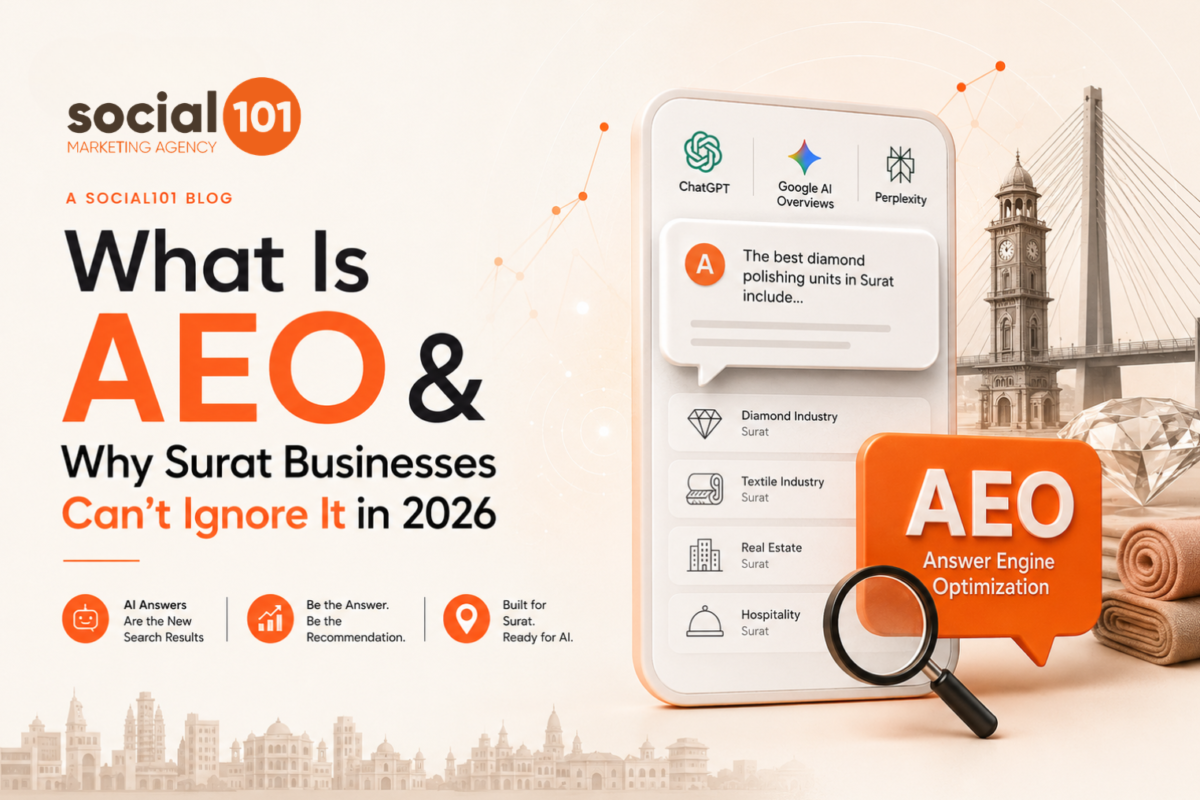
What Is AEO and Why Surat Businesses Can’t Ignore It in 2026

The way people search for businesses has changed forever and most business owners in Surat haven’t noticed yet.

A textile trader in Ring Road, a diamond exporter in Varachha, or a restaurant owner in Vesu no longer has customers typing queries into Google and scrolling through ten blue links. Today, that same customer is asking ChatGPT “best diamond polishing units in Surat” or asking Google’s AI Overview “which caterers in Surat are good for a 500-guest wedding” and getting one direct, synthesized answer. No links. No scrolling. Just one answer, sourced from a handful of websites the AI trusts.

If your business isn’t one of those sources, you don’t just rank lower; you become invisible.

This is the world of Answer Engine Optimization (AEO), and it’s the single biggest shift in digital marketing since the invention of Google Search itself.

What Is Answer Engine Optimization (AEO)?

Answer Engine Optimization (AEO) is the practice of structuring your website content so that AI-powered platforms such as ChatGPT, Google AI Overviews, Perplexity, and Gemini can easily find, understand, and cite it as the direct answer to a user’s question.

Where traditional SEO focused on ranking your webpage in a list of search results, AEO focuses on becoming the answer itself. Instead of hoping a user clicks through to your site, AEO ensures your business information, expertise, and offerings are the ones an AI assistant repeats back to a potential customer by name.

Industry research reinforces just how big this shift already is. According to Frase’s 2026 AEO guide, ChatGPT alone now handles over 2 billion queries every day, and AI-referred traffic to websites grew by more than 500% year-over-year through 2025. Similarweb’s clickstream data, cited by CXL, shows that roughly 68% of Google searches now end without the user clicking any external link at all because the AI already gave them the answer.

In short: the search box has become an answer box, and businesses that don’t optimize for it are being quietly left out of the conversation.

AEO vs. SEO: What’s the Difference?

 SEO (Search Engine Optimization)AEO (Answer Engine Optimization)
GoalRank high in a list of search resultsBecome the direct, cited answer
Success looks likeA click to your websiteA mention/citation by AI, even without a click
Content styleKeyword-optimized long-form pagesClear, direct answers backed by evidence & structure
Key toolsKeywords, backlinks, meta tagsSchema markup, FAQ structuring, entity clarity
Measured bySearch Console rankings & clicksCitation frequency across AI platforms

The important thing to understand is that AEO doesn’t replace SEO; it builds on it. As the AirOps 2026 State of AI Search Report notes, strong SEO still gets your content discovered and indexed, while AEO adds the structure and clarity that AI systems need in order to extract and cite your content as an answer. In 2026, businesses need both working together for full search visibility.

Why This Matters Specifically for Surat Businesses

Surat is one of India’s fastest-growing commercial hubs for diamonds, textiles, real estate, hospitality, and a booming SME and startup ecosystem. That also means Surat is an intensely competitive local market where visibility decides who gets the customer and who gets ignored. Here’s why AEO is no longer optional for local businesses:

1. Your Customers Are Already Asking AI, Not Just Google

Whether it’s a bride-to-be in Piplod asking ChatGPT to shortlist bridal lehenga stores, or a business owner searching Perplexity for “reliable CA firms in Surat,” decision-making now starts inside an AI conversation often before Google is even opened.

2. Zero-Click Search Means Fewer Website Visits Unless You’re the Cited Source

As zero-click search becomes the norm, businesses that aren’t structured for AEO will see organic traffic quietly decline, even if their SEO rankings look fine on paper. The only way to stay visible is to become the source the AI actually quotes.

3. Local Competitors Who Adopt AEO Early Will Dominate the AI Answer Layer

AEO is still new enough in India and especially in tier-1/tier-2 cities like Surat that early adopters have a major first-mover advantage. Once an AI engine “learns” which local brands to trust and cite for a category, it takes real investment for a competitor to unseat them.

4. Voice and Mobile Search Are Exploding

With increasing voice search usage on smartphones across Gujarat, structured, answer-ready content (the same content AEO demands) is exactly what voice assistants pull from to answer spoken questions.

5. AI Platforms Are Becoming Trusted Recommendation Engines

When ChatGPT or Google’s AI Overview recommends a business by name, it carries a credibility and trust factor that’s difficult to replicate through paid ads. For Surat’s diamond, textile, real estate, and hospitality sectors, industries built on trust and referrals, this is a powerful new channel for reputation building.

How Surat Businesses Can Start Optimizing for AEO in 2026

Structure Content to Lead With the Answer

Don’t bury your value proposition three paragraphs deep. Open each page or blog section with a clear, direct answer to the question your customer is likely asking, then support it with detail and evidence.

Implement Schema Markup

FAQPage, HowTo, LocalBusiness, and Organization schema help AI systems understand exactly who you are, what you offer, and where you’re located critical for local businesses competing in a specific city like Surat.

Build a Strong FAQ Section

Answer engines love clearly formatted question-and-answer content. A well-built FAQ page addressing real customer questions (“What are the best diamond cutting units in Surat?”, “Which caterers in Surat handle destination weddings?” gives AI models exactly the format they’re designed to extract from.

Keep Content Fresh

According to AirOps’ research, 83% of AI citations for commercial and evaluation-stage queries came from pages updated within the past 12 months, and more than 60% were refreshed within the last six months. Stale content, even if once well-ranked, gets passed over.

Establish Clear Entity and Authorship Signals

AI models identify businesses as “entities” before evaluating relevance. Make sure your business name, location (Surat, Gujarat), services, and credentials are consistent and clearly stated across your website, Google Business Profile, and third-party listings.

Earn Credible Mentions and Citations

Original data, case studies, expert quotes, and real customer stories make your content more citation-worthy to AI systems that are actively looking for trustworthy, evidence-backed sources.

The Bottom Line

AEO is not a future trend; it’s already reshaping how customers discover, evaluate, and choose businesses in 2026. For Surat’s business community, where competition is fierce and referrals matter deeply, being the business an AI assistant confidently recommends can be just as valuable as ranking #1 on Google used to be.

The businesses that invest in AEO now while it’s still relatively new in the local market will be the ones AI engines trust and recommend for years to come. The ones that wait will be optimizing for an SEO playbook that increasingly talks to an audience that isn’t clicking through anymore.

Want to make sure your business shows up when AI answers questions in your industry? Social101 helps Surat businesses build AI-ready, search-optimized digital strategies for 2026 and beyond. Explore more insights on our blog.