Last updated: October 2026
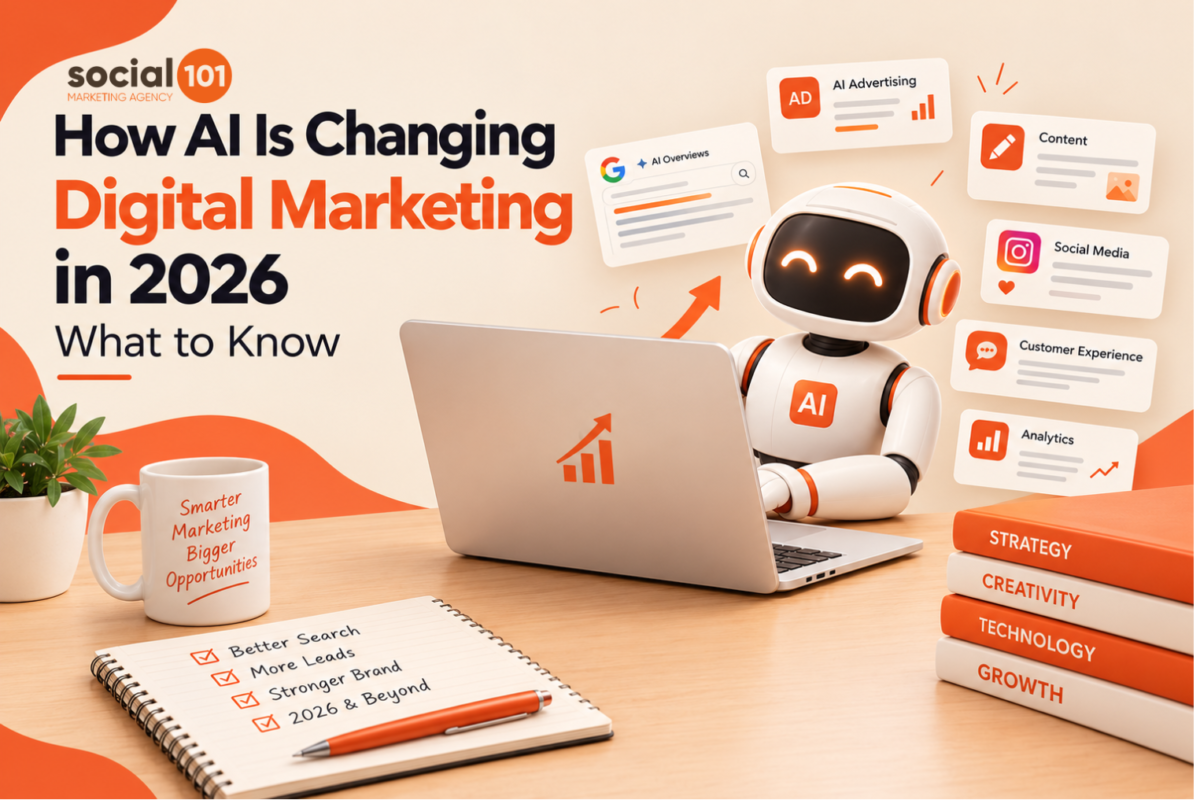
A few years ago, AI in marketing meant a chatbot or a tool that suggested hashtags. In 2026, it sits inside almost everything marketers touch: how customers find you on Google, how ads are targeted and created, how content is written, and how customers get support.
If you run a business in Surat, whether it’s a textile brand, a clinic, a jewelry store, or an online store, this affects you directly. AI in digital marketing is changing where your customers click, what you pay for ads and what your competitors can produce in a day.
This guide explains the biggest changes in plain language and what you can do about each one.
1. Search Is Becoming an Answer Engine
The biggest change is in search. Google’s AI Overviews and AI Mode now give people a written answer at the top of the results page, so fewer people click through to websites. Google has reported that AI Overviews reach billions of people every month, and AI Mode, its more conversational search experience, has passed a billion monthly users.
What does that mean for your website traffic? Studies differ on the exact numbers, but they point the same way. One widely cited study found that organic clicks fell by around 38% on searches where an AI overview appeared and that searches ending without any click rose from 54% to 72%. Other studies report smaller or larger drops depending on the topic.
The impact is uneven. Informational searches, such as “what is…” and “how to…,” lose the most clicks. Searches for a brand name, “near me” searches, and high-intent searches like booking or buying still send customers to businesses.
What to do:
- Write content that answers the question clearly in the first few lines, then adds depth that a summary can’t replace, such as your own experience, examples, and data.
- Optimize your Google Business Profile, because local searches still drive real calls, visits, and directions.
- Build your brand, because people who search for you by name are much harder for AI answers to intercept.
- Learn about Generative Engine Optimization (GEO): making your content easy for AI tools to understand, trust and cite.
- Measure more than clicks. Track enquiries, branded searches and leads, not just website visits.
Our guide to SEO services in Surat explains how we approach search in this new environment.
2. Advertising Is Now Automated by Default
On both Google and Meta, AI now runs most of the day-to-day work in advertising. Google’s Performance Max and AI Max for Search, and Meta’s Advantage+, choose who sees your ads, where they appear and how much to bid. In many accounts, automation is switched on from the start. Google has also announced that some older search campaign features will move to AI Max from September 2026.
Platforms are also creating ads for you. Meta’s tools can turn product photos into video ads, and Google can generate text and image assets. Ads are also starting to appear inside AI-generated answers, as both Google and OpenAI test and expand them.
This lowers the cost of getting started, but it changes what makes the difference:
- Targeting matters less; creative matters more. When every advertiser uses the same AI targeting, your offer, message, and visuals set you apart.
- Data quality is critical. The AI learns from your conversion tracking, product feeds, and customer lists. Messy data means poor results.
- Oversight is still needed. Automated campaigns can overspend, target the wrong searches, or show tired creative. Someone has to check them.
- Fatigue happens faster. If everyone uses AI-generated creative, ads start to look alike. Fresh, original creative stands out.
There’s also a trust issue. One US consumer survey found that around four in ten people view AI-generated ads negatively, so AI creative needs a human check for quality and authenticity.
3. Content Creation Is Faster, and Sameness Is the New Risk
AI can draft a blog post, a product description, or ten ad variations in minutes. That’s useful, but it also means the internet is filling up with similar, generic content.
Google’s position is that it rewards helpful, reliable content however it’s produced, and it targets mass-produced content that exists only to manipulate rankings. In practice, that means AI works best as a first-draft and research assistant, not as a replacement for expertise.
Good use of AI for content:
- Brainstorming topics, outlines, and angles
- Summarizing research and turning long material into short formats
- Repurposing one blog into social posts, emails, and scripts
- Editing, translating, and adapting content for different audiences
Always add what AI can’t: real customer stories, local knowledge, original data, your opinion, and your brand’s voice. We cover this in more detail in Is AI-Written Content Bad for SEO?
4. Social Media: More Output, Higher Bar for Authenticity
AI helps social media teams plan calendars, write captions, create short videos, resize creatives, and analyze what performs. This saves hours each week.
But audiences are getting better at spotting generic, AI-made posts. Brands that stand out in 2026 tend to use AI for the behind-the-scenes work, such as research, scheduling, drafts, and reporting, while keeping faces, stories, and community conversations human.
Also remember that platforms increasingly expect AI-generated or heavily edited content to be labeled, so check each platform’s current rules.
5. Customer Experience: Chatbots, WhatsApp, and Personalization
Customers expect fast replies. AI chatbots can now answer common questions, qualify leads, book appointments and follow up at any hour. In India, where WhatsApp is the main way many customers contact businesses, AI-powered WhatsApp assistants are becoming a practical tool for small and mid-size companies.
AI also improves email and website personalization, such as sending different messages to new visitors, returning customers, and people who abandoned their cart. The key is to set clear limits, decide when a human takes over, and never let a bot guess on pricing, medical advice, or promises.
6. Analytics and Decision-Making Get Smarter
AI tools can now spot patterns in campaign data, flag unusual drops in traffic, predict which leads are most likely to convert, and summarize reports in plain language. That gives marketers more time for strategy. But AI can also state wrong conclusions confidently, so important decisions should always be checked against the actual numbers.
Quick Summary: What Changed and What to Do
| Area | What AI changed | What to do |
| Search | AI answers reduce clicks on informational searches. | Answer-first content, strong brand, Google Business Profile, GEO |
| Advertising | Targeting and bidding are automated; AI creates ads. | Invest in creative, clean tracking and regular human review. |
| Content | Drafting is fast; generic content is everywhere. | Use AI for drafts; add original expertise and voice. |
| Social media | Faster planning and production | Keep storytelling and community human; follow labeling rules. |
| Customer care | 24/7 chatbots and personalization | Add WhatsApp automation with clear human handoff. |
| Analytics | Faster insights and predictions | Verify AI conclusions against real data |
Risks of Using AI in Marketing
- Inaccurate information: AI tools can make up facts, statistics, or quotes. Always fact-check.
- Loss of brand voice: unedited AI content sounds like everyone else’s.
- Privacy and data protection: don’t paste customer data or confidential information into public AI tools, and follow India’s data protection law (the DPDP Act).
- Copyright concerns: be careful with AI-generated images, music, and text, and check the usage terms of each tool.
- Over-reliance on platform automation: if you give the ad platform full control, you may lose visibility into what is working.
- Customer trust: be open about when customers are talking to AI.
Will AI Replace Digital Marketers?
AI is replacing repetitive tasks, such as first drafts, resizing, basic reports, and routine bid changes. It isn’t replacing strategy, creativity, judgment, or relationships. The marketers and agencies who do well will be the ones who use AI to move faster and spend their time on the thinking: understanding customers, shaping offers, testing ideas, and making sense of results.
7 Practical Steps for Your Business in 2026
- Audit your tracking. Make sure leads, calls, WhatsApp clicks, and sales are being measured correctly, because AI ad platforms depend on it.
- Refresh your key pages. Add clear answers, FAQs, pricing guidance, customer proof, and expert authorship.
- Strengthen your Google Business Profile with photos, reviews, services, and regular posts.
- Start small with AI tools. Pick one or two tasks, such as content drafts and reporting, and build from there.
- Set simple AI rules. Decide what must always be human-reviewed, such as facts, claims, pricing, and customer messages.
- Invest in original creativity. Real photos, videos, testimonials, and offers stand out in an AI-saturated feed.
- Track the right metrics. Look at leads, cost per lead, sales, and brand searches, not just clicks and followers.
How Social 101 Uses AI for Clients
At Social 101, we use AI to speed up research, content planning, reporting, and campaign testing and keep strategy, creative direction, and quality control with our team. For our clients in e-commerce, fashion, jewelry, education, consulting, and financial services, that means faster execution without losing the human touch that makes brands memorable.
Want to know where AI can help your business and where it can’t? Contact Social 101 for a free consultation and get a practical, jargon-free plan.
Frequently Asked Questions
1. How is AI changing digital marketing?
AI is changing how people search (through AI answers), how ads are targeted and created, how content and social posts are produced, and how businesses talk to customers. It speeds up routine work and raises the importance of strategy, original creative and brand trust.
2. Will AI replace digital marketing agencies?
AI will replace many repetitive tasks, but not strategy, creative judgment or accountability for results. Agencies that use AI well can deliver faster and better. Agencies that only repackage AI output will struggle.
3. Is SEO still worth it in 2026?
Yes, but it has changed. Informational clicks are falling, while local, branded and high-intent searches still drive traffic. SEO now also includes being cited and trusted in AI answers, not just ranking in blue links.
4. Can small businesses use AI for marketing?
Yes. Small businesses often benefit the most because AI lowers the cost of content, design and reporting. Start with one or two simple use cases and review the results.
5. Is AI-generated content bad for SEO?
Not automatically. Google focuses on whether content is helpful and trustworthy, not on how it was produced. But generic, unedited AI content rarely performs well. Add real expertise, check the facts and make it useful.
6. Are AI ads better than manual campaigns?
AI-driven campaigns often perform well when they have good data, clear goals and strong creative. They still need human oversight on budgets, search terms, brand safety and creative refreshes.
7. What are the main risks of AI in marketing?
The main risks are inaccurate information, generic content, privacy issues, copyright concerns and giving too much control to ad platforms without checking results.