


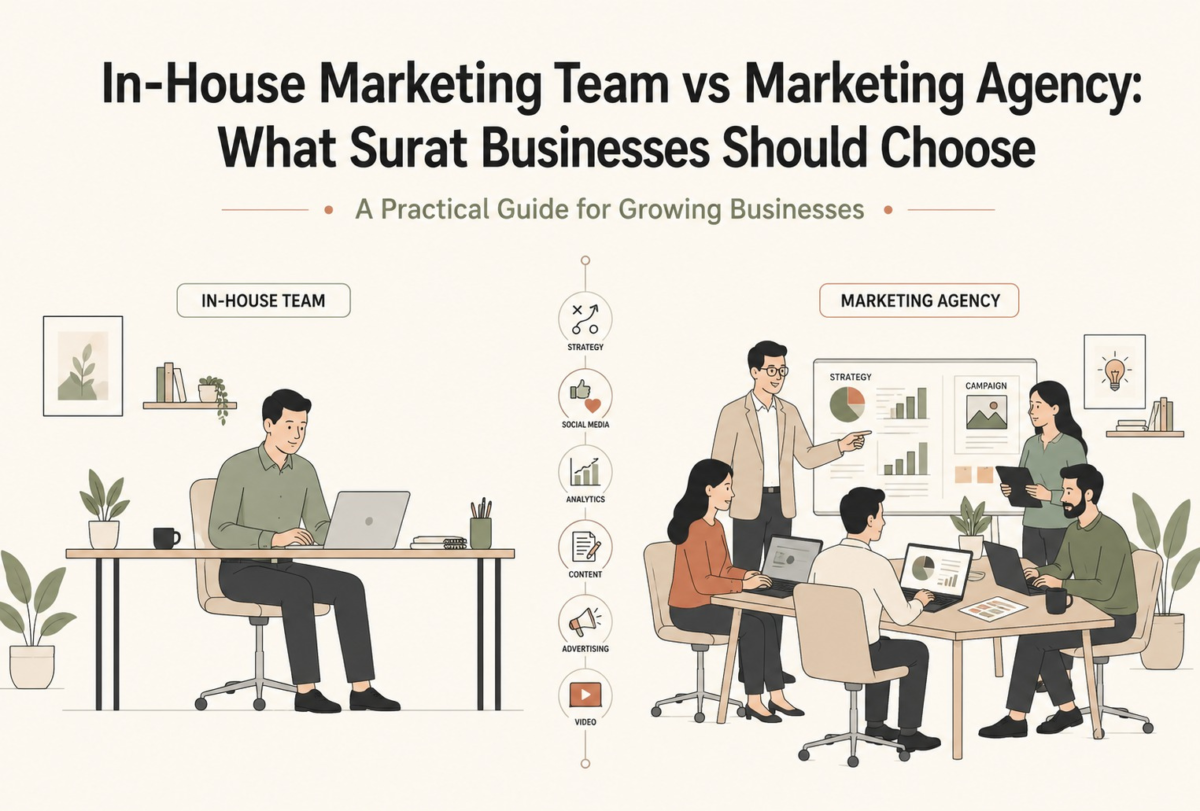
Every growing business in Surat eventually hits the same crossroads. Sales are climbing, the brand is getting noticed, and marketing can no longer be a side task handled “whenever someone gets time.” Now comes the real decision: do you build an in-house marketing team, or do you partner with a marketing agency?
It’s a question we hear constantly from textile manufacturers on Ring Road, jewellery houses in Varachha, real estate developers across the city, and D2C founders scaling on Meta and Google. There’s no universally correct answer, but there is a right answer for your business based on your stage, budget, and growth ambitions.
This guide breaks down both options honestly, so you can make a decision you won’t regret six months from now.

First, understand what each option actually means.
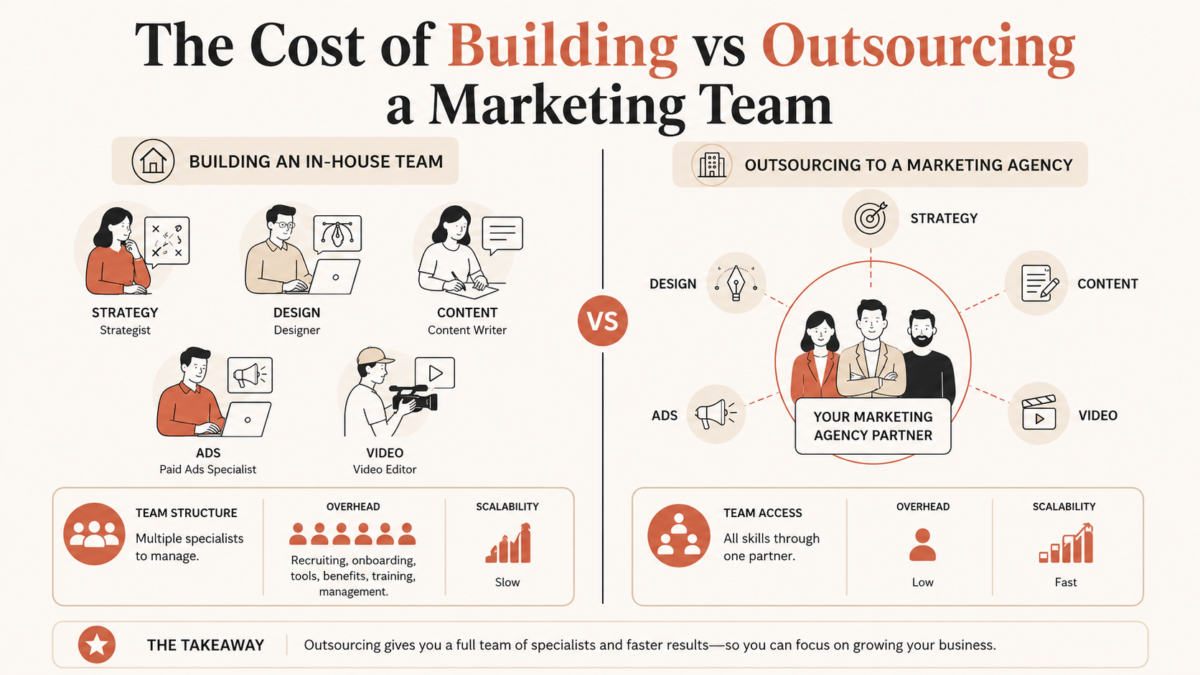
An in-house marketing team is a group of full-time employees on your payroll, working only on your brand. You hire, train, manage, and retain them. They sit in your office, absorb your culture, and live inside your business.
A marketing agency is an external partner you hire on a retainer or project basis. You get an entire team of strategists, designers, content writers, performance marketers, and video specialists without putting any of them on your payroll. A full-service agency like Social 101 functions as your outsourced marketing department.
The core trade-off is simple to state and hard to navigate: in-house gives you control and focus; an agency gives you breadth and speed. Everything else flows from that.
The Case for an In-House Marketing Team
Deep brand knowledge
Your in-house team breathes your business every day. They understand your products, customers, seasonal cycles, and the quirks that make your brand yours. A jewelry brand’s in-house designer eventually knows what sells in wedding season versus a festive Diwali push without being briefed each time.
Instant availability and control
Need a last-minute campaign change? Your team is right there. No waiting for a reply, no scope discussion, no “that’s outside the retainer.” For businesses that need rapid, constant iteration, this immediacy is valuable.
Long-term cultural alignment
Employees who stay for years build institutional memory: what worked, what flopped, and why. That knowledge doesn’t easily transfer.
Where in-house struggles
The honest difficulty is cost and capability gaps. A single competent marketing manager in Surat costs ₹5–12 lakh per year. To cover strategy, design, content, performance ads, and video, you’d need four to six specialists easily ₹30–60 lakh annually before tools, training, and attrition. Even then, one person rarely masters everything: your brilliant content writer probably can’t run a profitable Meta ad account, and your performance marketer likely can’t art-direct a shoot. Hiring is slow, good talent in tier-2 cities gets poached, and when someone leaves, momentum dies with them.
The Case for a Marketing Agency
A full team for the price of one or two hires
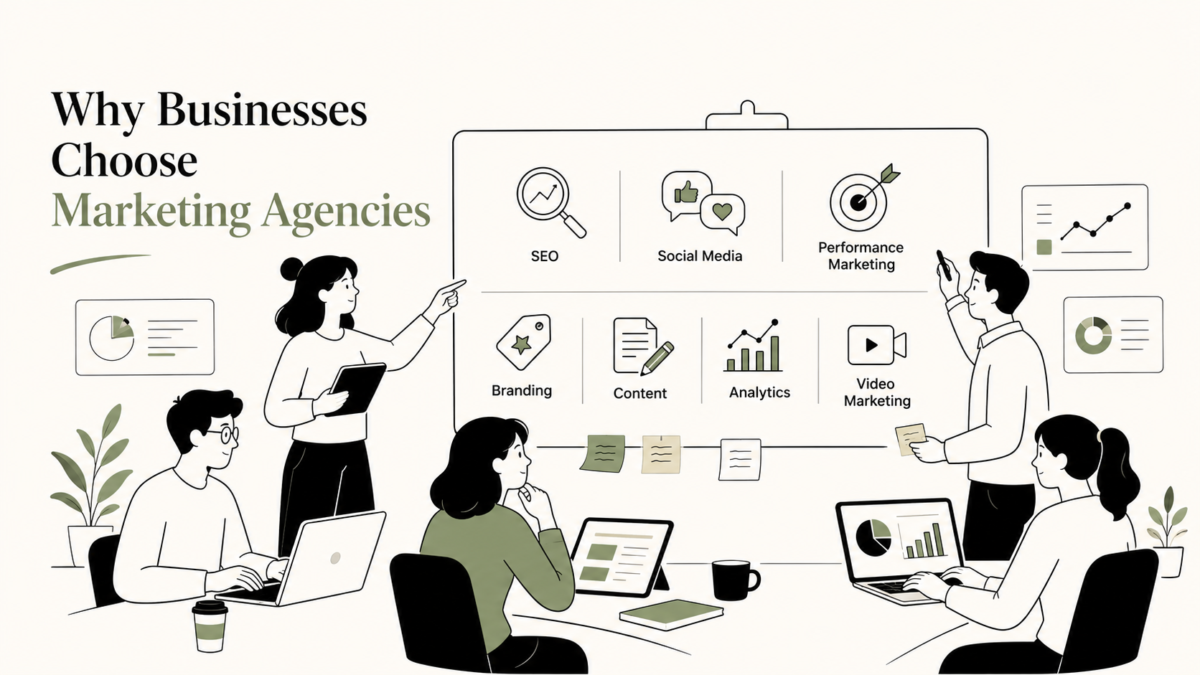
This is the headline advantage. You get strategists, designers, copywriters, performance marketers, and video editors working on your brand for less than the cost of two senior in-house salaries. You’re buying a department, not a person.
Specialized expertise across disciplines
A good agency has already solved problems like yours dozens of times across industries. When you work with a team that has handled performance marketing, branding, and content for hundreds of brands, you’re not paying them to learn on your budget you’re paying for pattern recognition they already have. (Our take on where to spend is here: Performance Marketing vs Branding: Where Should Your Ad Budget Go?
Speed and scalability
Agencies are built to move. Need to scale up for a launch and scale down after? An agency flexes with you: no hiring sprints, no layoffs, and no awkward bench time.
Outside perspective
An external partner sees what you can’t because you’re too close to it. That fresh, market-informed view catches positioning mistakes and missed opportunities that internal teams normalize over time.
Where agencies struggle
The honest difficulty: an agency works with multiple clients, so you don’t get 100% of anyone’s attention. There’s a ramp-up period while they learn your brand, and communication needs structure: clear briefs, regular reviews, and a single point of contact on your side. Quality also varies wildly between agencies, which is why choosing the right one matters more than the in-house-versus-agency decision itself. (Here’s how to evaluate one: Best Marketing Agencies in Surat.)
The Honest Side-by-Side
| Factor | In-House Team | Marketing Agency |
| Cost | High (₹30–60L+/year for a full team) | Lower (full team on a retainer) |
| Range of skills | Limited to who you hire | Broad — strategy to execution |
| Speed to launch | Slow (hiring + training) | Fast (team ready now) |
| Brand knowledge | Very deep | Builds over time |
| Availability | Always on-site | Scheduled, structured |
| Scalability | Rigid | Highly flexible |
| Fresh perspective | Low (too close) | High (external view) |
| Best for | Large brands, daily content needs | Most growing SMEs and D2C brands |
So What Should a Surat Business Actually Choose?
Choose in-house if you’re a large, established business with high daily marketing volume, the budget to hire genuinely senior talent across functions, and marketing so central it must stay fully under your roof. Think large retail chains or established manufacturing groups with constant, predictable output.
Choose an agency if you’re a growing SME, a D2C brand, a real estate developer, or a jewelry or textile business that needs professional, multidisciplinary marketing without building a department from scratch. This describes the majority of Surat businesses and it’s exactly why agency partnerships make sense at this stage.
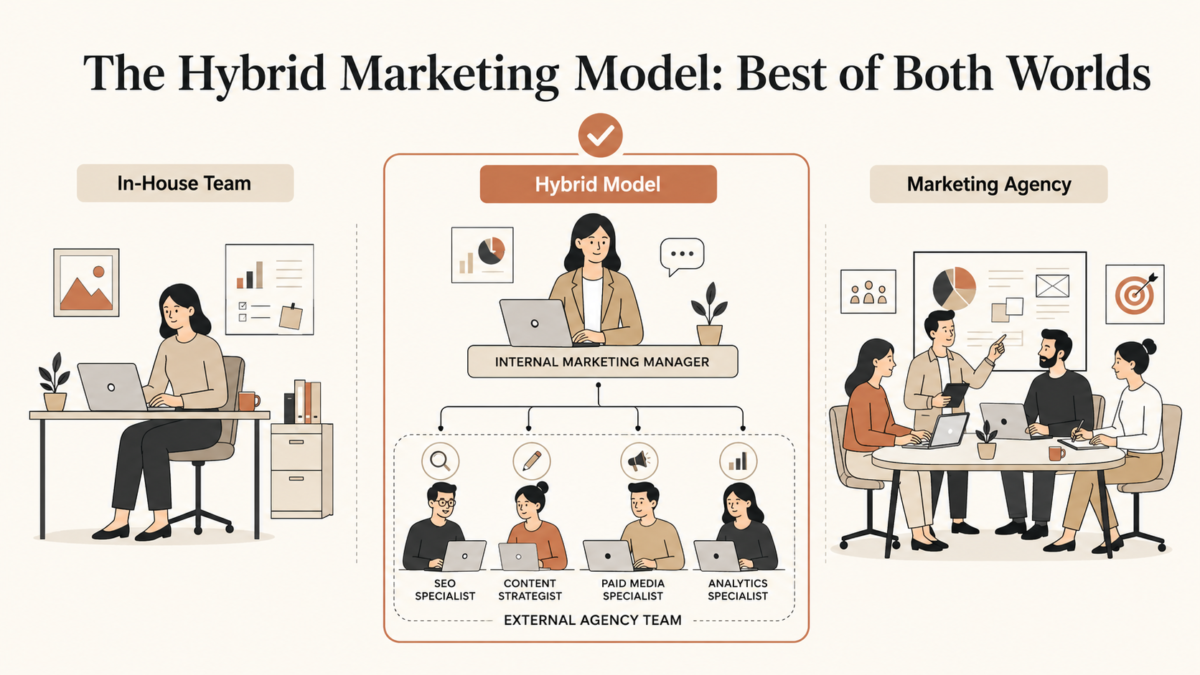
Or do both in the hybrid model. Many of the smartest companies keep one in-house coordinator managing day-to-day communication, brand consistency, and approvals, while an agency handles the heavy lifting: strategy, design, performance ads, and video. You get internal ownership plus external firepower. For most ambitious mid-sized Surat businesses, this is the sweet spot.
The Bottom Line
The in-house versus agency debate isn’t about which is better it’s about which fits where you are right now. A two-person startup and a 500-crore manufacturer should not make the same choice.
For the vast majority of growing businesses in Surat, the math favors an agency or a hybrid model: a complete, expert marketing team, faster results, and lower risk than building everything internally. As you scale, you can always bring more capability in-house.
If you’re weighing this decision and want a straight, no-pressure conversation about what fits your business, talk to our team at Social 101. We’ve helped 300+ brands across jewellery, real estate, textiles, BFSI, and FMCG make exactly this call and we’ll tell you honestly if an agency isn’t what you need.