


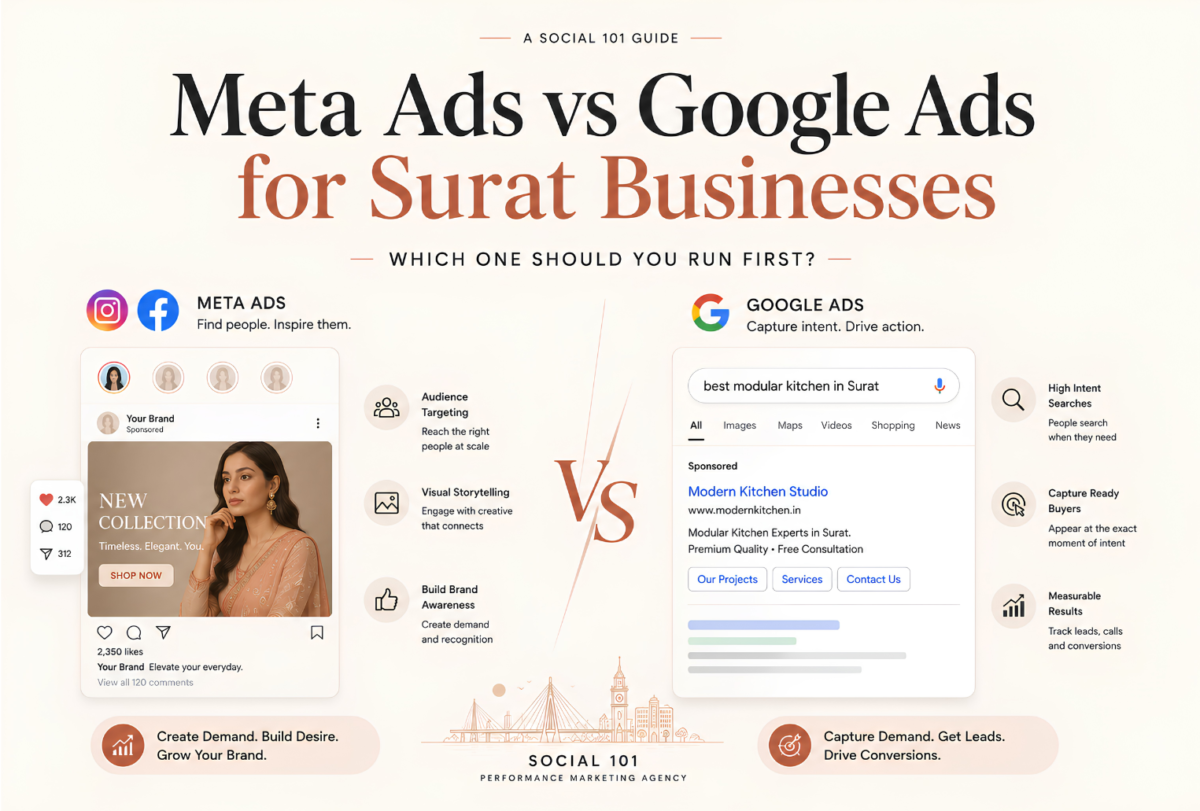
If you run a business in Surat and you have a fixed monthly ad budget, the first real decision isn’t “how much should I spend.” It’s “Where should this money go first Meta or Google?” Get this wrong and you burn three months learning a lesson a single conversation could have taught you. Get it right, and your first rupee starts compounding.
This guide answers that question for Surat businesses specifically and then goes one level deeper into the platform most local D2C founders actually care about: how to run profitable Instagram ads for an Indian D2C brand without lighting your budget on fire.
The core difference nobody explains simply
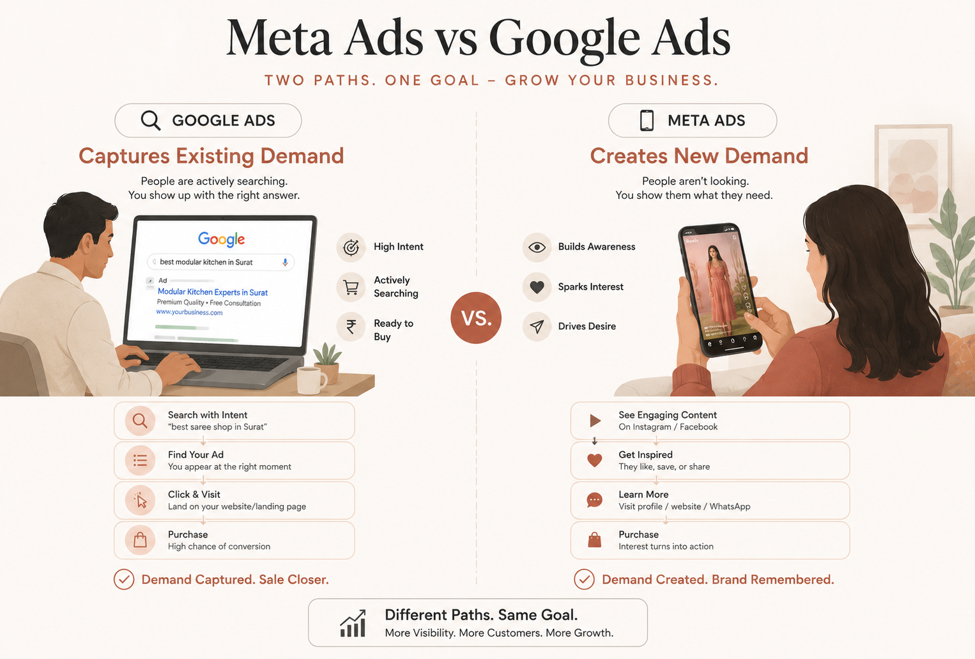
Google Ads captures existing demand. Someone in Surat is already typing “best modular kitchen in Surat” or “lab grown diamond ring price” into Google. They want it now. You’re paying to be the answer at the exact moment of intent.
Meta Ads (Facebook and Instagram) creates demand. Nobody opens Instagram looking to buy your saree or your furniture. You interrupt them with something good enough to make them want it. You’re paying for attention and persuasion, not intent.
That single distinction decides almost everything for a Surat business.

Which one should a Surat business run first?
Run Google Ads first if:
- You sell something people actively search for with buying intent real estate, interiors, dentists, lawyers, B2B textile suppliers, machinery, packers and movers, and coaching classes.
- Your average order value is high enough to justify a higher cost-per-click.
- You can answer “what would someone type into Google to find me?” in one clear sentence.
Run Meta Ads first if:
- You’re a D2C or lifestyle brand in fashion, jewelry, sarees, home decor, food, or beauty, where the product needs to be shown to be wanted.
- Your product is visual and impulse-friendly.
- Your audience scrolls Instagram far more than they search Google for your category.
- You’re building a brand, not just chasing one transaction.
For most consumer-facing Surat brands, especially the textile, saree, jewelry, fashion, and D2C businesses, this city is full of Meta. Meta is the better first platform because the demand for these products is created emotionally, not searched for. For service businesses and high-ticket B2B, Google usually wins the first round.
A useful rule: if your customer would search for you, start with Google. If your customer needs to be shown you, start with Meta.
Why this matters more in Surat than in metros
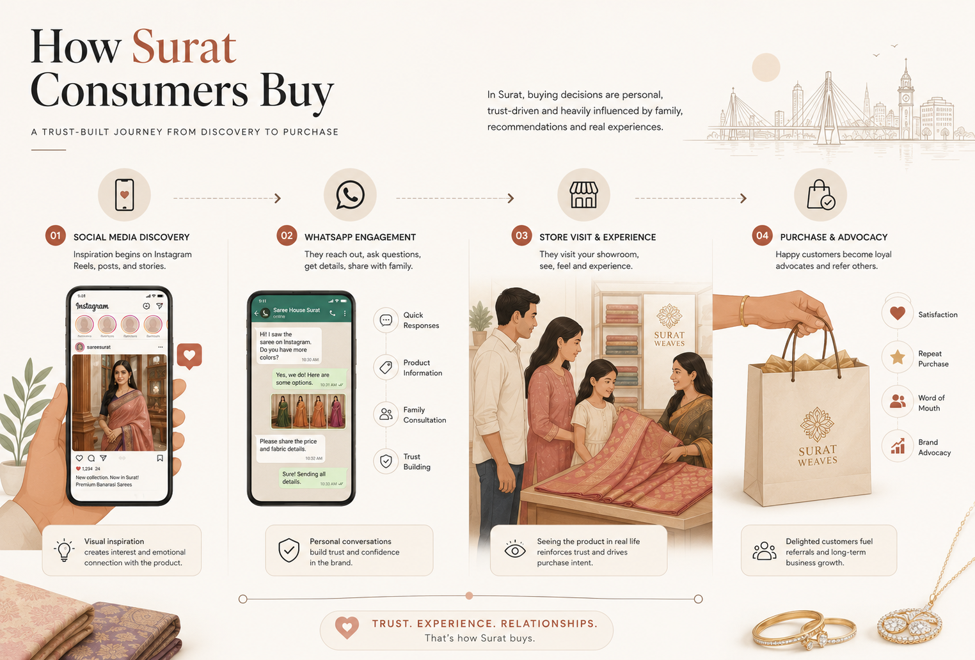
Surat’s consumer market behaves differently. Buying decisions are heavily word-of-mouth, family-influenced, and trust-driven. Instagram has become the local shop window for everything from sarees to diamonds to interiors. A well-run Meta campaign here doesn’t just sell it builds the social proof that closes the sale offline, in your showroom or over WhatsApp.
That’s also why a thin “boosted post” strategy fails. Boosting is not advertising. Which brings us to the second half of this guide.

How to Run Profitable Instagram Ads for a D2C Brand in India
Most Indian D2C founders don’t have a traffic problem. They have a profit problem. They get likes, reach, and even sales but the math doesn’t close. Here’s how to actually run Instagram ads that make money.
1. Stop boosting. Start structuring.
The “Boost Post” button is the single biggest waste of D2C ad spend in India. It optimizes for engagement, not purchases. Use Meta Ads Manager and build proper campaigns with a sales objective. This one switch alone changes your results.
2. Know your real numbers before you spend a rupee
Profitable Instagram advertising is a math problem before it’s a creative problem. You need three numbers:
- AOV your average order value.
- Contribution margin: what’s left after product cost, shipping, COD/RTO losses, and packaging.
- Break-even ROAS roughly 1 ÷ your margin percentage. If you keep 40% margin, you need ~2.5x ROAS just to break even.
If you don’t know your break-even ROAS, you can’t tell a winning campaign from a losing one. This is where most Indian D2C brands quietly bleed money.
3. RTO is your hidden killer
In India, COD and Return-To-Origin can destroy a “profitable” campaign on paper. A 30% RTO rate silently erases your margin. Push prepaid with small discounts, add address confirmation flows on WhatsApp, and factor RTO into your break-even ROAS from day one.
4. Creative is 80% of the result
On Instagram, your targeting matters less than it used to Meta’s algorithm finds buyers if your creative earns attention. Prioritise:
- UGC-style video that looks native, not like an ad.
- The first 3 seconds doing all the heavy lifting: hook hard or lose them.
- One clear message per creative, not five.
- Volume test 5–10 creatives, not one “perfect” one. Winners are discovered, not designed.
For Indian audiences, founder-led and customer-testimonial creatives consistently outperform polished studio shoots. If you sell sarees or textiles, our guide on social media marketing for textile and saree businesses in Surat breaks down creative angles that convert for this category.
5. A simple campaign structure that works
Keep it boringly simple to start:
- One Advantage+ Shopping campaign (or a broad-targeting Sales campaign) and let Meta optimize.
- A small testing campaign running new creatives weekly.
- A retargeting campaign for people who viewed your product or added it to the cart but didn’t buy this is usually your most profitable rupee.
Resist the urge to build 20 ad sets. Fragmenting your budget starves the algorithm of data.
6. Give it data and give it time
Meta needs roughly 50 conversions per ad set per week to optimize well. If your budget is too small and spread too thin, the algorithm never learns. Consolidate budget, be patient through the 7–14 day learning phase, and don’t kill campaigns after two days of bad numbers.
7. Read the right metric
Likes, reach, and CPM are vanity. The only metrics that decide profit are ROAS, cost per purchase, and contribution margin after RTO. Judge every campaign against your break-even ROAS, nothing else. For more on where each rupee should go, read Performance Marketing vs Branding: Where Should Your Ad Budget Go?.