


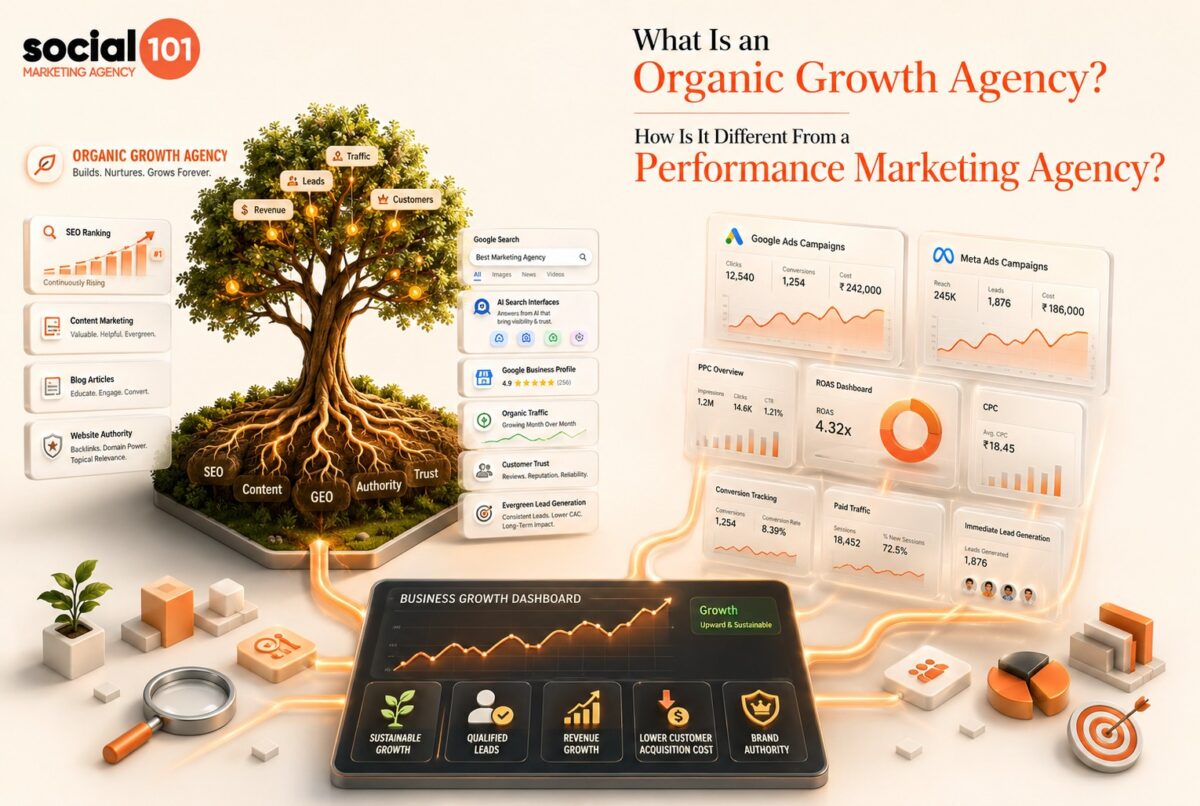
Every business owner eventually reaches the same crossroads: should you pay for every click, or build a brand that attracts customers on its own? The answer usually comes down to understanding two very different types of partners an organic growth agency and a performance marketing agency. Both promise growth. But they grow your business in completely different ways, on completely different timelines, and with completely different economics.
In this guide, we break down what an organic growth agency actually does, how it compares to a performance marketing agency, and how to decide which model fits your business whether you are searching for an organic growth agency in Surat or evaluating an organic growth agency in India for a national brand.

What Is an Organic Growth Agency?
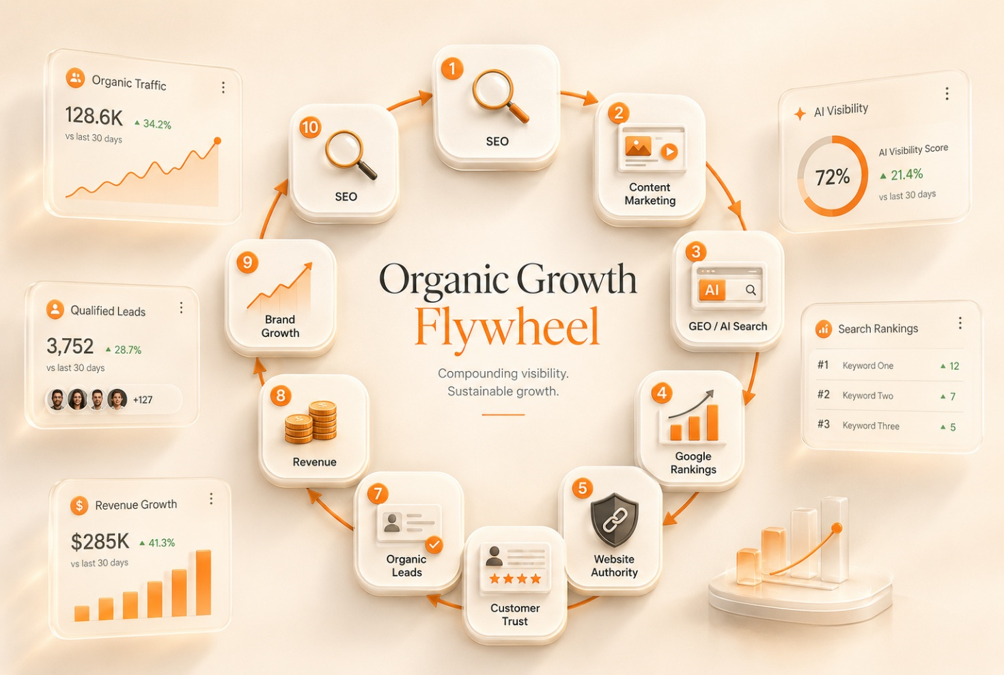
An organic growth agency helps your business attract customers without paying for every individual click, lead, or impression. Instead of renting attention through ads, it builds owned assets: search rankings, content libraries, social communities, email lists, and brand authority that compound in value over time.
The core services of an organic growth agency typically include:
- Search Engine Optimization (SEO): ranking your website on Google for the keywords your buyers actually search.
- Content marketing: blogs, guides, videos, and resources that answer buyer questions and build topical authority.
- AI search / GEO (Generative Engine Optimization): getting your brand recommended by ChatGPT, Gemini, and AI Overviews, the fastest-growing discovery channel in 2026.
- Organic social media: reels, carousels, and community building that grow reach without ad spend.
- Brand and reputation building: reviews, PR mentions, and thought leadership that make people trust you before they contact you.
- Email and retention marketing: converting one-time visitors into repeat customers using channels you own.
The defining trait: when you pause the work, the results do not disappear overnight. A blog ranking #1 on Google keeps generating leads. That is why organic growth is often called a compounding asset, not an expense.
What Is a Performance Marketing Agency?
A performance marketing agency drives measurable results through paid channels like Meta Ads, Google Ads, YouTube, and marketplace advertising, where you pay for a defined action: a click, a lead, or a purchase. We have covered this in depth in What Does a Performance Marketing Agency Actually Do? and How Much Does a Performance Marketing Agency Cost in India?.
Performance marketing is like a tap: turn on the budget, and leads flow; turn it off and they stop. It is fast, precisely measurable, and scalable, but every result carries a media cost, and rising CPMs mean that cost typically increases over time. If you want to see what realistic paid outcomes look like, read What Results Should You Expect From a Performance Marketing Agency in 90 Days?.
Organic Growth Agency vs Performance Marketing Agency: Key Differences
| Factor | Organic Growth Agency | Performance Marketing Agency |
| Primary goal | Build long-term visibility, trust, and inbound demand | Generate immediate, measurable leads and sales |
| Channels | SEO, content, GEO/AI search, organic social, email, PR | Meta Ads, Google Ads, YouTube Ads, marketplace ads |
| Speed of results | 3–6 months to gain momentum; compounds after that | Days to weeks; results visible almost immediately |
| Cost structure | Retainer only no media spend required | Retainer or % of ad spend, plus the ad budget itself |
| What happens if you stop | Rankings, content, and community keep working for months or years | Leads stop the moment ads are paused |
| Cost per lead over time | Decreases as authority compounds | It usually increases as auctions get more competitive |
| Trust factor | High buyers trust organic rankings and recommendations | Moderate audiences know ads are paid placements |
| Measurement | Traffic, rankings, share of voice, AI citations, inbound leads | ROAS, CPL, CPA, conversion rate |
| Best for | Building a brand and lowering acquisition cost long term | Launches, offers, and predictable short-term pipeline |
A Simple Analogy: Renting vs Owning
Performance marketing is renting a shop in a busy mall; footfall is guaranteed as long as you pay rent. Organic growth is buying land in an area that is developing; it takes time to build, but the asset appreciates, and eventually the footfall comes to you for free. Mature businesses in India rarely choose one or the other; they use paid to survive today and organic to own tomorrow. We explored this budget question in Performance Marketing vs Branding: Where Should Your Ad Budget Go?.
Why Organic Growth Matters More Than Ever in 2026
- AI search is rewriting discovery. Buyers increasingly ask ChatGPT and Google AI Overviews for recommendations instead of scrolling ten blue links. Brands with strong organic content get cited; brands that only run ads are invisible in AI answers. Our GEO Guide for 2026 explains how this works.
- Ad costs keep rising. CPMs on Meta and CPCs on Google have climbed year after year across Indian markets, squeezing margins for businesses that depend entirely on paid acquisition.
- Trust is the new currency. Organic rankings, reviews, and helpful content signal credibility in a way an ad placement never can especially in high-consideration categories like real estate, jewellery, healthcare, and B2B manufacturing.
- Owned audiences reduce platform risk. An email list, a ranking website, and a loyal community cannot be taken away by an algorithm change or an ad account suspension.

Which One Does Your Business Need?
Choose a performance marketing agency first if:
- You are launching a new product and need sales this month.
- You have a clear offer, healthy margins, and a working sales funnel.
- You need predictable, controllable lead volume for a sales team.
Choose an organic growth agency first if:
- Your customer acquisition cost from ads is eating your margins.
- You sell high-consideration products where buyers research before purchasing.
- You want to build a brand asset that keeps producing leads without daily ad spend.
- You want to appear in Google search, Google Maps, and AI recommendations when buyers look for your category.
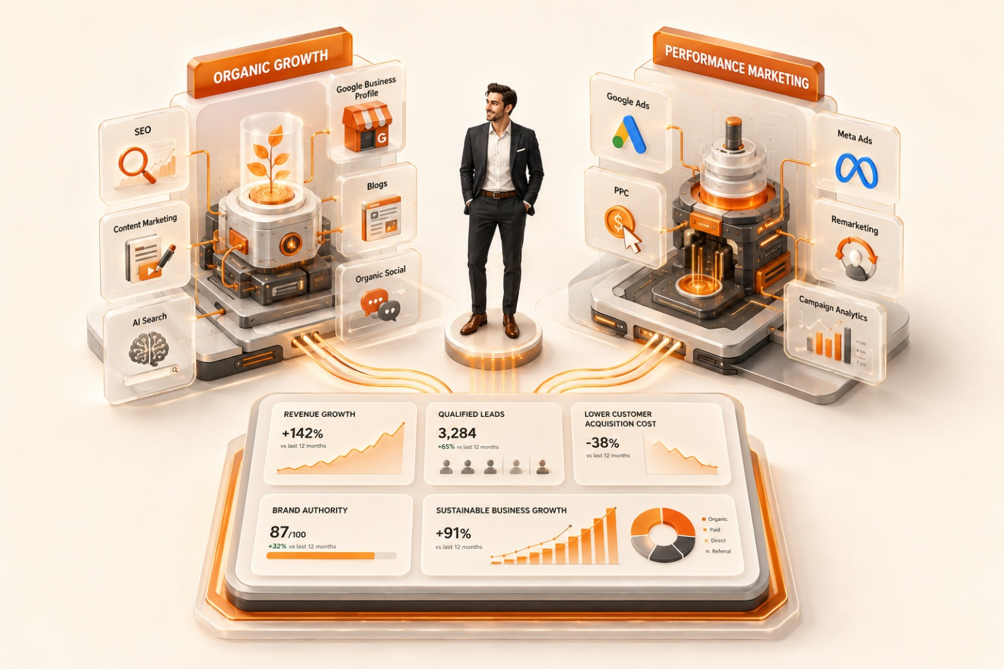
The honest answer for most businesses: both
The strongest growth engines in India combine the two. Paid campaigns deliver an immediate pipeline while organic assets are being built; then, as SEO, content, and AI visibility compound, dependence on ad spend gradually reduces and blended acquisition cost falls. This integrated approach is exactly how a full-service agency should structure a growth plan something we detailed in Best Digital Marketing Strategies for Surat Businesses in 2026.
How to Choose the Right Organic Growth Agency in India
Whether you are evaluating a local partner or a national one, use this checklist:
- Proof of rankings, not promises. Ask to see keywords they have ranked and the traffic growth behind them for their clients and for their own website.
- Content quality you would actually read. Thin, AI-spun articles no longer rank; depth, expertise, and original insight do.
- GEO / AI search capability. In 2026, an organic agency that cannot get you cited in AI answers is already behind.
- Industry understanding. Real estate, jewelry, textiles, BFSI, and manufacturing each need different content strategies; a generalist template will not work.
- Transparent reporting. Monthly reports on rankings, traffic, leads, and AI visibility are not vanity metrics.
- Realistic timelines. Any agency guaranteeing page-one rankings in 30 days is a red flag. Genuine organic growth shows momentum in 3–6 months and compounds after.
Looking for an organic growth agency in Surat?
Social 101 is a full-service organic growth agency in Surat with 6+ years of experience and 300+ brands served across real estate, jewelry, textiles, BFSI, FMCG, and manufacturing. We combine SEO, content marketing, GEO/AI search optimization, and organic social with performance marketing under one roof so your paid campaigns deliver today while your organic assets compound for tomorrow.
Explore our services, browse our work, or contact us for a free growth audit of your organic presence, including how visible your brand currently is on Google and in AI search results.
Frequently Asked Questions
What does an organic growth agency do?
An organic growth agency grows your business through non-paid channels SEO, content marketing, AI search optimisation, organic social media, email, and brand building creating assets that generate leads continuously without per-click ad costs.
Is organic growth better than performance marketing?
Neither is universally better. Performance marketing delivers speed and control; organic growth delivers compounding, lower-cost acquisition over time. Most successful businesses in India run both, shifting budget toward organic as it matures.
How long does organic growth take to show results?
Typically 3–6 months for early momentum (rankings, traffic, engagement) and 6–12 months for meaningful lead flow. Unlike ads, results compound and persist even during pauses.
How much does an organic growth agency in India cost?
Retainers in India generally range from ₹30,000 to ₹2,00,000+ per month depending on scope SEO-only engagements sit at the lower end, while full organic growth programs covering content, GEO, and social sit higher. There is no media budget on top, unlike paid campaigns.
Can one agency handle both organic and performance marketing?
Yes, and it is usually more effective because insights flow both ways: ad data reveals which messages convert (informing content), while organic content improves ad quality scores and landing-page conversion. Social 101 operates both practices under one strategy.
Final Word
A performance marketing agency buys you growth; an organic growth agency builds you growth. The first keeps your pipeline alive this quarter. The second lowers your cost of acquisition every quarter after. If your business is still 100% dependent on ad spend for leads, the smartest investment you can make in 2026 is to start building the organic engine before your competitors’ content, rankings, and AI citations make the gap too expensive to close.