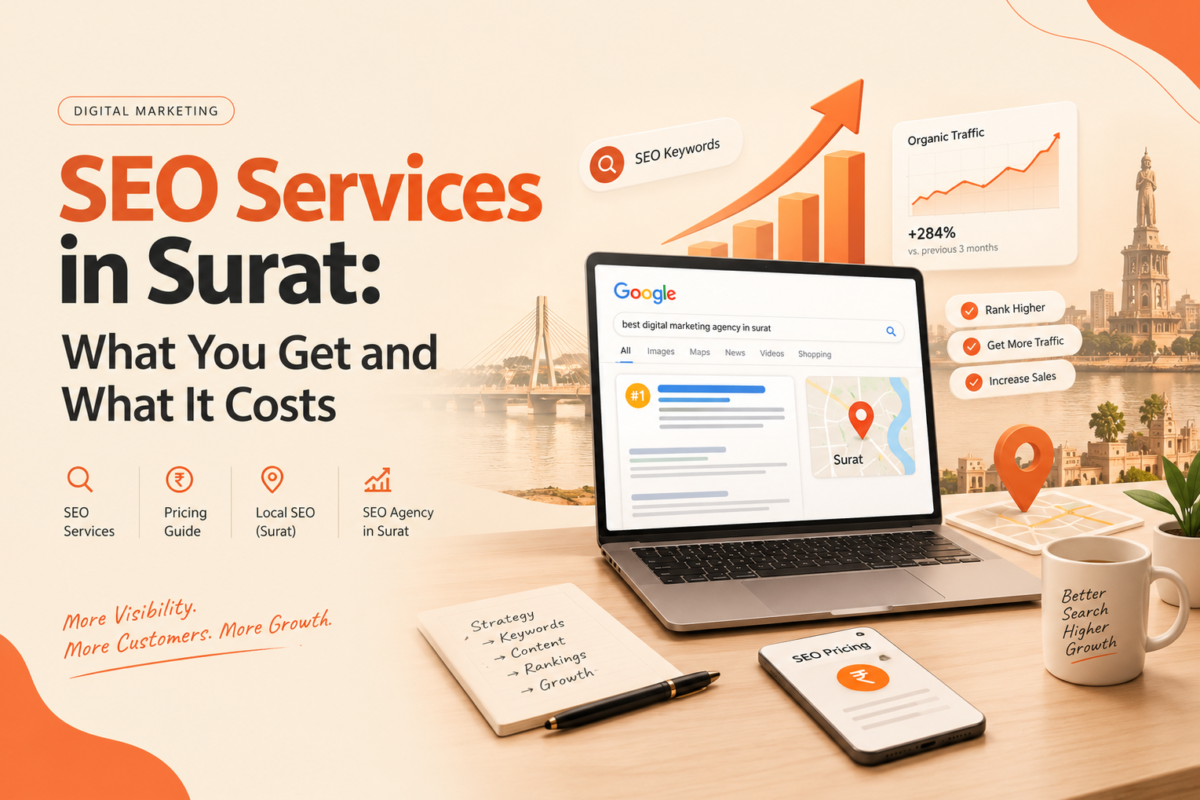
When someone in Surat searches for “saree manufacturers,” “diamond jewelry,” or “best dentist near me,” they usually click one of the first few results on Google. If your business isn’t there, your competitor gets that customer.
That’s what SEO services in Surat are for: helping your business show up when local and national customers are searching. But SEO is also one of the most confusing services to buy. Packages look similar, prices range from a few thousand rupees to lakhs, and results take time.
This guide explains in plain language what SEO services include, what they typically cost in India in 2026, how long results take, and how to avoid paying for work that doesn’t help.
What Are SEO Services?
SEO (search engine optimization) is the work of improving your website and online presence so it ranks higher on Google and attracts visitors who are already looking for what you sell. Unlike ads, you don’t pay per click. The traffic you earn keeps coming as long as your rankings hold, which is why SEO is a long-term asset.
What Do You Get With SEO Services?
A proper SEO package covers several areas of work. Here’s what to expect:
- SEO audit: a full check of your website’s technical health, content gaps, and competitors. This is where every campaign should start.
- Keyword research: finding the exact phrases your customers search for, including local ones like “in Surat” or “near me.”
- On-page SEO: optimizing titles, meta descriptions, headings, URLs, images, and page content for your target keywords.
- Technical SEO: fixing site speed, mobile usability, broken links, indexing problems, sitemaps, and structured data (schema).
- Content creation: blogs, service pages, and location pages that answer customer questions and support your rankings.
- Local SEO: optimizing your Google Business Profile, local listings, reviews, and Google Maps visibility.
- Link building: earning quality backlinks from relevant, trustworthy websites through genuine outreach and not spammy shortcuts.
- Reporting and strategy: regular reports on rankings, traffic, leads, and next steps so you can see what the work is achieving.
Types of SEO Services in Surat
Different businesses need different kinds of SEO:
- Local SEO: for shops, clinics, restaurants, schools, and service businesses that serve customers in and around Surat.
- E-commerce SEO: for online stores, covering product pages, category pages, site structure, and product schema.
- National SEO: for brands that want to rank across India, such as D2C fashion, jewelry, and education brands.
- B2B SEO: for manufacturers, exporters, and consultants who need to rank for high-value, lower-volume searches.
- One-time SEO audit or fix: a project-based service when you want to solve specific problems without a monthly contract.
How Much Do SEO Services Cost in Surat?
SEO pricing in India varies widely. Based on 2026 market guides, entry-level local SEO packages in India start at roughly ₹8,000-₹25,000 per month, local growth packages commonly run ₹25,000-₹60,000, e-commerce SEO often runs ₹50,000-₹1,50,000 or more, and enterprise programs go higher. Surat prices generally sit within these national ranges.
| Package type | Typical monthly range (India, 2026) | Usually suited for |
| Entry-level local SEO | ₹8,000 – ₹25,000 | Single-location shops and service businesses in low-competition niches |
| Local growth SEO | ₹25,000 – ₹60,000 | Clinics, restaurants, schools, and local brands wanting steady inbound leads |
| E-commerce / D2C SEO | ₹50,000 – ₹1,50,000+ | Online stores with many products and strong competition |
| B2B / enterprise SEO | ₹75,000 – ₹2,00,000+ | Manufacturers, exporters, and large brands targeting national or global searches |
These are indicative market ranges, not fixed prices. Your actual quote depends on your goals, competition, and scope of work.
Common SEO Pricing Models
- Monthly retainer: the most common model. You pay a fixed fee each month for ongoing work. Best for long-term growth.
- Project-based: a fixed price for a defined job, such as an SEO audit, a website migration, or a full on-page overhaul.
- Hourly: you pay for consulting or specialist time. Useful for advice or small fixes.
- Performance-based: you pay based on results. Be careful here. Since nobody controls Google, these deals can encourage shortcuts that put your site at risk.
What Affects the Cost of SEO?
- Competition: ranking for “digital marketing agency” is harder than ranking for a niche local service.
- Your website’s current condition: a site with technical problems or thin content needs more work upfront.
- Scope: the number of pages, keywords, locations, and content pieces involved.
- Content volume and quality: more and better content costs more but drives more results.
- Link building needs: competitive niches need more quality backlinks.
- Agency experience and team size: specialists and senior strategists cost more than freelancers or junior teams.
A better question than “what’s the cheapest option?” is “what return should I expect over 12 months?” A cheap package that delivers nothing is more expensive than a fair one that brings in leads.
How Long Do SEO Results Take?
SEO is not instant. Most businesses should expect:
- Months 1-2: audit, fixes, and strategy. Rankings may barely move.
- Months 3-4: early improvements in rankings and traffic for lower-competition keywords.
- Months 5-8: steady growth in organic traffic and inquiries.
- Months 9-12 and beyond: compounding results, as content and authority build up.
Local SEO can move faster than national SEO. These timelines are typical but not guaranteed, because they depend on your competition and how consistently the work is done.
SEO for Surat Businesses: Example Opportunities
Surat’s economy creates specific SEO opportunities:
- Textile and saree businesses: product and wholesale searches that reach buyers across India.
- Diamond and jewelry brands: a mix of local showroom searches and national online buying searches.
- Clinics, dentists and skin specialists: “near me” and area-based searches like “Adajan” or “Vesu” where Google Maps rankings matter most.
- Restaurants and cafes: local discovery searches, reviews, and photos.
- Coaching classes and colleges: searches by course, area, and exam.
8 Red Flags When Hiring an SEO Company
- Guaranteed #1 ranking. No one can promise this.
- Extremely low prices with promises of big results.
- No audit or strategy before work starts.
- Bulk or paid backlinks from spammy sites. This can lead to Google penalties.
- Vague reports that show activity but not rankings, traffic, or leads.
- No access to your own accounts. You should own your website, Google Business Profile, Search Console, and Analytics.
- Secret methods. A good agency explains what it’s doing and why.
- Long lock-in contracts without proof of results first.
Questions to Ask an SEO Agency Before You Hire
- What exactly is included in the monthly fee?
- What results have you achieved for businesses like mine?
- Which keywords will you target, and why?
- How do you build links, and can I see examples?
- What will your reports show, and how often will I get them?
- Who will work on my account?
- What’s the contract length, and what happens if I want to stop?
If you’re still comparing agencies, read our guide on how to choose the best digital marketing agency in Surat.
Why Businesses Choose Social 101 for SEO
Social 101 is a Surat-based digital marketing agency, founded in 2018. SEO is one of our core services, alongside social media, performance marketing, and email marketing, so your SEO works together with the rest of your marketing. We start every project with an audit and clear goals, share transparent reports, and build our strategy around your business results.
Want to know where your website stands today? Contact Social 101 for a free SEO consultation and get honest advice on what will actually move the needle for your business.
Frequently Asked Questions
1. How much do SEO services cost in Surat?
Costs depend on your goals, competition, and scope. In India in 2026, entry-level local SEO commonly starts from around ₹8,000-₹25,000 per month, while growth and e-commerce packages are significantly higher. Always get a detailed proposal showing exactly what’s included.
2. How long does SEO take to work?
Most businesses see early improvements in 3-4 months and stronger, steadier results after 6-12 months. Local SEO can be faster than national SEO.
3. Is SEO better than Google Ads?
They do different jobs. Ads bring faster results but stop when you stop paying. SEO takes longer but builds lasting traffic. Many businesses use both.
4. Can SEO guarantee first-page rankings?
No. Search results change constantly, and no agency controls Google. A good agency can improve your chances using proven methods but should never guarantee a specific position.
5. Do I need a local SEO agency in Surat?
Not necessarily, but a local agency understands the Surat market, local search habits, and industries like textiles and jewelry. What matters most is their experience, transparency, and results.
6. What’s the difference between local SEO and regular SEO?
Local SEO focuses on appearing in Google Maps and local searches like “dentist in Adajan,” using your Google Business Profile, reviews, and local pages. Regular (national) SEO targets broader searches across a wider area.
7. Can I do SEO myself?
You can handle the basics, such as setting up your Google Business Profile and writing helpful content. But technical fixes, competitive keyword strategy, and link building usually need specialist time and tools.