
Type a question into Google today and there’s a good chance you’ll never click a single link. An AI overview at the top of the page or a fully formed answer inside ChatGPT, Perplexity, or Gemini already gave you what you needed. That single shift is why “SEO” and “AEO” are no longer interchangeable terms, even though they’re often used in the same breath.
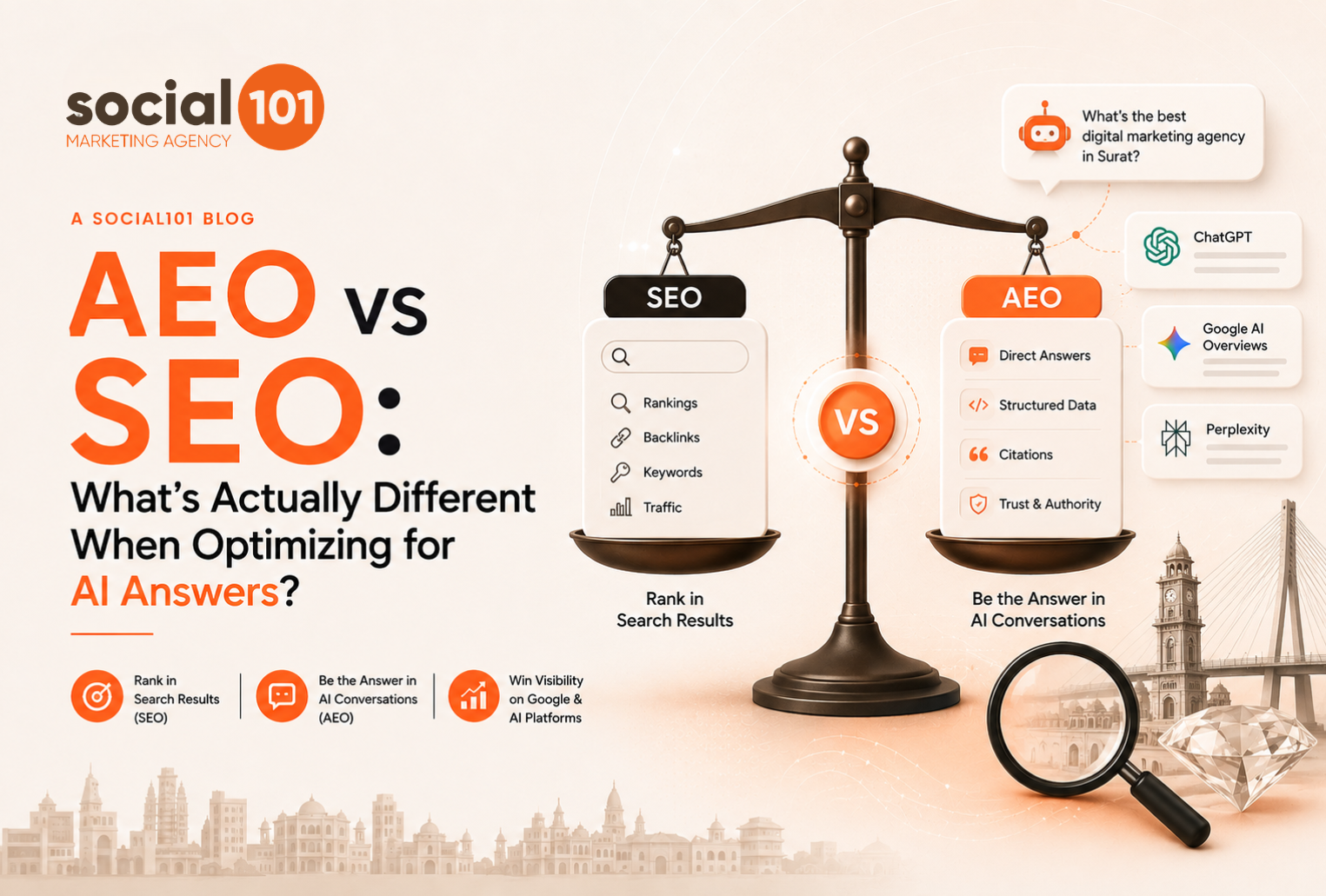
Search Engine Optimization (SEO) and Answer Engine Optimization (AEO) both aim to make your business visible when someone searches, but they compete for different prizes. SEO competes for a position in a list of links. AEO competes to be the one answer an AI system decides to give. Understanding exactly where they diverge is the difference between a marketing strategy built for 2015 and one built for 2026.
The Core Difference: Ranking vs. Being the Answer
SEO has always been a game of ranking and clicks. You optimize a page so it appears as high as possible in a results list, and you rely on the searcher to click through to your website to get their answer. Success is measured in position (are you #1, #3, or #10?) and in traffic.
AEO flips that model entirely. Instead of aiming for a ranked position, AEO aims to be selected as the single response an AI system gives inside an AI overview, a ChatGPT reply, a voice assistant’s spoken answer, or a Perplexity summary. There is no list of ten options here. There is usually just one answer, built from a handful of trusted sources, and only a few brands get named at all.
As one 2026 industry analysis puts it, SEO competes for rankings, while AEO competes to be selected as the answer, and answer selection depends far more on clarity, structure, and trust than on position alone.
Where the Signals Actually Diverge
| Factor | SEO | AEO |
| Primary goal | Rank in a list of results (positions 1–10) | Be selected as the single cited/synthesized answer |
| Success metric | Rankings, organic traffic, click-through rate | Citation frequency, AI mentions, share of voice across AI tools |
| What’s rewarded | Backlinks, keyword targeting, page authority, UX/Core Web Vitals | Fact density, structured data, direct answers, expert attribution |
| Content shape | Long-form, keyword-optimized pages built to be browsed | Concise, answer-first sections built to be extracted and quoted |
| Trust signals | Domain authority, backlink profile | Schema markup, third-party mentions, reviews, analyst/press coverage |
| User intent served | Browsing and research mode: comparing multiple options | Direct-answer mode wants one clear response, not a list |
The Surprising Part: Ranking #1 Doesn’t Guarantee an AI Citation
One of the most important and most counterintuitive findings in 2026 research is this: a page can rank #1 on Google and still get zero AI citations. Some analyses put the number of AI-cited sources that don’t even appear on Google’s first page as high as 80%.
Why? Because Google’s ranking algorithm and an AI model’s citation logic are evaluating content for different jobs. Google ranks pages based on backlinks, keywords, and overall user experience. AI assistants select sources based on structured data, directness of the answer, and clear attribution of expertise. A beautifully optimized, high-ranking page that buries its answer under three paragraphs of preamble is exactly the kind of content AI models skip over no matter how well it ranks.
This is also why roughly 85% of AI citations are estimated to come from third-party sources rather than a brand’s own website, meaning reviews, press coverage, analyst write-ups, and expert mentions elsewhere on the web often carry as much weight as your own content does.
Why This Isn’t an Either/Or Decision
It’s tempting to read all of this as “SEO is dying; AEO is the future” but that’s not what the data shows. SEO and AEO are built on the same foundation: a technically sound, authoritative, well-structured website. SEO provides the access crawlability, indexing, discoverability. AEO provides the synthesizability the structure and clarity an AI needs to lift your content into an answer.
Google’s own AI Overviews are disproportionately more likely to cite pages that already rank well organically. In other words, strong SEO doesn’t guarantee an AI citation, but it dramatically improves your odds of getting one. The two disciplines are complementary layers of the same visibility strategy, not competing budgets.
How to Actually Optimize for Both
1. Lead With the Answer, Then Support It
Structure pages so the direct answer to the likely question appears in the first sentence or two of a section not after three paragraphs of scene-setting. AI systems extract the clearest, most self-contained statement they can find.
2. Prioritize Fact Density Over Fluff
AI models increasingly reward content rich in verifiable data points, statistics, specifics, and named examples over narrative padding. Concise, information-dense writing now functions as a ranking signal in its own right.
3. Invest in Structured Data
FAQPage, HowTo, Organization, and Article schema help both Google’s classic algorithm and AI crawlers understand exactly what your page is answering and who’s behind it.
4. Don’t Neglect Third-Party Presence
Because a large share of AI citations come from sources other than your own website, reviews, press mentions, directory listings, and expert quotes elsewhere on the web meaningfully shape whether AI tools trust and cite your brand.
5. Track Both Sets of Metrics
Keep watching keyword rankings, organic traffic, and backlinks for SEO, but add AI overview appearances, brand mentions in ChatGPT/Perplexity/Gemini, and AI referral traffic to your reporting. They tell two different, equally important stories about your visibility.
The Bottom Line
SEO gets you ranked. AEO gets you the answer. Neither replaces the other in 2026; they function as one visibility strategy viewed through two different lenses. Businesses that treat SEO and AEO as a single, dual-channel effort are already outperforming those still treating one as “the old way” and the other as “the new way.” The real competitive edge in 2026 belongs to brands that show up whether the customer scrolls a results page or simply asks an AI for the answer.
Want a content strategy built to win on both Google and AI answer engines? Social101 helps businesses build search strategies that work across SEO and AEO together. Explore more insights on our blog.

