If you use ChatGPT, Gemini, or any AI tool to write blogs, product descriptions, or website pages, you’ve probably wondered, “Will Google penalize me for it?”
It’s a fair worry. Google has released several spam updates in 2026, and it updated its AI content guidance as recently as October 1. This guide explains what Google actually says, what puts your site at risk, and how to use AI for content without hurting your rankings.
The Short Answer
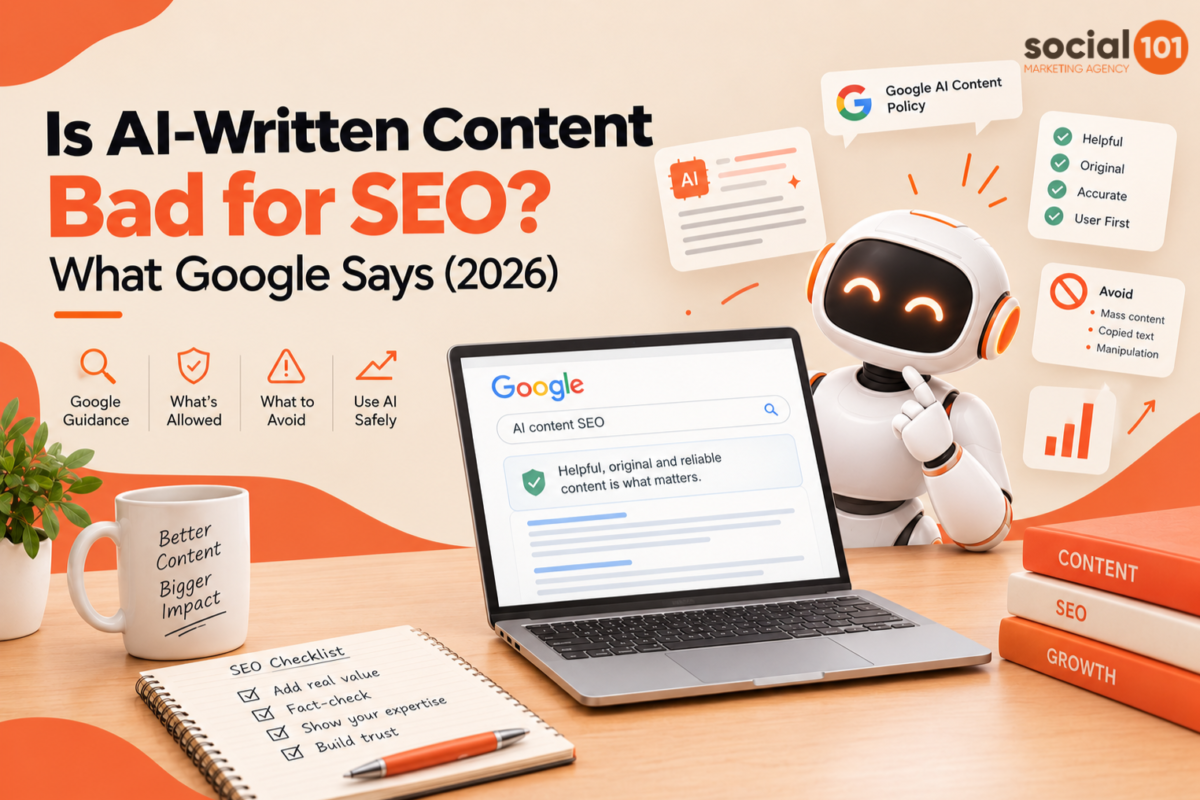
No, AI-written content is not automatically bad for SEO. Google’s published guidance says AI can be useful for researching a topic and adding structure to original content. What Google targets is using AI (or any automation) to produce large amounts of low-value content mainly to manipulate rankings.
In other words, Google doesn’t penalize AI. It penalizes content that doesn’t help people. A thin, copied, or inaccurate page is a problem whether a human or a machine wrote it.
What Google Actually Says About AI Content
Here are the main points from Google’s guidance and spam policies:
- AI isn’t banned. Google has said for years that it rewards quality content, however it is produced, and that not all use of automation, including AI, is spam.
- Quality matters more than method. Google asks you to focus on accuracy, quality, and relevance, especially when content is generated automatically.
- Scaled content abuse is the real risk. Google’s spam policy covers generating many pages without adding value for users, whether the content comes from AI, humans, or a mix of both.
- Fact-checking is critical. In its October 2026 update to its AI content guidance, Google says AI tools predict words rather than look up facts, so their output can contain errors, and that all AI-generated content should be manually fact-checked and reviewed before publishing.
- Spam rules cover AI search too. In May 2026, Google clarified that its existing spam policies also apply to attempts to manipulate AI Overviews and AI Mode.
- Telling readers can help. Google suggests that sharing how content was created can give readers helpful context, especially when they would reasonably wonder.
What Is Scaled Content Abuse?
Scaled content abuse is the spam policy most relevant to AI writing. Google introduced it in March 2024. It targets publishing lots of pages mainly to rank, rather than to help the people who land on them.
Examples that raise risk:
- Publishing hundreds of near-identical pages from one template, such as one page for every area or keyword with only the name changed
- Mass-producing blog posts with AI with no editing, fact-checking, or original input
- Rewording or combining other websites’ content without adding anything new
- Creating many websites to hide how much content is being mass-produced
Notice what’s missing from that list: a single, well-edited blog post that you drafted with AI and improved with your own expertise. That sits outside the policy.
Recent Google Changes You Should Know About
| Date | What happened? |
| March 2024 | Google introduced the scaled content abuse policy, which applies whether content is made by AI, humans, or both. |
| May 15, 2026 | Google clarified that its spam policies also apply to generative AI responses in Search, including AI Overviews and AI Mode. |
| September 24, 2026 | Google began rolling out its September 2026 spam update worldwide. Google hasn’t said it specifically targets AI content, and it covers spam in general. Check Google’s Search Status Dashboard to see whether the rollout has finished. |
| October 1, 2026 | Google updated its generative AI content guidance to stress manual fact-checking of all AI-generated content before publishing. The spam policies themselves were not changed. |
The direction is consistent: Google isn’t against AI, but it is getting stricter about low-effort, unchecked, and mass-produced pages.
When AI Content Hurts Your SEO
- It’s generic. It says what every other page says, with nothing new.
- It contains mistakes. AI can invent statistics, quotes, prices, laws, or product details.
- It’s mass-produced. Dozens of similar pages published quickly without review.
- It has no real author or experience behind it. There’s no proof that anyone with knowledge was involved.
- It doesn’t match what people want. It’s long but doesn’t answer the question or help the reader decide.
- It sounds off-brand. Visitors notice, leave quickly, and don’t trust you.
When AI Content Works Well
- A draft or outline that an expert then rewrites, fact-checks, and improves
- Research support, such as summarizing sources or suggesting questions to answer
- Repurposing your own original material, such as turning a webinar or case study into a blog
- Editing, translating, and simplifying content you’ve already written
- FAQs and meta descriptions that a human reviews and adjusts
Risky vs Safe: Quick Comparison
| Risky approach | Safer approach |
| Publishing raw AI output | Using AI for a draft, then rewriting and editing it |
| Hundreds of similar pages from one template | Fewer pages that each serve a clear purpose |
| Trusting facts and numbers from AI | Checking every claim against reliable sources |
| No author or expert input | Real author, real examples, and original insight |
| Writing for search engines only | Writing to answer the reader’s question |
A Safe Workflow for Using AI in Content
- Start with the reader’s question. Decide what the page must help them do or understand.
- Do real keyword and competitor research. Look at what already ranks and find what’s missing.
- Use AI for an outline or first draft. Treat it as a starting point.
- Add what AI can’t: your experience, client examples, local knowledge, original data, photos, and opinions.
- Fact-check everything. Verify numbers, names, dates, laws, prices, and claims, including in titles, meta descriptions, and image alt text.
- Edit for voice and clarity. Make it sound like your brand and remove filler.
- Show who’s behind it. Add a real author name with relevant credentials and a short bio.
- Update regularly. Review important pages every few months so they stay accurate.
Extra Care for Health, Finance, and E-commerce
Some content needs more caution than others:
- Health and medical content: wrong advice can harm people. Have a qualified professional review it. This matters for clinics, skin specialists, and wellness brands.
- Finance, tax, and legal content: inaccurate AI statements can mislead readers and damage trust, so review it carefully and avoid promises.
- E-commerce: Google Merchant Center has its own rules for AI-generated content. AI-generated images should carry the right metadata, and AI-generated product titles and descriptions should be labeled as such in your product data. Check the current rules before bulk-generating product content.
Should You Tell Readers a Page Was Written With AI?
Google doesn’t require a label on every AI-assisted page, but it says that explaining how content was made can help readers, especially when they’d reasonably wonder about it, for example, with AI-generated images or video. A short note, such as “drafted with AI assistance and reviewed by our team,” can build trust if you use AI heavily. Always follow the rules of the platform where you publish. Never invent fake authors, because Google’s updated guidance treats misleading author information as a problem.
Pre-Publish Checklist for AI-Assisted Content
- Does this page answer a real question better than what’s already out there?
- Have I added original experience, examples, or data?
- Has a human fact-checked every claim, number, and name?
- Does it sound like our brand?
- Is there a real author with a short bio?
- Is the title and meta description accurate and not exaggerated?
- Would I be comfortable if Google’s quality reviewers read this page?
How Social 101 Uses AI for SEO Content
At Social 101, we use AI to speed up research, outlines, and first drafts. Every piece is then planned around search intent, fact-checked, edited, and improved with real examples before it goes live. We don’t mass-produce pages. We focus on content that earns trust and leads. This is also how we approach our SEO services in Surat.
Not sure whether your current content is helping or hurting your rankings? Contact Social 101 for a free content and SEO review.
Frequently Asked Questions
1. Does Google penalize AI-generated content?
Not because it’s AI-generated. Google penalizes spam, including mass-produced, low-value content, whether it comes from AI or humans. AI content that is accurate, original, and helpful is not penalized for being AI-assisted.
2. Can Google detect AI content?
Google has said its focus is on content quality, not on how content was produced. Even if text could be detected, a helpful page isn’t a violation. The risk comes from low-quality or scaled content, which Google’s spam systems are built to catch.
3. Is AI content bad for SEO in 2026?
It can be if it’s generic, inaccurate, or mass-produced. Used as a drafting tool with human expertise, editing and fact-checking, it can perform just as well as content written by hand.
4. What is scaled content abuse?
It’s a Google spam policy that covers generating many pages mainly to manipulate rankings instead of helping users. It applies regardless of whether the content was made by AI, people, or a combination.
5. Should I fact-check AI-written content?
Yes, always. Google’s updated guidance says manual fact-checking of all AI-generated content before publishing is critical, because AI tools can state wrong information confidently.
6. How many AI-written blogs can I publish?
There’s no magic number. What matters is that each page is genuinely useful, accurate, and different from what’s already out there. Publishing a large batch of unedited pages quickly is the pattern most likely to cause problems.
7. Do I need to disclose AI use on my website?
Google doesn’t require disclosure on every page, but it says that explaining how content was created can help readers. Disclosure is especially useful for AI-generated images, audio or video, and heavily AI-written pages.