How Much Does a Performance Marketing Agency Cost in India?

Introduction

“How much will this cost me?” is the first question every business owner asks a performance marketing agency in India and the one that gets the vaguest answers. Agencies say “it depends,” businesses hear “expensive,” and deals die in the first call.

This guide gives you the real numbers. What Indian agencies actually charge in 2026, the four pricing models in use, what is included at each price band, the hidden costs nobody mentions, and how to judge whether a quote is fair or inflated.

If you are still unclear on what you would be paying for in the first place, start with our foundation guide: What Does a Performance Marketing Agency Actually Do?

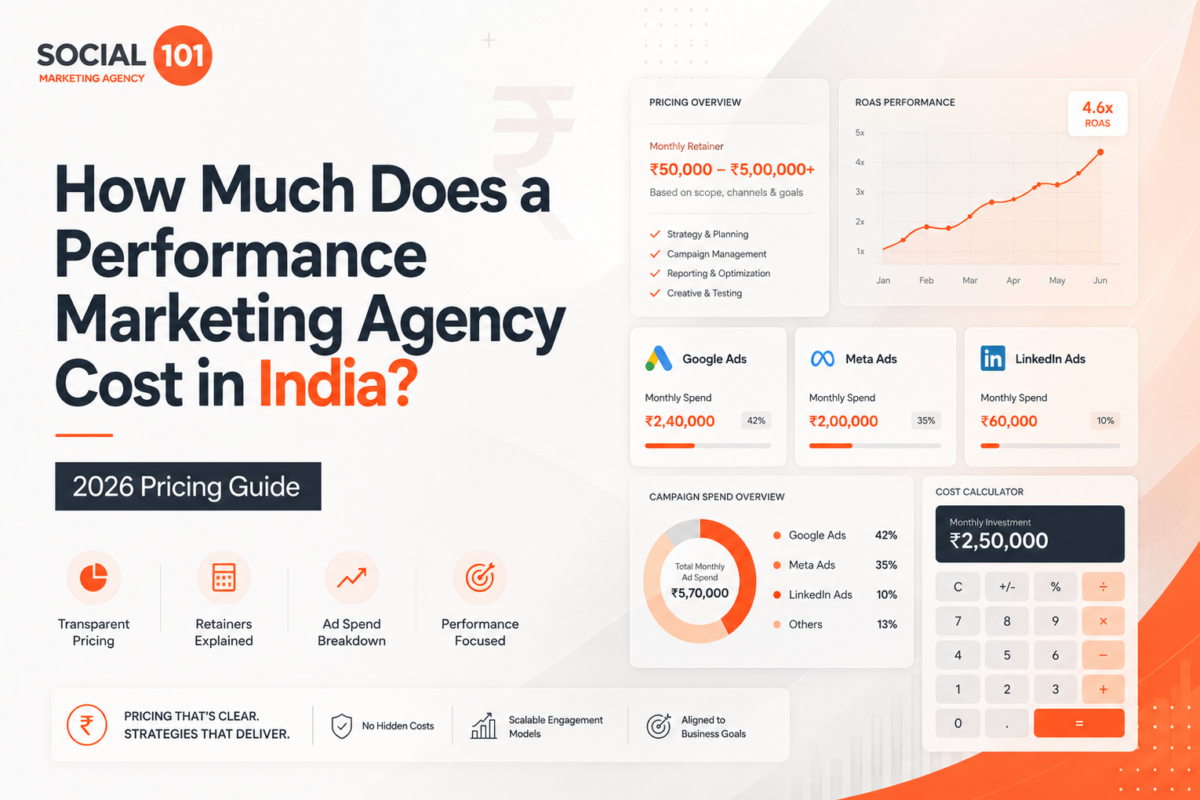
The Short Answer: What Performance Marketing Agencies Charge in India (2026)

Here is the honest range across the Indian market:

Business StageTypical Monthly RetainerTypical Monthly Ad Budget
Small / local business₹15,000 – ₹40,000₹30,000 – ₹100,000
Growing SME / D2C brand₹40,000 – ₹100,000₹100,000 – ₹500,000
Established brand / real estate project₹100,000 – ₹300,000₹500,000 – ₹2,500,000
Enterprise / multi-city₹300,000+₹2,500,000+

Two things to note. First, the retainer and the ad budget are separate ad spend goes directly to Meta, Google, or LinkedIn, never through the agency. Second, these are market ranges, not rules; what you pay should map to scope, not to a rate card.

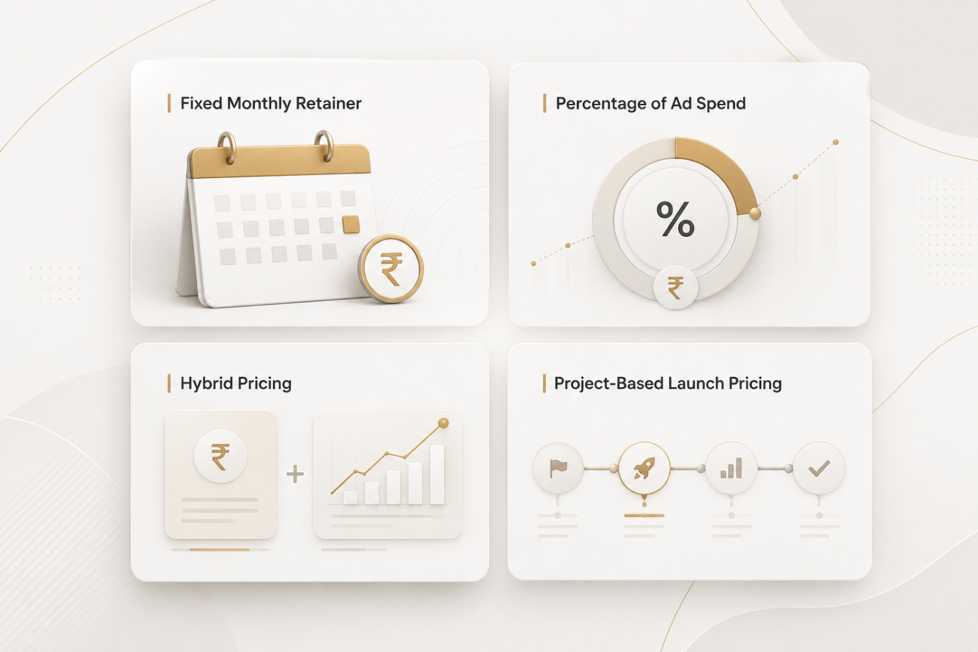
The 4 Pricing Models Performance Marketing Agencies Use in India

1. Fixed Monthly Retainer

The most common model. You pay a flat fee for a defined scope — strategy, campaign management, creatives, landing pages, and reporting.

  • Best for: businesses that want predictable costs and a full-service partner
  • Typical range: ₹25,000 – ₹1,50,000+ per month depending on scope and city
  • Watch for: vague scopes; a retainer without defined deliverables is a blank cheque

2. Percentage of Ad Spend

The agency charges 10–20% of your monthly ad budget as its fee. Spend ₹5 lakh on ads and pay ₹50,000–₹100,000 to the agency.

  • Best for: brands with large, scaling ad budgets
  • Typical range: 10–20%, often with a minimum fee floor of ₹25,000–₹50,000
  • Watch for the incentive problem: the agency earns more when you spend more, whether or not results improve. Demand ROAS accountability alongside this model.

3. Hybrid (Retainer + Performance Bonus)

A lower base retainer plus incentives tied to results cost per lead targets, ROAS thresholds, or revenue milestones.

  • Best for: businesses that want aligned incentives and agencies confident in their systems
  • Typical structure: ₹30,000–₹75,000 base + bonus per qualified lead or ROAS slab
  • Watch for bonus definitions. “Leads” must mean qualified leads your sales team accepts, not form fills from junk traffic.

4. Project-Based / Launch Pricing

One-time pricing for a defined campaign — a real estate project launch, a festive season push, a product drop.

  • Best for: seasonal businesses and event-driven campaigns
  • Typical range: ₹50,000 – ₹5,00,000+ depending on duration and deliverables
  • Watch for: no optimisation window. Performance marketing needs 4–6 weeks of data to work; ultra-short projects rarely show the model at its best.

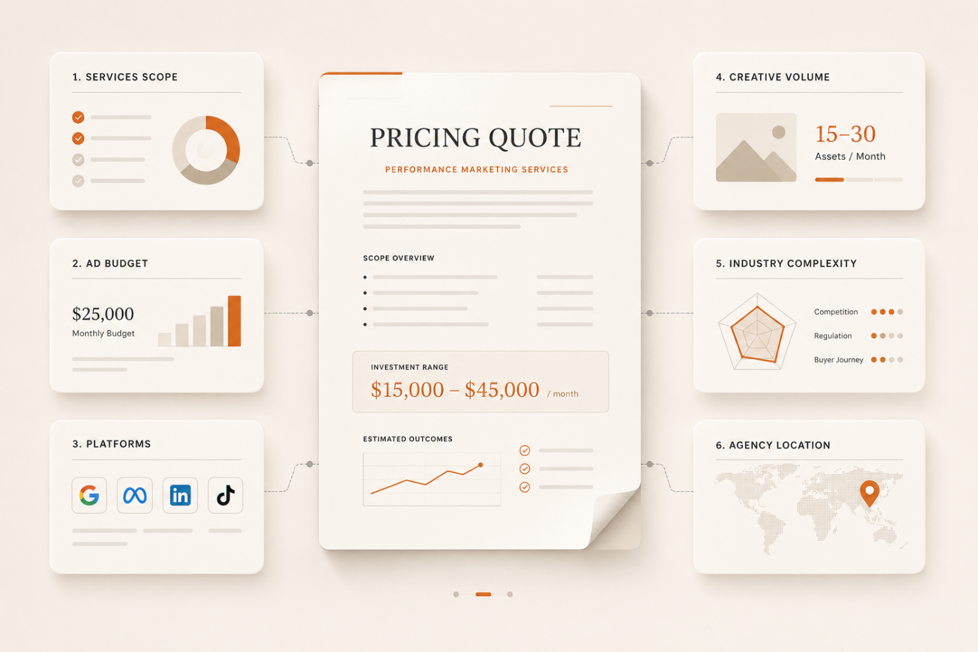
What Determines the Price? 6 Factors That Move Your Quote

  1. Scope of services: ads-only management is cheaper than a full system with creatives, landing pages, CRO, and reporting. See the full service breakdown in our guide to performance marketing agency services.
  2. Ad budget size: managing ₹20 lakh across platforms takes more strategy, testing, and manpower than managing ₹50,000.
  3. Number of platforms: Meta only vs Meta + Google + LinkedIn changes the workload materially. Not sure which platform you need first? Read Meta Ads vs Google Ads: Which One Should You Run First?
  4. Creative volume: agencies producing 15–20 fresh ad creatives a month charge more than those recycling three statics and outperform them.
  5. Industry complexity: real estate, BFSI, and healthcare demand compliance-aware campaigns and longer sales cycles, which price higher than simple e-commerce.
  6. Agency location and positioning: metro agencies (Mumbai, Bangalore, Delhi) typically charge 40–80% more than equally capable agencies in cities like Surat, Ahmedabad, or Pune for the same platforms, same dashboards, and same skills.

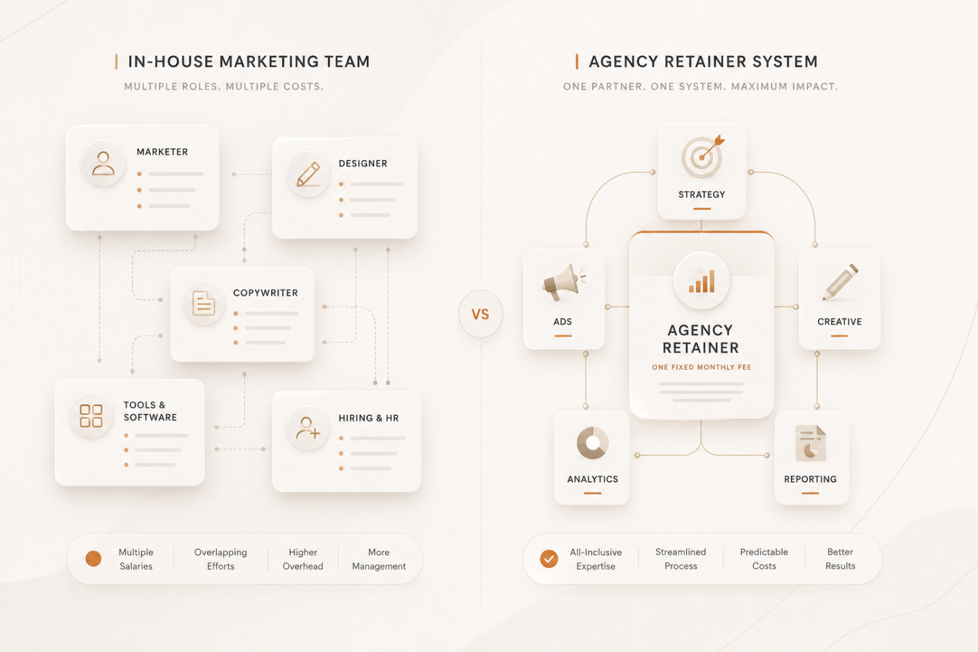
Agency Retainer vs In-House Hire: The Cost Math

A common comparison and the numbers are clearer than most expect:

Cost HeadIn-House TeamAgency Retainer
Performance marketer (senior)₹8–15 LPAIncluded
Designer + copywriter₹6–12 LPA combinedIncluded
Tools and software₹1–3 LPAIncluded
Hiring, training, attrition riskOngoingNone
Effective annual cost₹15–30 lakh+₹3–12 lakh

An agency gives you a full team strategist, media buyer, designer, copywriter, and analyst at roughly the cost of one senior hire, plus learning from dozens of live ad accounts. In-house makes sense at scale. We have covered the full decision framework in In-House Marketing Team vs Marketing Agency: What Should You Choose?

The Hidden Costs Nobody Mentions

The retainer is not the full picture. Budget for these upfront:

  • Ad spend: paid directly to platforms; never bundled inside a retainer. If an agency quotes one combined number, ask for the split in writing.
  • Landing page development: sometimes included, often a one-time add-on of ₹10,000–₹50,000
  • Ad account and tracking setup: Pixel, Conversions API, GA4 usually a one-time onboarding cost
  • Video and UGC production: premium creative shoots are typically billed separately
  • The real hidden cost a cheap agency: a ₹15,000 retainer that burns ₹1 lakh of ad spend on untracked, unoptimised campaigns is the most expensive option on this page

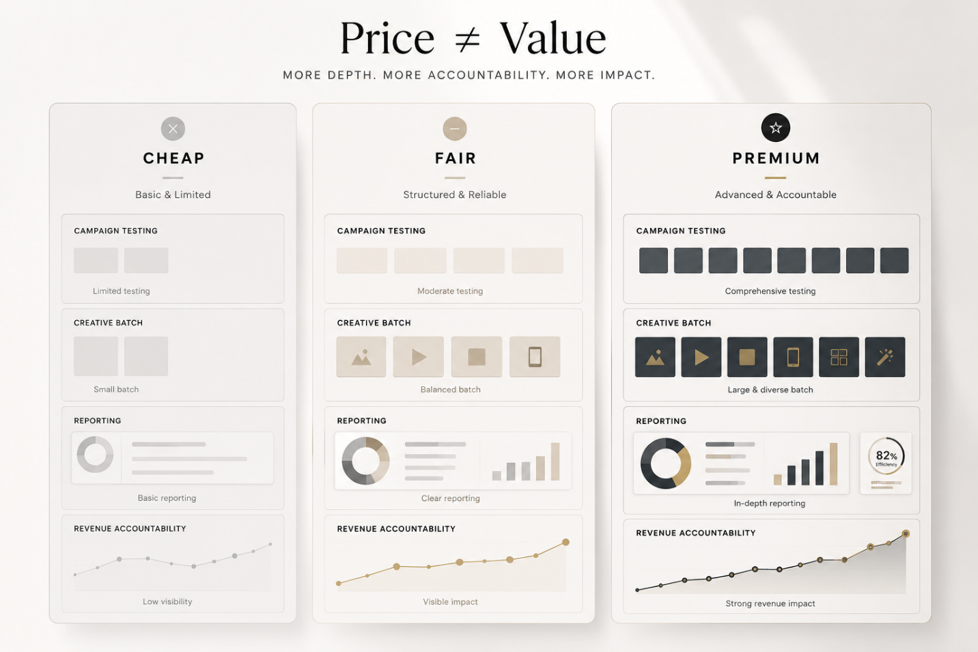
Cheap vs Fair vs Premium: How to Judge a Quote

Price alone tells you nothing. Match the quote to the deliverables:

  • Under ₹20,000/month: usually one person boosting posts. No testing structure, no CRO, and template reports. Fine for a basic start; do not expect a system.
  • ₹40,000–₹100,000/month: the fair zone for serious SMEs dedicated media buyers, monthly creative batches, structured A/B testing, CPL/ROAS reporting, and a team that talks to your salespeople about lead quality.
  • ₹150,000+/month: justified only with dedicated pods, aggressive creative volume, CRO ownership, and revenue-level accountability. Ask what specifically you get that the fair zone does not include.

The evaluation questions that expose an inflated quote are the same ones that expose a weak agency we have listed all of them in How to Choose the Right Performance Marketing Agency in Surat (2026 Buyer’s Checklist).

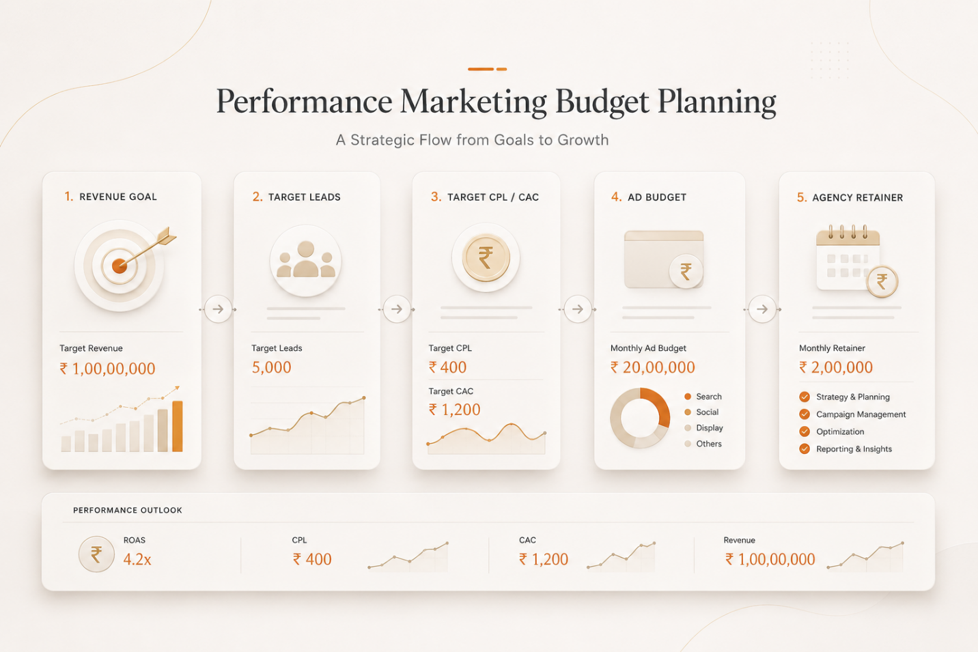
How to Think About Budget: Retainer as a % of Revenue Goal

Instead of asking, “What does an agency cost?” work backward from the outcome:

  1. Define your revenue or lead target for the next quarter
  2. Estimate your target CAC or CPL from margins (your agency should help with this)
  3. Set ad budget = target leads × realistic CPL
  4. Sanity-check: total marketing cost (retainer + ad spend) should typically sit at 7–15% of the revenue it is expected to generate

If the math does not close at your margins, the problem is the offer or the pricing not the ad platform. A good agency will tell you this before taking your money. If you need the lead system itself fixed first, read How Local Businesses Can Generate Consistent Leads Online.

FAQs: Performance Marketing Agency Cost in India

What is the minimum budget to start performance marketing in India?

Realistically, ₹50,000–₹75,000 per month combined (retainer + ad spend) for a local business. Below that, there is not enough data volume for platforms to optimize.

Do agencies charge a percentage of ad spend in India?

Yes — typically 10–20% of monthly spend, usually with a minimum fee. It is common for budgets above ₹2–3 lakh per month.

Why do agency prices vary so much between cities?

Overheads and positioning. A performance marketing agency in India operating from Surat or Ahmedabad runs the same Meta and Google platforms as a Mumbai agency at 40–80% lower retainers.

Is a performance marketing retainer negotiable?

Scope is negotiable; quality is not. Reduce platforms or creative volume to fit budget; never accept removed tracking, testing, or reporting.

Should the agency fee come out of my ad budget?

No. Ad spend is paid directly to Meta or Google from your own account, which you should own. Agency fees are separate and invoiced transparently.

How long is a typical agency contract in India?

Three to six months minimum, because paid campaigns need 60–90 days of data to optimize. Month-one exit clauses attract agencies that never plan beyond month one.

Final Word: Buy Outcomes, Not Hours

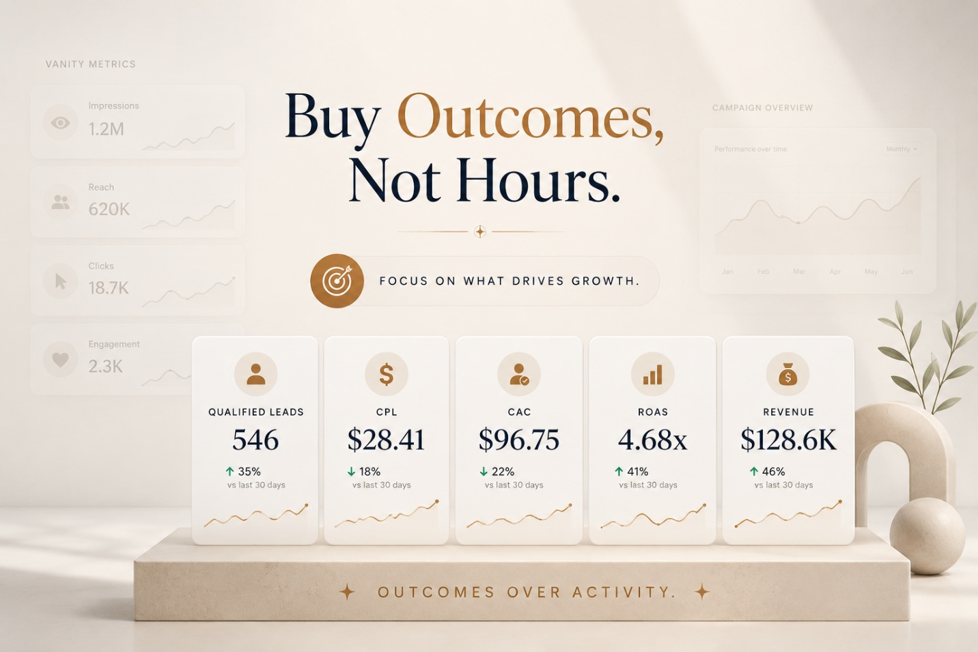
The right question is not “What does a performance marketing agency cost?” It is “What does a qualified lead or a sale cost me through this agency, and does that math work at my margins?” An agency that anchors the conversation on CPL, CAC, and ROAS is worth a fair retainer. An agency that anchors itself on reach and impressions is expensive at any price.

Social 101 is a performance marketing agency in India, based in Surat, working with 300+ brands across real estate, jewelry, D2C, manufacturing, and BFSI since 2018. We price on scope, report on revenue metrics, and give you full ownership of your ad accounts and data. Explore more guides on our blog or talk to our team here.

How AI Is Changing What a Performance Marketing Agency Does in 2026

Quick Answer

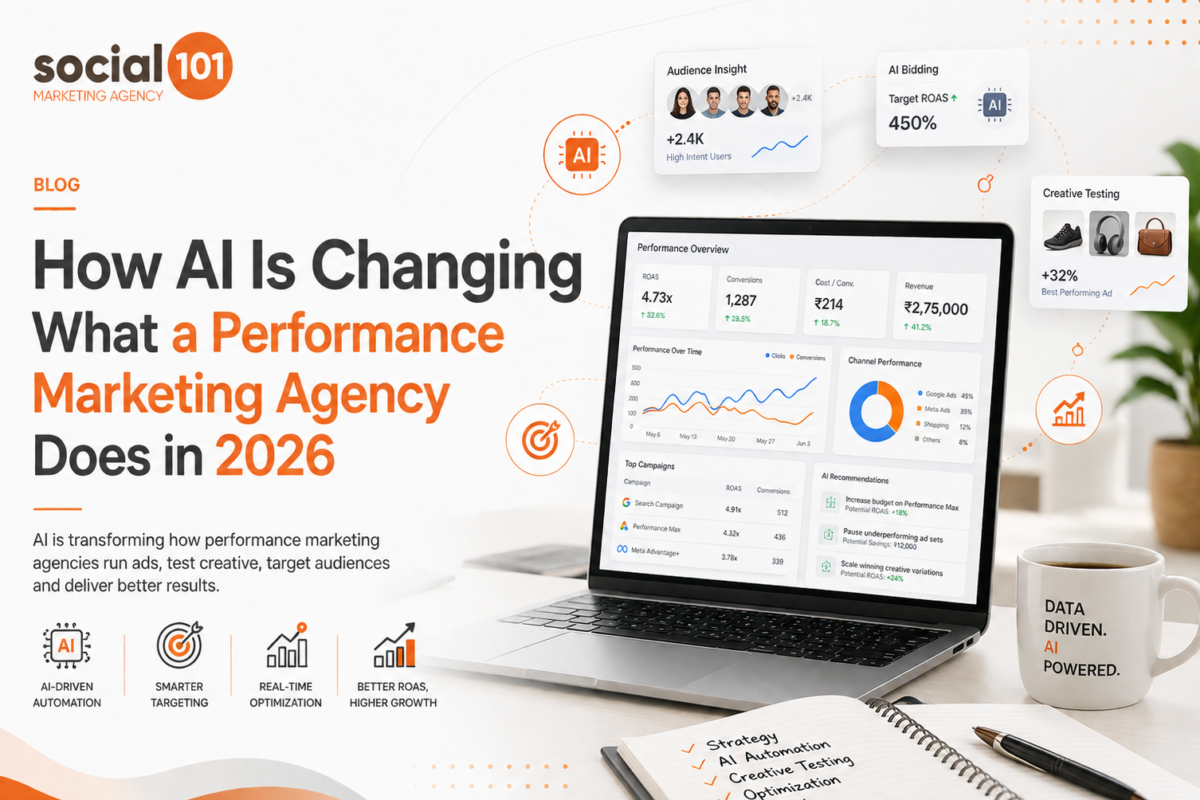
A performance marketing agency in 2026 isn’t just running ads it’s running AI systems that bid, write, and optimize faster than any human team could alone. AI now handles bid automation, creative generation, audience prediction, and real-time budget shifts. But AI doesn’t replace strategy it removes the busywork so agencies can focus on positioning, offer, and creative judgment. If your agency can’t explain which parts of your campaigns are AI-driven and which parts still need a human, that’s a gap worth asking about.

Why This Matters Right Now

Two years ago, “performance marketing” mostly meant a media buyer manually adjusting bids on Google Ads and Meta Ads Manager, checking dashboards every morning, and tweaking budgets by feel. That world is mostly gone.

Google’s Performance Max and Meta’s Advantage+ campaigns now run on machine learning models that test thousands of creative and audience combinations per day, something no human team could do manually. At the same time, generative AI tools can produce ad copy, product images, and even short-form video variations in minutes.

This has changed what a good performance marketing agency actually does. The value has shifted from “who can set up a campaign correctly” to “who can direct AI systems toward the right outcome, catch what they get wrong, and build the strategy AI can’t build on its own.”

For Surat businesses, where budgets are often tighter and every rupee of ad spend needs to earn its place, understanding this shift matters before you sign with any agency in 2026.

AI vs Traditional: What Actually Changed

 Traditional Performance MarketingAI-Driven Performance Marketing (2026)
BiddingManual, adjusted by a media buyer dailyAutomated (Target ROAS, Advantage+), adjusted in real time
Creative testingOne variable at a time, slowDozens of variants tested simultaneously
Audience targetingDemographic filters (age, location, interest)Predictive modeling based on behavior patterns
Budget allocationReviewed and shifted manuallyShifts across channels within the same day
Agency’s real jobExecution and monitoringStrategy, oversight, and correcting the AI when it’s wrong

What AI Actually Changed Inside a Performance Marketing Agency

1. Bidding Is Now Machine-Driven, Not Manual

Platforms like Google Ads and Meta now use automated bidding models (Target ROAS, Target CPA, Advantage+ Shopping Campaigns) that adjust bids in real time based on thousands of signals device, time of day, past purchase behavior, and even weather in some verticals. A human simply cannot react that fast.

What this means for you: the agency’s job is no longer “set the bid”; it’s “set the right goal, feed the algorithm clean data, and give it enough budget and time to learn.” An agency that’s still manually adjusting bids line-by-line in 2026 is likely working against the platform, not with it.

2. Creative Testing Happens at a Scale Humans Can’t Match

AI tools can now generate dozens of ad copy variations, image crops, and even short video edits from a single creative brief. Agencies use this to run true multivariate testing, testing headline, visual, and CTA combinations simultaneously instead of one variable at a time.

The catch: AI-generated creative still needs a human filter. Machine-generated copy can be generic, repetitive, or off-brand if nobody is reviewing it against your brand voice. This is where an agency’s strategic judgment, not the AI tool itself, becomes the differentiator.

3. Audience Targeting Is Predictive, Not Just Demographic

Older targeting worked off basic filters age, location, interest. AI-driven targeting now works off predictive modeling: it identifies people who behave like your existing customers, even if they don’t match obvious demographic filters. This is especially useful for niche categories like jewelry, real estate, or B2B manufacturing, where the “ideal customer” doesn’t always fit a simple age-and-income box.

4. Budget Allocation Shifts in Real Time Across Channels

AI-powered media mix tools can now shift budget between Google, Meta, and other channels within the same day based on which is converting better, something that used to require a human checking multiple dashboards and manually reallocating spend. This reduces wasted spend, but only if the underlying tracking and attribution setup is accurate. For a deeper comparison of where to start, see Meta Ads vs Google Ads for Surat Businesses. Garbage data in still means garbage decisions out, no matter how good the AI is.

5. Reporting Is Faster, But Explainability Matters More

AI can generate a performance report in seconds. What it can’t always do is explain why something worked, tie it back to your business goals, or tell you what to do next. This is arguably the single biggest gap between agencies that use AI well and agencies that just plug your account into automated tools and call it a strategy.

What Hasn’t Changed (and Never Will)

It’s worth being direct about this: AI has not replaced the need for strategy, offer clarity, or brand judgment. AI can optimize toward a goal — it cannot decide what that goal should be, what your positioning is, or whether your offer is actually competitive in your category. This is also the core argument in our piece on performance marketing vs branding: automation only works well once the underlying strategy is right.

A performance marketing agency’s real job in 2026 is

  • Defining the right campaign objective and success metric before AI starts optimizing
  • Building the creative concepts and brand voice AI then scales
  • Catching when automated bidding is optimizing for the wrong signal (cheap leads instead of qualified ones, for example)
  • Connecting ad performance back to actual business outcomes, not just platform metrics

If an agency’s pitch is “we use AI” without explaining what that AI is doing and what a human is still doing, that’s a sign to dig deeper. See our full buyer’s checklist for choosing a performance marketing agency in Surat for the questions to ask before you sign.

Questions to Ask an Agency About Their AI Use

Before hiring any performance marketing agency in 2026, ask:

  1. Which parts of my campaigns are automated, and which are managed manually?
  2. How do you validate that automated bidding is optimizing toward the right outcome, not just the cheapest one?
  3. Who reviews AI-generated ad creative before it goes live, and against what brand guidelines?
  4. How is my tracking and attribution set up is the data feeding these AI systems accurate?
  5. Can you show me a campaign where you had to override or correct what the AI system was doing?

That last question is often the most revealing. An agency that has never needed to override automation either isn’t paying close enough attention or isn’t being fully honest about how much oversight AI campaigns actually need.

AI Is Also Changing How Customers Find Agencies

It’s not just ad campaigns AI is changing discovery itself. Buyers increasingly ask ChatGPT, Perplexity, or Gemini questions like “Which performance marketing agency in Surat handles jewelry or real estate brands?” instead of scrolling Google’s blue links. If an agency isn’t structuring its own content and site to be picked up by these AI search tools, they may not even show up as an option regardless of how good their ad management actually is.

We covered this shift in detail in how Surat businesses can get found on ChatGPT and AI search the same GEO principles apply whether you’re a business looking for an agency or an agency trying to be found.

Where Social 101 Fits In

At Social 101, we’ve built performance marketing systems for 300+ brands across 10+ cities since 2018, real estate, BFSI, manufacturing, FMCG, textiles, jewelry, and e-commerce among them. We use AI where it genuinely improves speed and testing scale, bid automation, creative variant testing, and predictive audiences, but every campaign is built on a human strategy layer first: clear objectives, honest attribution, and creative that actually reflects the brand.

If you’re evaluating agencies and want to understand exactly what to ask before you commit, start with our complete guide to choosing a performance marketing agency in Surat.

Want an honest read on how AI-ready your current ad setup actually is? Get in touch with Social 101 for a free audit.

Related Reading From Social 101

Frequently Asked Questions

Is AI replacing performance marketing agencies?

No. AI is replacing the manual, repetitive parts of campaign management, bidding, creative testing at scale, reporting but strategy, positioning, and creative judgment still require a human agency team.

What should I look for in an AI-driven performance marketing agency?

Look for an agency that can clearly explain which parts of your campaign are automated, how they validate that automation is optimizing correctly, and how they review AI-generated creative before it’s published.

Does using AI make ads cheaper?

Not automatically. AI can reduce wasted spend when tracking and data are accurate, but poor setup or unclear goals can make automated bidding just as inefficient as manual bidding, sometimes worse, since it happens faster.

How is GEO (AI search visibility) different from AI in ad campaigns?

AI in ad campaigns (bidding, creative, targeting) affects how your paid ads perform. GEO affects whether your business shows up when someone asks an AI tool like ChatGPT for a recommendation. Both matter, but they’re separate systems.

Should a small Surat business worry about AI in performance marketing yet?

Yes, in a practical sense most ad platforms now default to AI-driven automated bidding whether you opt in consciously or not. The real question isn’t whether to use AI, it’s whether your agency is directing it with a clear strategy.

How Local Businesses in Surat Can Generate Consistent Leads Online

Surat is one of India’s fastest-growing commercial hubs textiles, diamonds, real estate, jewellery, manufacturing, and a booming D2C scene. But here’s the problem most local business owners face: footfall and referrals are no longer enough. Your next customer is searching on Google, scrolling Instagram, and comparing options online before they ever walk through your door.

If you run a business in Surat and want a steady, predictable flow of leads instead of feast-or-famine months, this guide walks you through exactly how to make it happen.

Why Online Lead Generation Matters for Surat Businesses

Local buyers in Surat now research before they buy. Whether someone is looking for the best textile wholesaler, a real estate project in Vesu, a jewelry showroom, or a digital marketing agency in Surat, their journey starts with a search.

The businesses that show up consistently online are the ones that capture these high-intent buyers. The rest lose them to competitors who invested in digital visibility early. Consistent online lead generation isn’t about going viral; it’s about building a system that brings in qualified inquiries every single week.

1. Build a Strong, Locally Optimized Website

Your website is your digital storefront. For Surat businesses, local SEO is the foundation of consistent leads.

Target location-based keywords like “textile manufacturer in Surat,” “real estate consultant Surat,” or “digital marketing agency in Surat.” Add a clear value proposition, contact details, and lead capture forms above the fold. Optimize page speed and make the site mobile-first most local searches happen on phones. Create dedicated service and location pages so Google understands exactly what you offer and where.

2. Claim and Optimize Your Google Business Profile

For local lead generation in Surat, a fully optimized Google Business Profile is non-negotiable. It’s often the first thing buyers see when they search “near me.”
Fill out every detail: category, services, hours, and service areas across Surat. Add high-quality photos of your products, office, or completed projects. Collect and respond to reviews consistently; social proof drives clicks and calls. Post regular updates to stay active and visible in local map results.

3. Invest in Local SEO and Content Marketing

SEO is the engine of consistent, compounding leads. Unlike ads, the traffic you earn through ranking doesn’t disappear when you stop paying. A structured content marketing strategy built on efficient keyword research turns your website into a 24/7 lead source.

Publish helpful blog content answering the exact questions your Surat customers ask. Use long-tail keywords that show buying intent, like “how to choose a wholesale textile supplier in Surat.” Build internal links and earn local backlinks from Surat directories, business associations, and partners. Optimize for GEO (Generative Engine Optimization) so your business appears in AI-powered search answers, not just traditional Google results.

4. Run Targeted Paid Ads for Quick Wins

While SEO builds long-term momentum, paid advertising delivers leads fast. Not sure where to start? Our guide on Meta Ads vs Google Ads for Surat businesses breaks down which to run first. The key is precise targeting. Use Meta Ads (Instagram and Facebook) to reach Surat audiences by location, interest, and behavior. Run Google Search Ads to capture buyers actively searching for your product or service. Build lead-capture funnels with strong offers, clear CTAs, and instant follow-up and avoid the common PPC mistakes that drain budgets. Retarget website visitors and social engagers who didn’t convert the first time.

5. Leverage Social Media for Trust and Reach

In a relationship-driven market like Surat, social media builds the trust that converts. A consistent social media strategy across platforms like Instagram and LinkedIn lets you stay top-of-mind. Share customer stories, behind-the-scenes content, and product highlights. Use locally relevant content and cultural moments to connect authentically.

Maintain consistency; a regular posting rhythm signals reliability and builds a following that converts over time.

Use LinkedIn for B2B lead generation and build a strong personal brand, especially in manufacturing, real estate, and professional services.

6. Capture and Nurture Every Lead

Generating leads is only half the battle. Consistent conversion comes from a system that follows up.

Use WhatsApp Business, CRM tools, and email marketing to boost sales and engagement to nurture inquiries. Responding within minutes speeds dramatically increasing conversion rates.

Build automated follow-up sequences so no lead slips through the cracks.

Industry-Specific Lead Generation in Surat

Every Surat industry has its own buyer behavior. We’ve put together focused playbooks for the city’s biggest verticals:

Social media marketing for textile & saree businesses in Surat
Digital marketing for diamond & jewellery manufacturers in Surat
Top real estate developers of Surat (2025–26 guide)
In-house marketing team vs marketing agency: what to choose

Turn Your Online Presence into a Lead-Generating Machine

Consistent leads don’t come from one tactic they come from an integrated system: a strong website, local SEO, an optimized Google Business Profile, smart paid ads, engaging social media, and disciplined follow-up. If you’re weighing where to focus, our take on performance marketing vs branding helps you decide where your budget works hardest.

This is exactly what we do at Social 101 a full-service marketing, sales, and technology consulting agency in Surat helping 300+ brands generate consistent, qualified leads online.

If you want more strategies tailored to growing your business online, explore our latest insights on the Social 101 blog.

Ready to build a lead-generation system that actually works? Get in touch with Social 101 and let’s grow your business.

Best Digital Marketing Strategies for Surat Businesses in 2026

Surat has always known how to sell. From the diamond bourse to the textile markets of Ring Road, this is a city built on trade, relationships, and a sharp instinct for what customers want. But in 2026, the marketplace has moved and a large part of it now lives on a screen.

India’s digital advertising market is projected to reach ₹62,000 crore by 2026, growing at 25% CAGR. For a business hub like Surat packed with textile manufacturers, jewellers, real estate developers, and a fast-growing D2C scene that growth is both an opportunity and a warning. The brands that adapt their digital strategy will capture demand; the ones still relying on 2023 tactics will quietly lose visibility.

Here are the digital marketing strategies that actually matter for Surat businesses this year.

1. Optimise for AI Search, Not Just Google (GEO)

The single biggest shift in 2026 is how people find businesses. They are no longer only typing into Google; they are asking ChatGPT, Gemini, Perplexity, and Google’s AI Overviews. Most searches in 2026 are now answered before a user ever visits a website.

This makes Generative Engine Optimization (GEO) non-negotiable. The goal is no longer just ranking first; it is becoming the source these AI tools trust and cite. AI doesn’t learn from websites alone; it learns from every place your brand exists online: websites, social platforms, ads, reviews, forums, and mentions.

For a Surat business, that means structuring your website content with clear entity details (who you are, where you operate, what you do), earning consistent mentions across platforms, and writing content that directly answers the questions your customers ask. A textile exporter or jeweler that gets cited by an AI tool when someone asks “best diamond jewelry manufacturer in Surat” wins before the competition even shows up.

2. Double Down on Local SEO

Local intent is where Surat businesses have the strongest advantage. Customers searching “near me” or “in Surat” are high-intent and ready to act. Yet most local businesses still under-invest here.

A strong local SEO foundation includes a fully optimized Google Business Profile, consistent name-address-phone details across directories, genuine customer reviews, and location-rich content on your website. SEO remains the channel that delivers long-term traffic without paying for every click. If you want a structured approach to this, it’s worth exploring our content marketing and SEO services.

3. Treat Social Platforms as Search Engines

Instagram and YouTube are no longer just for engagement; they are discovery engines. Businesses that treat social platforms like “search engines with video results” will dominate early discovery in 2026.

For Surat’s visual-first industries fashion, textiles, jewelry, interiors, and food, this is a gift. But the rules have changed: quality now beats quantity. Instead of posting seven mediocre reels a week, brands win with two to three meaningful, story-led pieces. The algorithm rewards content people watch to the end, not content that chases views.

4. Make WhatsApp a Sales Channel, Not Just a Chat App

If there is one channel uniquely suited to how Surat does business, it’s WhatsApp. The platform has evolved from a messaging tool into a full commerce engine. With WhatsApp Payments, catalog integration, and Click-to-WhatsApp ads enabling direct purchase journeys from ad to checkout, it has become a complete commerce channel for Indian D2C brands.

The numbers back it up: D2C brands with properly built WhatsApp automation report that WhatsApp now contributes 20–35% of their total digital revenue in India. For local retailers and manufacturers used to closing deals over a phone call, this is a natural extension just structured and scalable.

5. Invest in Vernacular and Culturally Local Content

Surat is a Gujarati-first market with a strong regional identity, and 2026 rewards brands that speak the customer’s language literally. Brands that create localized, vernacular content are seeing significantly higher engagement and conversion rates. But this is not just translation; it requires cultural localization, regional references, and native speakers in the creative process.

A campaign that references Surat’s business culture, festivals, and local pride will always outperform a generic English ad copied from a national playbook.

6. Shift to Micro-Influencers

Influencer marketing in India is moving away from celebrity reach toward genuine trust. Indian brands are shifting budgets from mega-influencers to micro-influencers (10,000–100,000 followers), who consistently deliver higher engagement rates of 5–8% versus 1–2% for mega-influencers, plus more genuine audience trust and better cost-per-acquisition.

For Surat brands, partnering with local creators a Surat fashion blogger, a regional food reviewer, or or a city lifestyle page builds credibility with exactly the audience you want to reach.

7. Let AI Run Your Paid Campaigns Smarter

AI has become the infrastructure of modern advertising. Google’s Performance Max, Meta’s Advantage+ Shopping Campaigns, and LinkedIn’s AI-optimized campaigns now handle bidding, placement, audience expansion, and creative combination automatically.

The human job is no longer adjusting bids it’s feeding these systems the right creative, clear goals, and quality data. This is where performance marketing expertise separates a wasted budget from a profitable one.

8. Build an Integrated Ecosystem, Not Isolated Channels

The most common and costly mistake in 2026 is treating marketing as separate, disconnected channels. AI does not evaluate brands in silos it evaluates consistency, reinforcement, and credibility across the entire customer journey.

The proof is in the data: brands using three or more digital channels see 287% higher purchase rates than single-channel campaigns. Your website, social, paid ads, WhatsApp, and SEO should all reinforce one coherent brand story.

The Bottom Line for Surat Businesses

Digital marketing in 2026 rewards clarity, authority, and adaptability. The brands that will win in Surat aren’t necessarily the ones with the biggest budgets they’re the ones that show up consistently across search, social, and AI, speak their customer’s language, and build trust at every touchpoint.

This is exactly the kind of integrated, strategy-first work we do at Social 101. As a leading digital marketing agency in Surat with over six years of experience and 500+ projects delivered, we help brands move from scattered tactics to a connected system that grows. Take a look at our work, explore what we offer, or get in touch to talk about your 2026 strategy.

Meta Ads vs Google Ads for Surat Businesses: Which One Should You Run First?

If you run a business in Surat and you have a fixed monthly ad budget, the first real decision isn’t “how much should I spend.” It’s “Where should this money go first Meta or Google?” Get this wrong and you burn three months learning a lesson a single conversation could have taught you. Get it right, and your first rupee starts compounding.

This guide answers that question for Surat businesses specifically and then goes one level deeper into the platform most local D2C founders actually care about: how to run profitable Instagram ads for an Indian D2C brand without lighting your budget on fire.

The core difference nobody explains simply

Google Ads captures existing demand. Someone in Surat is already typing “best modular kitchen in Surat” or “lab grown diamond ring price” into Google. They want it now. You’re paying to be the answer at the exact moment of intent.

Meta Ads (Facebook and Instagram) creates demand. Nobody opens Instagram looking to buy your saree or your furniture. You interrupt them with something good enough to make them want it. You’re paying for attention and persuasion, not intent.

That single distinction decides almost everything for a Surat business.

Which one should a Surat business run first?

Run Google Ads first if:

  • You sell something people actively search for with buying intent real estate, interiors, dentists, lawyers, B2B textile suppliers, machinery, packers and movers, and coaching classes.
  • Your average order value is high enough to justify a higher cost-per-click.
  • You can answer “what would someone type into Google to find me?” in one clear sentence.

Run Meta Ads first if:

  • You’re a D2C or lifestyle brand in fashion, jewelry, sarees, home decor, food, or beauty, where the product needs to be shown to be wanted.
  • Your product is visual and impulse-friendly.
  • Your audience scrolls Instagram far more than they search Google for your category.
  • You’re building a brand, not just chasing one transaction.

For most consumer-facing Surat brands, especially the textile, saree, jewelry, fashion, and D2C businesses, this city is full of Meta. Meta is the better first platform because the demand for these products is created emotionally, not searched for. For service businesses and high-ticket B2B, Google usually wins the first round.

A useful rule: if your customer would search for you, start with Google. If your customer needs to be shown you, start with Meta.

Why this matters more in Surat than in metros

Surat’s consumer market behaves differently. Buying decisions are heavily word-of-mouth, family-influenced, and trust-driven. Instagram has become the local shop window for everything from sarees to diamonds to interiors. A well-run Meta campaign here doesn’t just sell it builds the social proof that closes the sale offline, in your showroom or over WhatsApp.

That’s also why a thin “boosted post” strategy fails. Boosting is not advertising. Which brings us to the second half of this guide.

How to Run Profitable Instagram Ads for a D2C Brand in India

Most Indian D2C founders don’t have a traffic problem. They have a profit problem. They get likes, reach, and even sales but the math doesn’t close. Here’s how to actually run Instagram ads that make money.

1. Stop boosting. Start structuring.

The “Boost Post” button is the single biggest waste of D2C ad spend in India. It optimizes for engagement, not purchases. Use Meta Ads Manager and build proper campaigns with a sales objective. This one switch alone changes your results.

2. Know your real numbers before you spend a rupee

Profitable Instagram advertising is a math problem before it’s a creative problem. You need three numbers:

  • AOV your average order value.
  • Contribution margin: what’s left after product cost, shipping, COD/RTO losses, and packaging.
  • Break-even ROAS roughly 1 ÷ your margin percentage. If you keep 40% margin, you need ~2.5x ROAS just to break even.

If you don’t know your break-even ROAS, you can’t tell a winning campaign from a losing one. This is where most Indian D2C brands quietly bleed money.

3. RTO is your hidden killer

In India, COD and Return-To-Origin can destroy a “profitable” campaign on paper. A 30% RTO rate silently erases your margin. Push prepaid with small discounts, add address confirmation flows on WhatsApp, and factor RTO into your break-even ROAS from day one.

4. Creative is 80% of the result

On Instagram, your targeting matters less than it used to Meta’s algorithm finds buyers if your creative earns attention. Prioritise:

  • UGC-style video that looks native, not like an ad.
  • The first 3 seconds doing all the heavy lifting: hook hard or lose them.
  • One clear message per creative, not five.
  • Volume test 5–10 creatives, not one “perfect” one. Winners are discovered, not designed.

For Indian audiences, founder-led and customer-testimonial creatives consistently outperform polished studio shoots. If you sell sarees or textiles, our guide on social media marketing for textile and saree businesses in Surat breaks down creative angles that convert for this category.

5. A simple campaign structure that works

Keep it boringly simple to start:

  • One Advantage+ Shopping campaign (or a broad-targeting Sales campaign) and let Meta optimize.
  • A small testing campaign running new creatives weekly.
  • A retargeting campaign for people who viewed your product or added it to the cart but didn’t buy this is usually your most profitable rupee.

Resist the urge to build 20 ad sets. Fragmenting your budget starves the algorithm of data.

6. Give it data and give it time

Meta needs roughly 50 conversions per ad set per week to optimize well. If your budget is too small and spread too thin, the algorithm never learns. Consolidate budget, be patient through the 7–14 day learning phase, and don’t kill campaigns after two days of bad numbers.

7. Read the right metric

Likes, reach, and CPM are vanity. The only metrics that decide profit are ROAS, cost per purchase, and contribution margin after RTO. Judge every campaign against your break-even ROAS, nothing else. For more on where each rupee should go, read Performance Marketing vs Branding: Where Should Your Ad Budget Go?.

Digital Marketing for Diamond & Jewellery Manufacturers in Surat

Surat polishes roughly 90% of the world’s diamonds, yet most manufacturers here still win business the way they did twenty years ago: through brokers, family networks, trade-show handshakes, and word of mouth. That model isn’t broken, but it is shrinking. International buyers, retail chains, and large wholesalers now run supplier due diligence online before they ever reply to an email. If a manufacturer can’t be found and verified digitally, it quietly loses deals it never even knew existed.

This guide lays out exactly how diamond and jewelry manufacturers in Surat can build a B2B digital marketing engine that generates qualified buyer inquiries, shortens sales cycles, and positions the company as a credible, export-ready supplier.

Why B2B Jewellery Marketing Is Different (and Why Most Agencies Get It Wrong)

Most marketing advice you’ll find online is built for B2C jewelry brands selling rings to brides. That advice actively hurts a manufacturer. The buyer is not an individual; it’s a procurement manager, a retail buyer, an importer, or a wholesaler placing repeat orders worth lakhs to crores.

The differences that matter:

  • Long sales cycles. A single export relationship can take months to close and years to mature. Marketing has to nurture, not just capture.
  • Trust over aesthetics. Buyers care about certifications, consistency, capacity, and compliance far more than a pretty Instagram grid.
  • Smaller, higher-value audience. You’re not trying to reach a million people. You’re trying to reach a few thousand of the right decision-makers.
  • Relationship-led conversion. The deal closes in a meeting, a factory visit, or a video call, not a checkout cart. Digital’s job is to get you into that room.

If your current agency keeps pushing festival-themed reels and discount posts, they’re treating your manufacturing business like a jewelry showroom. That’s the wrong playbook.

The Foundation: Your Website Is Your Factory’s First Impression

Before any campaign, your website needs to do for an online buyer what a factory tour does in person — prove you are serious, capable, and trustworthy.

A B2B-ready manufacturer website should include:

  1. Clear capability statement: what you cut, polish, or manufacture, in what range, at what volume.
  2. Certifications front and center: GIA, IGI, BIS Hallmark, Kimberley Process, RJC, and ISO. These are trust signals buyers actively search for.
  3. Capacity and infrastructure: number of machines, monthly output, in-house vs. outsourced processes.
  4. Product catalog or range even without prices: buyers need to see what you produce.
  5. Export-ready countries served, logistics partners, packaging, and documentation support.
  6. A real “About” story: family heritage, years in operation, leadership. Buyers buy from people.
  7. Frictionless inquiry paths: WhatsApp, inquiry forms, and a direct line, in that order of speed.

If your website needs a credibility overhaul before you spend a rupee on ads, that’s the right place to start. You can see how we approach B2B website and brand positioning for manufacturers and consulting-led businesses.

SEO: Get Found by Buyers Searching Right Now

There are real buyers typing “diamond manufacturer in Surat,” “CVD diamond supplier India,” and “lab-grown diamond wholesaler” into Google and increasingly into AI search tools like ChatGPT and Perplexity. If you don’t appear, a competitor does.

What B2B jewellery SEO actually involves

  • Keyword targeting around buyer intent, not vanity terms. “Loose diamond manufacturer Surat” converts; “beautiful diamonds” does not.
  • Dedicated pages per capability and per market: a page for natural diamonds, one for lab-grown/CVD, one for specific cuts, and one per key export geography.
  • Technical SEO: fast load speed, mobile readiness, clean structure, and schema markup so search engines understand you’re a manufacturer.
  • Local SEO: A fully optimized Google Business Profile so you show up in “diamond manufacturer near me” and map searches.
  • GEO (Generative Engine Optimization) structuring content so AI assistants cite you when a buyer asks them to recommend suppliers. This is the newest and least-contested edge available right now.

SEO is a compounding asset: unlike ads, the inquiries keep coming after you stop paying. We’ve written more on building search visibility on our Social 101 blog, where we break down SEO and content strategy for businesses in and around Surat.

LinkedIn: The Single Highest-Leverage Channel for B2B Jewellery

If you do only one thing from this guide, make it LinkedIn. This is where retail buyers, importers, brand sourcing heads, and distributors actually spend professional attention. Instagram builds awareness; LinkedIn builds pipeline.

How manufacturers should use LinkedIn

  • Optimize the founder/owner profile, not just the company page. People trust people. A credible personal profile from the MD or director outperforms a faceless brand page.
  • Post insight, not inventory. Share market commentary on diamond pricing, lab-grown trends, export shifts, GST changes, and Surat’s industry developments. Position yourself as someone who understands the market.
  • Document the factory. Behind-the-scenes process content, quality checks, and craftsmanship build enormous trust with international buyers who can’t visit in person.
  • Target and connect deliberately. Use LinkedIn to identify and reach buyers, sourcing managers, and distributors in your target countries, then nurture them with consistent, valuable content.
  • Use outreach + content together. Cold outreach alone gets ignored. Outreach backed by a credible, active profile and useful content gets replies.

This founder-led, narrative approach is exactly the kind of positioning that wins high-value B2B relationships.

Instagram & Video: Awareness and Craft, Not Discounts

Instagram still matters for manufacturers, but for a specific purpose: showcasing craftsmanship and scale to build top-of-funnel awareness and trust. Think process reels, precision cutting, quality control, and finished product showcases that signal capability. The goal is to make a buyer think “these people are serious,” then route them to LinkedIn or your website to take the relationship forward.

Avoid the B2C trap of discount posts, festival templates, and consumer-style giveaways. They attract the wrong audience and dilute your positioning as a manufacturer.

Lead Generation: Turning Attention Into Inquiries

Visibility without a capture-and-nurture system just creates traffic, not revenue. A working B2B lead engine for a jewellery manufacturer looks like this:

  1. Attracting SEO, LinkedIn content, and targeted ads bring the right buyers into your orbit.
  2. Capturing inquiry forms, lead magnets (a catalogue, a capability deck, and a pricing guide), and WhatsApp entry points convert interest into contact details.
  3. Qualify separate serious buyers (volume, geography, repeat potential) from time-wasters early.
  4. Nurturing email and LinkedIn follow-ups, catalogs, and case studies keep you top-of-mind through a long cycle.
  5. Convert the sales team’s closes via call, meeting, or factory visit.
  6. Retain & expand repeat orders and referrals are where manufacturer profitability really lives.

Paid ads (Google Search and LinkedIn) can accelerate the “attract” stage, but only once the foundation website, positioning, and capture system is in place. Running ads before that is pouring water into a leaking bucket.

A Realistic 90-Day Starting Plan

Days 1–30 Foundation. Fix the website for B2B credibility, set up and optimize the Google Business Profile, and rebuild the founder’s LinkedIn profile. Define your target buyer and target geographies clearly.

Days 31–60 Visibility. Publish foundational SEO pages (capabilities, lab-grown/CVD, key export markets). Begin consistent LinkedIn posting (2–3 times a week) and start deliberate buyer-side connection building.

Days 61–90 Pipeline. Launch a lead-capture system (catalogue/capability deck + inquiry forms + WhatsApp). Begin targeted LinkedIn outreach backed by your now-credible profile. Test a small Google Search ad budget on high-intent buyer keywords.

By day 90, you should have measurable inbound inquiries and a repeatable system, not just “more posts.”

Common Mistakes Surat Manufacturers Make

  • Treating B2B marketing like B2C jewelry retail.
  • Relying entirely on brokers and trade shows with no digital presence to back them up.
  • Hiring an agency that posts consistently but generates zero qualified inquiries.
  • Ignoring LinkedIn because “our buyers aren’t there.” They are; you just haven’t shown up.
  • Spending on ads before the website and positioning are ready.
  • Measuring vanity metrics (likes, followers) instead of inquiries and pipeline.

The Bottom Line

Surat’s manufacturers don’t have a quality problem; the world already trusts the city’s craftsmanship. What many have is a visibility and positioning problem in a market where buyers now research and shortlist digitally. The manufacturers who win the next decade will be the ones who show up credibly online, lead with insight on LinkedIn, get found in search, and run a real lead system behind it all.

That’s not a campaign. It’s an engine, and building it is exactly the kind of B2B growth work we focus on.

Social 101 is a full-service marketing and business consulting agency based in Surat, helping manufacturers, B2B brands, and high-value businesses build positioning, visibility, and lead-generation systems that actually convert. Explore how we work or read more strategy guides on our blog.

Ready to build a B2B marketing engine for your jewelry or diamond business? Talk to Social 101.

In-House Marketing Team vs Marketing Agency: What Surat Businesses Should Choose

Every growing business in Surat eventually hits the same crossroads. Sales are climbing, the brand is getting noticed, and marketing can no longer be a side task handled “whenever someone gets time.” Now comes the real decision: do you build an in-house marketing team, or do you partner with a marketing agency?

It’s a question we hear constantly from textile manufacturers on Ring Road, jewellery houses in Varachha, real estate developers across the city, and D2C founders scaling on Meta and Google. There’s no universally correct answer, but there is a right answer for your business based on your stage, budget, and growth ambitions.

This guide breaks down both options honestly, so you can make a decision you won’t regret six months from now.

First, understand what each option actually means.

An in-house marketing team is a group of full-time employees on your payroll, working only on your brand. You hire, train, manage, and retain them. They sit in your office, absorb your culture, and live inside your business.

A marketing agency is an external partner you hire on a retainer or project basis. You get an entire team of strategists, designers, content writers, performance marketers, and video specialists without putting any of them on your payroll. A full-service agency like Social 101 functions as your outsourced marketing department.

The core trade-off is simple to state and hard to navigate: in-house gives you control and focus; an agency gives you breadth and speed. Everything else flows from that.

The Case for an In-House Marketing Team

Deep brand knowledge

Your in-house team breathes your business every day. They understand your products, customers, seasonal cycles, and the quirks that make your brand yours. A jewelry brand’s in-house designer eventually knows what sells in wedding season versus a festive Diwali push without being briefed each time.

Instant availability and control

Need a last-minute campaign change? Your team is right there. No waiting for a reply, no scope discussion, no “that’s outside the retainer.” For businesses that need rapid, constant iteration, this immediacy is valuable.

Long-term cultural alignment

Employees who stay for years build institutional memory: what worked, what flopped, and why. That knowledge doesn’t easily transfer.

Where in-house struggles

The honest difficulty is cost and capability gaps. A single competent marketing manager in Surat costs ₹5–12 lakh per year. To cover strategy, design, content, performance ads, and video, you’d need four to six specialists easily ₹30–60 lakh annually before tools, training, and attrition. Even then, one person rarely masters everything: your brilliant content writer probably can’t run a profitable Meta ad account, and your performance marketer likely can’t art-direct a shoot. Hiring is slow, good talent in tier-2 cities gets poached, and when someone leaves, momentum dies with them.

The Case for a Marketing Agency

A full team for the price of one or two hires

This is the headline advantage. You get strategists, designers, copywriters, performance marketers, and video editors working on your brand for less than the cost of two senior in-house salaries. You’re buying a department, not a person.

Specialized expertise across disciplines

A good agency has already solved problems like yours dozens of times across industries. When you work with a team that has handled performance marketing, branding, and content for hundreds of brands, you’re not paying them to learn on your budget you’re paying for pattern recognition they already have. (Our take on where to spend is here: Performance Marketing vs Branding: Where Should Your Ad Budget Go?

Speed and scalability

Agencies are built to move. Need to scale up for a launch and scale down after? An agency flexes with you: no hiring sprints, no layoffs, and no awkward bench time.

Outside perspective

An external partner sees what you can’t because you’re too close to it. That fresh, market-informed view catches positioning mistakes and missed opportunities that internal teams normalize over time.

Where agencies struggle

The honest difficulty: an agency works with multiple clients, so you don’t get 100% of anyone’s attention. There’s a ramp-up period while they learn your brand, and communication needs structure: clear briefs, regular reviews, and a single point of contact on your side. Quality also varies wildly between agencies, which is why choosing the right one matters more than the in-house-versus-agency decision itself. (Here’s how to evaluate one: Best Marketing Agencies in Surat.)

The Honest Side-by-Side

FactorIn-House TeamMarketing Agency
CostHigh (₹30–60L+/year for a full team)Lower (full team on a retainer)
Range of skillsLimited to who you hireBroad — strategy to execution
Speed to launchSlow (hiring + training)Fast (team ready now)
Brand knowledgeVery deepBuilds over time
AvailabilityAlways on-siteScheduled, structured
ScalabilityRigidHighly flexible
Fresh perspectiveLow (too close)High (external view)
Best forLarge brands, daily content needsMost growing SMEs and D2C brands

So What Should a Surat Business Actually Choose?

Choose in-house if you’re a large, established business with high daily marketing volume, the budget to hire genuinely senior talent across functions, and marketing so central it must stay fully under your roof. Think large retail chains or established manufacturing groups with constant, predictable output.

Choose an agency if you’re a growing SME, a D2C brand, a real estate developer, or a jewelry or textile business that needs professional, multidisciplinary marketing without building a department from scratch. This describes the majority of Surat businesses and it’s exactly why agency partnerships make sense at this stage.

Or do both in the hybrid model. Many of the smartest companies keep one in-house coordinator managing day-to-day communication, brand consistency, and approvals, while an agency handles the heavy lifting: strategy, design, performance ads, and video. You get internal ownership plus external firepower. For most ambitious mid-sized Surat businesses, this is the sweet spot.

The Bottom Line

The in-house versus agency debate isn’t about which is better it’s about which fits where you are right now. A two-person startup and a 500-crore manufacturer should not make the same choice.

For the vast majority of growing businesses in Surat, the math favors an agency or a hybrid model: a complete, expert marketing team, faster results, and lower risk than building everything internally. As you scale, you can always bring more capability in-house.

If you’re weighing this decision and want a straight, no-pressure conversation about what fits your business, talk to our team at Social 101. We’ve helped 300+ brands across jewellery, real estate, textiles, BFSI, and FMCG make exactly this call and we’ll tell you honestly if an agency isn’t what you need.

How Surat Businesses Can Get Found on ChatGPT and AI Search (GEO Guide 2026)

Why this matters right now for Surat

The way people search has changed. A buyer in Surat no longer types “best digital marketing agency near me” into Google and scrolls ten blue links. They ask ChatGPT, “Which marketing agency in Surat handles real estate and jewelry brands? and get one direct answer with two or three names.

If your business is not one of those names, you are invisible at the exact moment of decision.

Research suggests roughly 60% of searches will end without a website click by 2026, and Gartner projects organic search traffic to commercial sites will fall around 25% as discovery moves to AI tools. ChatGPT alone processes billions of prompts a day and already drives referral traffic to tens of thousands of websites.

For a city like Surat, where textiles, diamonds, real estate, jewelry, and fast-growing D2C brands compete hard, being the recommended answer inside an AI tool is the new front page of Google.

GEO vs SEO: what actually changed

GEO is not a replacement for SEO it is a parallel layer on top of it. The brands winning at GEO in 2026 are almost always the same ones with strong SEO foundations.

 Traditional SEOGenerative Engine Optimization (GEO)
GoalRank in the top 10 blue linksGet cited inside the AI’s answer
WhereGoogle search results pageChatGPT, Perplexity, Gemini, AI Overviews
MechanismKeywords + backlinksRetrieval + synthesis of trusted passages
Win conditionA click to your siteA mention in the generated answer

Here is what most owners miss: ranking on page one of Google no longer guarantees you appear in AI answers. The overlap between top Google links and AI-cited sources has reportedly dropped from around 70% to below 20%. AI engines are developing their own taste in which sources to trust that gap is your opportunity.

The 7 GEO moves for Surat businesses

1. Answer the exact questions your customers ask

AI tools mirror how people actually talk. Instead of stuffing a page with “digital marketing Surat,” write content that answers full questions:

  • “How much does social media marketing cost for a jewelry brand in Surat?”
  • “Which agency handles real estate marketing in Gujarat?”
  • “Best performance marketing agency for D2C brands in Surat?”

Use AlsoAsked, Google Search Console, and Reddit to find how people phrase problems, then build an FAQ that matches those prompts word-for-word. (See our guide on efficient keyword research.)

2. Lead every page with a “quick answer” block

AI engines pull specific passages, not whole pages. Place a direct, 40–60 word answer to the page’s core question right at the top, before the long explanation. This single tactic dramatically increases the chance of being quoted.

3. Add schema markup (the technical layer AI reads)

Schema (structured data) tells AI engines what your content is. For local businesses, prioritize the following:

  • LocalBusiness schema name, address, Surat location, hours, service area
  • FAQPage schema so your Q&As get pulled directly
  • Article / BlogPosting schema with both datePublished and dateModified

Updating dateModified with genuinely new content and resubmitting your sitemap can get AI bots to re-crawl within 48–72 hours.

4. Build local trust signals

AI engines weigh credibility heavily. For a Surat business, that means

  • A complete, active Google Business Profile with consistent NAP (Name, address, and Phone)
  • Genuine customer reviews mentioning your services and location
  • Local citations listings on Indian and Gujarat business directories
  • Mentions in local news, industry bodies and Surat business communities

5. Write with evidence, not adjectives

AI prefers content rich in specifics. Replace “we deliver great results” with data: brands served, cities covered, measurable outcomes, years of experience. For example, Social 101 has served 300+ brands across 10+ cities since 2018 exactly the kind of concrete, verifiable detail that gets cited.

6. Keep content fresh (the 14-day rule)

Stale content gets penalized in AI citations; pages older than ~14 days without updates can see a noticeable drop. Set a cadence: refresh key pages, add new FAQs, publish regularly, and add a visible “Reviewed monthly” line to signal freshness.

7. Earn mentions on sites AI already trusts

AI engines synthesise from sources they trust. Mentions in industry publications, credible directories, partner sites, and guest articles build the third-party validation that pushes you into AI answers. Each week you are missing, a competitor takes your place on the buyer’s shortlist.

A simple 4-step rollout

  1. Discover Open ChatGPT, Perplexity, and Gemini in incognito. Ask the 10 questions your ideal Surat customer would ask. Note where you and competitors appear.
  2. Optimize Apply the seven moves to your highest-intent pages first (services, location, and pricing).
  3. Measure and track which AI tools cite you and for which queries. Re-test monthly.
  4. Improve Double down on pages that earn citations; refresh the ones that don’t.

Where Social 101 fits in

GEO rewards businesses that treat content as a long-term asset. That means combining solid SEO foundations, structured content, local trust-building, and consistent publishing across both traditional search and AI engines.

At Social 101, we help Surat businesses build exactly this kind of dual SEO + geo presence so when a customer asks an AI tool for a recommendation in your category, your name is in the answer.

Want to know if your business currently shows up on ChatGPT and AI search? Get in touch with Social 101 for a GEO audit of your brand.

Related reading from Social 101

Frequently Asked Questions

What is GEO (Generative Engine Optimization)?

GEO is the practice of structuring and publishing content so AI engines like ChatGPT, Perplexity, Gemini and Google AI Overviews cite your brand when answering questions. Where SEO targets rankings, GEO targets being part of the answer itself.

Is GEO replacing SEO?

No. GEO is an additional layer on top of SEO. The strongest performers usually have strong SEO foundations, but GEO adds requirements around content structure, citation-friendliness, and freshness.

How long does GEO take to work?

Most brands see measurable improvement in AI citation frequency within 4–8 weeks, though local trust signals compound over a longer period.

Why does GEO matter specifically for Surat businesses?

Surat’s competitive textile, diamond, jewelry, real estate, and D2C markets mean buyers increasingly use AI tools to shortlist vendors. Being the cited recommendation captures customers at the decision moment.

Which AI engines should Surat businesses optimise for?

Prioritize ChatGPT, Google AI Overviews, Perplexity, and Gemini; these drive the most discovery traffic in 2026.

Social Media Marketing for Textile & Saree Businesses in Surat

Surat moves more fabric in a day than most cities see in a month. It is the engine room of India’s man-made textile industry, with over 65,000 looms, the country’s largest saree market, and a supply chain that dresses half the weddings in India. And yet, walk through any textile market on Ring Road and you’ll find world-class products being sold with marketing that stops at a WhatsApp broadcast.

That gap is the opportunity. For textile manufacturers, wholesalers, and saree brands in Surat, social media marketing is no longer the “nice to have” it was five years ago. It is where your next distributor discovers you, where a bride saves your design to her wedding board, and where a retailer in Hyderabad decides to place a first order without ever visiting your office.

This guide breaks down exactly how to make social media work for a textile or saree business not in theory, but in the language of margins, MOQs, and festive calendars.

Why Surat’s Textile Businesses Can’t Ignore Social Media Anymore

The buyer has changed. A retailer sourcing sarees today scrolls Instagram before they pick up the phone. A bride in Pune browses Reels before she walks into a store. Even B2B distributors now shortlist suppliers based on how credible and active a brand looks online.

A few things make this shift especially sharp for Surat:

Visual product, visual platforms. Sarees and fabrics are inherently photogenic. Drape, fall, shine, weave these are things people want to see, and Instagram and Pinterest are built for exactly that.

• A pan-India and export buyer base. Your customer isn’t only in Gujarat. Social platforms let a Surat manufacturer reach a boutique in Chennai or an importer in Dubai at near-zero cost.

• Trust before transaction. In a market crowded with thousands of sellers, a consistent, well-presented social presence signals reliability, which matters enormously when someone is placing a bulk order on credit.

The businesses winning right now aren’t the ones with the biggest looms. They’re the ones whose brand shows up, clearly and confidently, where buyers are already looking.

B2B vs B2C: Two Different Games on the Same Platforms

Most textile businesses in Surat sit somewhere on a spectrum between wholesale (B2B) and direct-to-consumer (B2C). Your social media strategy must reflect where you sit, because the two play very differently.

If you’re B2B (manufacturer / wholesaler): Your audience is retailers, distributors, and boutique owners. They care about catalogue depth, consistency of supply, MOQs, pricing tiers, and how fast you ship. Your content should signal scale and reliability production capability, new catalog drops, dispatch volumes, and testimonials from existing trade buyers. LinkedIn and a tightly run Instagram catalog work hardest here.

If you’re B2C (own saree label / D2C brand): Your audience is the end customer, often a woman shopping for a wedding, festival, or gifting occasion. She cares about how the saree looks on a real body, styling, occasion fit, and price. Emotion and aspiration sell. Reels, influencer drapes, and Pinterest boards do the heavy lifting.

Knowing which game you’re playing prevents the most common mistake: a wholesaler posting bridal-emotion content to an audience that just wants a rate list or a D2C brand drowning beautiful drapes in technical fabric specs.

Choosing the Right Platforms

You don’t need to be everywhere. You need to be where your buyer is, done well.

Instagram: your non-negotiable

This is the center of gravity for any saree or textile brand. Use the feed as a curated catalog, Reels for reach and discovery, and Stories for daily restocks, behind-the-scenes, and limited drops. Instagram’s shopping features also let D2C brands tag products directly.

WhatsApp Business: your conversion engine

Surat already lives on WhatsApp, so use it properly. Catalogues, broadcast lists segmented by buyer type, and quick order confirmation turn casual interest into dispatched orders. Pair it with social discovery on Instagram and conversion on WhatsApp.

Pinterest: quietly powerful for sarees

Hugely underused by Surat brands. Brides and shoppers plan on Pinterest, and saree pins have a long shelf life, driving traffic for months. Excellent for B2C and bridal-focused labels.

Facebook: still relevant for reach and trade

Facebook groups and marketplace activity remain active in the wholesale textile community, and Facebook’s ad platform (shared with Instagram) is essential for paid campaigns.

LinkedIn: for the serious B2B player

If you’re targeting large retail chains, exporters, or institutional buyers, LinkedIn builds the kind of credibility a catalog can’t.

YouTube: for depth

Long-form catalogue walkthroughs, factory tours, and styling videos build trust and rank on search. A solid complement, not a starting point.

Content That Actually Sells Fabric

Here’s where most textile brands stall they post product photos and wonder why nothing moves. Great textile content tells a story around the product. Some formats that consistently work:

•       The drape reel. A static saree photo says little. A 10-second reel showing the same saree falling, moving, and catching light says everything. This single video marketing format drives more saree discovery than any other.

•       Behind the loom. Footage from the production floor weaving, dyeing, quality checks turns a faceless manufacturer into a credible brand. Buyers love seeing the making.

•       Catalogue drops. Treat each new design batch like a launch. A carousel or reel announcing “New collection live” trains your audience to expect and anticipate fresh stocks.

•       Occasion-led content. Tie collections to the calendar: Navratri, wedding season, Diwali, and Raksha Bandhan. A “Navratri 9-color saree edit” almost markets itself.

•       Styling and how-to. Different draping styles, blouse pairing, and mix-and-match. Educational content earns saves and shares, which platforms reward with reach.

•       Customer and trade proof. Repost a retailer’s store display or a customer wearing your saree. Social proof closes deals quietly.

A practical rule: for every three product posts, publish one piece of story, education, or proof. Pure catalog feeds get ignored; mixed feeds get followed.

The Festive Calendar Is Your Marketing Calendar

For Indian textile businesses, demand is seasonal and predictable which is a gift if you plan for it. Wedding season, Navratri, Diwali, and the summer cotton cycle each have a buildup window. The brands that win don’t start posting during the festival; they start weeks before, building anticipation, running teasers, and capturing buyers while competitors are still loading their catalogs.

Build a 12-month content calendar anchored to these peaks. Plan collections, shoots, teasers, and ad budgets backward from each festival date. This single habit separates brands that ride the season from brands that miss it.

Paid Ads: Spending Smart, Not Big

Organic reach builds your brand slowly; paid ads accelerate it. The good news for Surat businesses is that textile ads can be remarkably cost-effective when targeted well.

•       For B2B: Target by interest and behaviour retailers, boutique owners, and reseller audiences across India. Lead-form ads that capture WhatsApp numbers work especially well.

•       For B2C: Use Instagram and Facebook ads with strong creative (always lead with a drape reel), targeting by location, occasion intent, and lookalike audiences built from your existing buyers.

Retargeting: Anyone who viewed your catalog or visited your site is your warmest audience. Retargeting them is the highest-ROI spend you can make.

Start small, measure cost per lead and per order, and double down on what works. You don’t need a Mumbai-sized budget; you need disciplined targeting.

Measuring What Matters

Followers are a vanity metric. For a textile business, track the numbers that connect to revenue:

•       Reach and saves on Reels (saves signal genuine buying interest)

•       Profile visits to WhatsApp / website clicks (the discovery-to-conversion bridge)

•       Cost per qualified lead from paid campaigns

•       Enquiries and orders attributable to social

If a piece of content gets 50,000 views but zero inquiries, it entertained; it didn’t sell. Optimize for the metrics that fill your dispatch register.

Common Mistakes Surat Textile Brands Make

•       Posting only product images with no story, styling, or context

•       Treating Instagram as a dumping ground for the same images sent on WhatsApp

•       Ignoring Reels the single biggest discovery engine available today

•       No consistency: a burst of posts during one festival, then silence

•       Beautiful content with no clear path to enquire or order

•       Trying to be on every platform instead of being excellent on two

Where Social 101 Comes In

We’re based in Surat, and the textile industry is in our DNA. Over six years and 500+ projects, we’ve built brands across sarees, fashion, jewelry, real estate, and BFSI and we understand the specific rhythm of a textile business: the catalog cycles, the festive peaks, and the B2B-and-B2C balancing act.

We don’t post for the sake of posting. We build social media strategies anchored to your business goals, whether that’s distributor reach, D2C sales, or brand authority. From content and video marketing to performance campaigns, our team handles the full stack so you can focus on what you do best: making products the rest of India wants to wear.

Curious what this could look like for your brand? See our work, read more on the Social 101 blog, or get in touch; first coffee’s on us.

Frequently Asked Questions

Which is the best social media platform for a saree business in Surat?

Instagram is the priority for almost every saree brand, paired with WhatsApp Business for conversion. B2C brands should add Pinterest; B2B players should layer in LinkedIn for credibility with large buyers.

How much should a Surat textile business spend on social media marketing?

There’s no fixed number — it depends on goals and margins. Start with a modest, disciplined ad budget focused on retargeting and lead generation, measure cost per enquiry, and scale what works. Strategy and consistency matter more than budget size.

Does social media marketing work for B2B textile wholesalers, not just D2C brands?

Yes. Retailers and distributors now research suppliers on Instagram and LinkedIn before ordering. A consistent, professional presence signals reliability and directly drives trade enquiries.

How long before social media marketing shows results for a textile brand?

Paid campaigns can generate leads within weeks. Organic brand building typically takes three to six months of consistent, strategic content to compound into meaningful reach and enquiries.


Performance Marketing vs Branding: Where Should Your Ad Budget Go?

Every business owner we meet at Social 101 eventually arrives at the same crossroads. One voice says, “Run ads that bring in sales today.” The other says, “Build a brand people remember tomorrow.” Both feel right, both cost money, and almost nobody explains how to divide your budget between them without it becoming a guessing game.

This is the heart of the performance marketing versus branding debate, and in our experience it is one of the most expensive misunderstandings in marketing. When a business pours everything into performance, it becomes a name nobody recognises, dependent on ad platforms for every rupee of revenue. When it pours everything into branding, it ends up with a beautiful identity and an empty order book.

The answer, as we have seen across the hundreds of brands we have worked with, lies in the balance. In this guide we will walk through what each approach actually does, when to lean on one over the other, and how to think about your ad budget so it serves both today’s sales and tomorrow’s growth.

Understanding Performance Marketing

Performance marketing is exactly what the name suggests: marketing you pay for based on measurable results. Clicks, leads, sales, sign-ups. Every rupee is tracked, and you know precisely what came back.

This is the world of Meta ads, Google ads, search campaigns, and retargeting. You set a goal, the campaign chases it, and a dashboard tells you whether it worked. It is fast, accountable, and easy to justify because the numbers sit right in front of you. If you want to see how we structure campaigns like these at Social 101, our breakdown of running a successful PPC campaign covers the practical side in detail.

The strength of performance marketing is obvious when you need immediate, trackable sales, a return you can measure campaign by campaign, and the flexibility to scale up or pause overnight. The catch is just as important to understand: performance marketing captures demand that already exists. It is brilliant at converting people who are ready to buy, but it does very little to make people want your brand in the first place. The moment you stop paying, the traffic stops with you.

Understanding Branding

Branding is the long game. It is everything that shapes how people feel about your business before they ever click “buy” your visual identity, your tone, your story, and the consistency with which you show up. We explored this foundation in our piece on creating a strong brand identity through digital marketing, and the principle holds across every industry we work in.

Branding rarely produces a sale you can trace back to a single ad. Instead it builds something more durable: recognition, preference, and trust. It is the reason someone chooses your jewellery brand over a cheaper one, or recommends your agency without being asked. Done well, it earns you customers who stay, who buy again, and who do not flinch at your price.

The challenge with branding is patience. It does not hand you a neat weekly report. Its returns compound quietly, which is precisely why it is the first thing cut when budgets tighten and often the hidden reason growth stalls later.

The Core Difference, and Why It Matters

Here is the simplest way we explain it to clients: performance marketing harvests demand, while branding creates it.

Performance marketing reaches into a pool of people who already want what you sell and pulls them to checkout. Branding fills that pool in the first place. If you only ever harvest and never refill, the pool eventually runs dry and your cost per sale climbs higher every quarter.

This is why businesses that rely purely on performance ads often feel like they are sprinting just to stay in place. Their costs keep rising because they are competing for the same shrinking pool of ready-to-buy customers, while never building the recognition that would make new customers come looking for them.

So Where Should Your Ad Budget Actually Go?

There is no single split that works for everyone, but there is a smart way to think it through based on your stage and goals.

If you are a new business or launching something, we usually advise leaning a little heavier on branding early to establish recognition, while keeping a meaningful performance budget running to generate immediate cash flow and learn what messaging converts. You need sales to survive, but you also need people to remember you when they are ready.

If you are an established business with steady sales, this is where the classic balance applies. A commonly referenced starting point is roughly sixty percent performance and forty percent branding, then adjusting based on what your own data reveals. The aim is to keep the sales engine running while consistently investing in long-term recall.

And if your performance costs keep climbing, take it as a signal that you have under-invested in branding. When too few people recognise you, every sale has to be bought through ads. Shifting more budget toward brand building lowers those performance costs over time, because warm, familiar audiences convert far more cheaply than cold ones.

The real shift in thinking is this: stop seeing branding and performance as rivals competing for the same budget. They are two halves of the same machine. Branding makes your performance ads cheaper and more effective, and performance marketing funds the patience that branding demands.

The Mistakes We See Most Often

The most common error is chasing only what is measurable. Because performance marketing reports clean numbers and branding does not, owners over-fund the trackable and starve the brand. But easy to measure is not the same as more important.

Closely related is expecting branding to behave like performance. Branding will not show you a sale within forty-eight hours, and judging it by performance metrics almost guarantees disappointment and premature budget cuts.

We also see inconsistency quietly undo good work. Branding only compounds when it is consistent sporadic, off-tone, or constantly changing messaging resets the very trust you are trying to build. Our guide on creating a social media strategy for your business is a useful starting point for keeping that consistency in place.

Finally, too many businesses ignore the loop between the two. The brands that win treat branding and performance as a single system: strong branding lowers acquisition costs, and strong performance funds continued brand investment. Run them in isolation, and both underperform.

How Surat Businesses Should Approach This

For businesses in Surat  whether you are in textiles, jewellery, real estate, or D2C there is a local nuance worth weighing. Word of mouth, reputation, and recognition carry enormous weight in this market. A brand people already trust converts dramatically better, both online and off.

That makes the case for branding even stronger here. Yet many local businesses still funnel their entire budget into performance ads because the results feel immediate. The ones who pull ahead are those who pair sharp, well-targeted performance campaigns with consistent brand building, so that when a customer is finally ready to buy, the business is already a name they know and trust. You can see how this plays out industry by industry in our complete playbook on social media marketing for jewellery brands and our ideas for marketing real estate businesses.

The Final Verdict

So, where should your ad budget go? The honest answer is both but with intention.

Performance marketing keeps the lights on. Branding builds the house. Fund only the first and you remain forever dependent on ad platforms, paying more each year for the same results. Fund only the second and you may never see the sales needed to sustain it.

The businesses that grow consistently are the ones that stop treating this as an either-or decision. They build a brand worth choosing, and they run sharp performance campaigns to convert the demand that brand creates. Get that balance right, and your marketing stops being a cost you justify every month and becomes an engine that compounds.

If you are trying to find the right balance for your business, that is exactly the kind of strategic thinking we do every day at Social 101. Get in touch with our team, and let’s build a marketing approach that works for today and tomorrow.