How a Growth Marketing Agency Builds a Full-Funnel Strategy for Surat Brands

Most Surat businesses don’t have a marketing problem. They have a marketing fragmentation problem.

One agency runs the Instagram page. A freelancer manages Google Ads. Someone’s cousin handles the website SEO on the side. Nobody owns the customer’s actual journey from the first time they see your brand to the day they refer a friend. That’s what a full-funnel marketing strategy fixes, and it’s the single biggest difference between brands that scale predictably and brands that just “post content and hope.”

This is a practical breakdown of how a growth marketing agency in Surat actually builds that funnel stage by stage for the industries that define this city: real estate, textiles, diamond and jewelry manufacturing, and D2C.

What “Full-Funnel” Actually Means (Beyond the Buzzword)

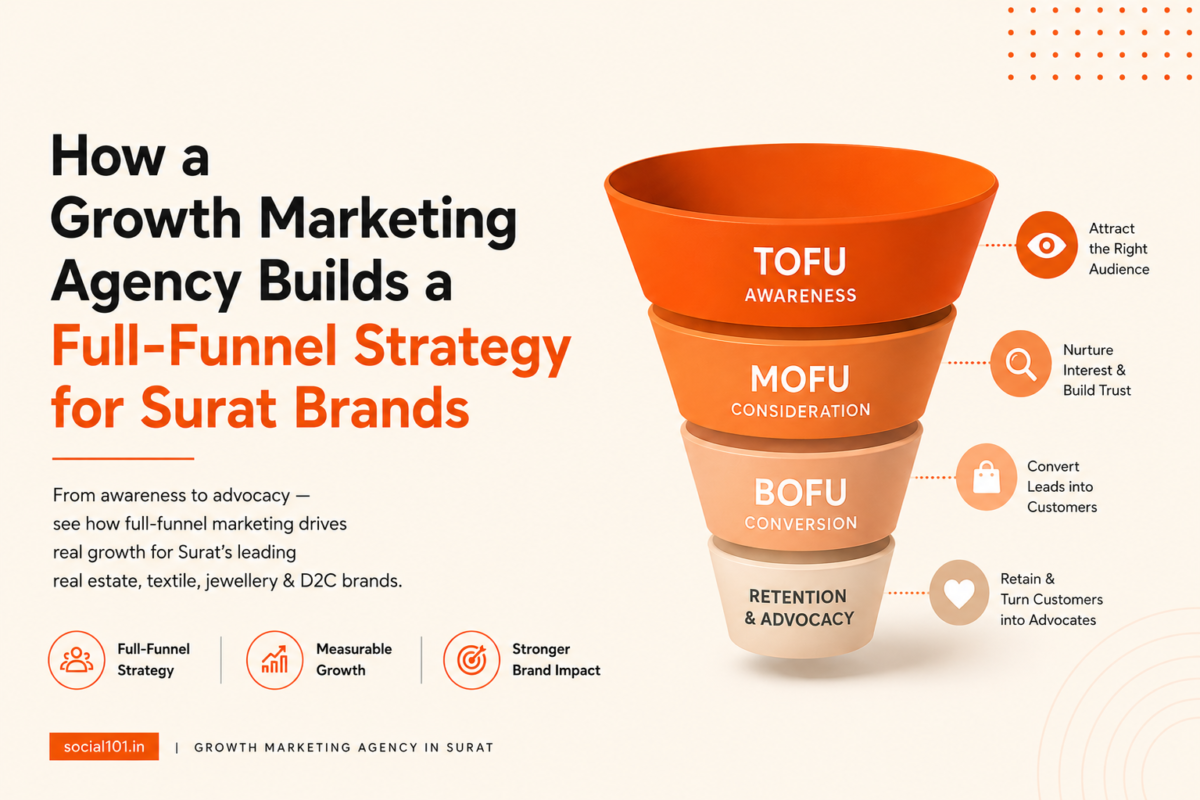
A full-funnel marketing strategy maps every marketing activity to a specific stage of the buyer’s decision instead of running disconnected campaigns:

  • TOFU (Top of Funnel): Strangers discover your brand exists
  • MOFU (Middle of Funnel): Interested people evaluate you against alternatives
  • BOFU (Bottom of Funnel): Warm leads are converted into paying customers
  • Retention & Advocacy: Customers stay, repeat-purchase, and refer others

The reason most Surat brands plateau is that they only invest in one stage, usually TOFU (reels, hashtags, and “reach”), while MOFU and BOFU are left to a sales team with no supporting content, retargeting, or nurture sequence. Reach without a conversion path is just noise.

Step 1: Audience Mapping and Funnel Audit

Before any content or ad spend, a proper agency audits three things:

  1. Where your current customers actually come from (referral, Google, Instagram, WhatsApp forwards, showroom walk-ins)
  2. Where the funnel currently leaks high traffic but no leads, high leads but no closures
  3. Who the buyer is at each stage: a real estate buyer researching for six months behaves nothing like a jewellery buyer who decides in a week

This is also where budget allocation gets decided. If you’re evaluating what this costs, our breakdown on performance marketing agency pricing in India is a useful reference point before you commit to a retainer.

Step 2: TOFU Building Awareness in a Crowded Surat Market

At the top of the funnel, the goal isn’t sales; it’s getting found by the right people. For Surat brands, that means two channels working together:

Organic and social content. Reels, carousels, and short-form video that speak to Surat’s specific buyer psychology: textile buyers respond to fabric-in-motion content very differently than a real estate audience responds to project walkthroughs. See our vertical-specific breakdowns for textile and saree businesses and diamond and jewelry manufacturers.

AI search visibility (GEO). In 2026, a growing share of Surat’s affluent buyers are asking ChatGPT and Google AI Overviews “best real estate developer in Surat” before they ever open Instagram. If your brand isn’t structured for AI search, you’re invisible at the exact moment intent is forming. We cover this in detail in how Surat businesses get found on ChatGPT and AI search.

Paid awareness (Meta and Google) supplements this but shouldn’t lead it. Organic builds the trust signal that makes paid perform better later in the funnel.

Step 3: MOFU Turning Attention Into Consideration

This is the stage most Surat businesses skip entirely, and it’s the most expensive gap to leave open. Someone saw your ad, visited your page, maybe even DM’d, and then went quiet. MOFU exists to keep that conversation alive:

  • Retargeting campaigns on Meta and Google for anyone who engaged but didn’t convert
  • WhatsApp and email nurture sequences with case studies, project details, or product catalogues
  • Social proof content: client testimonials, before/after, founder credibility posts
  • Comparison and education content that answers the objections a buyer has before they’ll pick up the phone

If you’re running paid ads without a retargeting layer behind them, you’re paying full price for every single lead, every single time. Our comparison of Meta Ads vs Google Ads for Surat businesses breaks down which platform fits which MOFU objective.

Step 4: BOFU Closing the Loop With Sales

At the bottom of the funnel, marketing and sales have to work as one system, not two departments that occasionally talk. This is where a growth marketing agency builds:

  • Sales enablement assets: one-pagers, WhatsApp catalogs, and pitch decks the sales team can send instantly
  • Founder and leadership personal branding on LinkedIn, which closes B2B and high-ticket deals faster than any ad ever will, especially in BFSI, real estate, and manufacturing
  • Time-bound offers and urgency triggers tied to inventory, festive seasons, or limited slots are particularly effective for real estate and jewelry.
  • Lead scoring and CRM handoff, so sales knows exactly which leads are warm and why

Real estate developers specifically benefit from structured, always-on lead systems rather than campaign bursts. Our guide on how local Surat businesses generate consistent leads online goes deeper into this.

Step 5: Retention and Advocacy The Stage Everyone Ignores

Full-funnel doesn’t stop at the sale. The cheapest customer to acquire is one you already have. This stage includes:

  • Post-purchase email/WhatsApp sequences
  • Referral incentive programs
  • UGC and review campaigns
  • Community building (especially powerful for D2C and jewellery brands with repeat-purchase potential)

D2C brands in particular should treat this as a core strategy, not an afterthought. Our channel-by-channel organic growth playbook for D2C brands in India covers retention tactics that most agencies never mention.

What This Looks Like Across Surat’s Key Industries

IndustryTOFU FocusMOFU FocusBOFU Focus
Real EstateProject reels, AI search visibilityRetargeting, site-visit nurtureUrgency offers, sales collateral
Textiles & SareesFabric/process content, cataloguesWhatsApp catalogue nurtureB2B trade show follow-up, bulk offers
Diamonds & JewelleryCraftsmanship storytelling, GEORetargeting, certification trust contentPersonalized consultations, limited editions
D2C / E-commerceInfluencer + organic contentEmail/SMS flows, retargetingCart recovery, loyalty programs

Common Mistakes Surat Brands Make With Their Funnel

  1. Running only TOFU big reach, no system to convert it
  2. No retargeting budget, treating every ad click as a one-shot opportunity
  3. Sales and marketing operating separately leads go cold in the handoff
  4. Ignoring AI search while competitors get cited by ChatGPT and Google AI Overviews
  5. No retention layer spending entire budgets on new acquisition, none on repeat business

If any of these sound familiar, it’s worth reading our checklist on how to choose the right performance marketing agency in Surat before signing another retainer that only covers half the funnel.

How Social 101 Builds Full-Funnel Strategies for Surat Brands

We’ve built and run this exact framework for 300+ brands across real estate, BFSI, textiles, jewelry, and D2C combining organic growth, performance marketing, and AI search optimization under one strategy instead of three disconnected vendors. If you want to see the full methodology behind our organic-first approach, our 2026 organic growth strategy guide is a good starting point, or explore our full services.

FAQs

What is a full-funnel marketing strategy?

It’s a marketing approach that maps content, ads, and sales activity to every stage of the buyer’s journey awareness, consideration, conversion, and retention instead of focusing only on one stage like social media reach.

Why do Surat brands need this more than a generic strategy?

Surat’s core industries (real estate, textiles, diamond and jewelry, and D2C each have very different buyer timelines and trust triggers. A one-size-fits-all campaign wastes budget; a funnel built around local buyer behavior converts it.

How long does it take to see results from a full-funnel strategy?

TOFU visibility can show movement in 4–6 weeks. MOFU and BOFU improvements (higher lead-to-close rates) typically show measurable impact within 90 days once retargeting and nurture sequences have enough data.

Is full-funnel marketing only for big brands?

No, the framework scales down. A local jewelry showroom needs the same four stages as a large real estate developer; the channels and budget just look different.

Ready to build a full-funnel strategy for your brand? Talk to Social 101 about a growth audit for your business.

Growth Marketing Agency in Surat: What It Does Differently From a Traditional Ad Agency

Surat’s business landscape—textiles, diamonds, real estate, manufacturing has long relied on traditional advertising: a hoarding here, a newspaper ad there, and a festive campaign once a year. It worked when attention was scarce and competition was local. It doesn’t work anymore.

A growth marketing agency in Surat approaches the same business problem, “get more customers,” with a completely different operating model than a traditional ad agency. This post breaks down exactly what that difference looks like, so you know what to expect before you sign a retainer.

1. Traditional Agencies Sell Creative. Growth Agencies Sell Outcomes.

A traditional ad agency’s deliverable is usually a campaign: a video, a print ad, a set of banners. Once it’s delivered and approved, the job is done. Success is measured by whether the client liked the creative, not by what it did for the business.

A growth marketing agency starts from the opposite end. Before a single asset is made, the question on the table is: what number are we trying to move? Leads, site visits, cost per acquisition, revenue per customer. Creativity is one lever among many alongside targeting, funnel design, pricing tests, and retention, all pointed at that number.

2. Data Drives the Strategy, Not Just the Report

Traditional agencies typically report data after a campaign runs: impressions, reach, and a vanity engagement chart at month-end. Growth agencies use data before and during the campaign to decide what to build next.

That means:

  • Weekly performance reviews, not just monthly recaps
  • A/B testing on creative, copy, and audience segments as a default practice, not an add-on
  • Attribution tracking that connects an ad click to an actual sale or site visit, not just a “like”

For sectors like real estate and jewelry, where a single lead can be worth lakhs, this difference alone can determine whether a marketing budget is profitable or wasted.

3. Full-Funnel Thinking vs. Top-of-Funnel Noise

Most traditional campaigns stop at awareness, getting the brand seen. A growth marketing agency maps the entire buyer journey: awareness, consideration, conversion, and repeat purchase or referral. Each stage gets its own content, channel, and message, because a first-time visitor and a warm lead need very different things said to them.

This is particularly relevant for Surat’s core industries:

  • Real estate: nurturing a lead from “just browsing” to a site visit and booking, often over weeks or months
  • Textiles and manufacturing: building B2B trust and technical credibility, not just brand recall
  • Jewellery and fashion: moving from Instagram discovery to an in-store or WhatsApp conversation

4. Retainers Built Around Business Goals, Not Deliverable Counts

Ask a traditional agency what you’re paying for, and the answer is usually a list: “X posts, Y reels, Z ads per month.” Ask a growth agency, and the conversation is about a target: “reduce cost per lead by 20% this quarter,” or “generate 50 qualified site visits a month.”

This changes the incentive structure entirely. A deliverable-based agency is paid whether or not the deliverable works. A growth-based agency’s retainer is justified by the result it produces,, which pushes both parties toward tracking, iterating, and course-correcting instead of just producing more content.

5. Technology and AI as Working Tools, Not Buzzwords

Traditional agencies have been slow to fold AI and automation into day-to-day execution; it’s often bolted on as a talking point in a pitch deck. Growth marketing agencies increasingly use AI for the following:

  • Faster creative testing and variant generation
  • Audience segmentation and predictive targeting
  • Automated reporting so strategists spend time on decisions, not spreadsheets

For an MSME-heavy market like Surat, this matters because it closes the resource gap between a large brand’s marketing team and a mid-sized manufacturer or jeweler working with a lean in-house team.

6. Vertical Expertise Over Generalist Execution

A traditional ad agency often applies the same playbook across every client. A template for a jeweler looks a lot like the template for a builder, just with different colors. A growth marketing agency operating in Surat has the advantage of deep, repeated exposure to the city’s core verticals: real estate, BFSI, manufacturing, FMCG, textiles, fashion, and jewelry.

That repetition builds pattern recognition. What messaging actually moves a real estate buyer in Vesu versus a wholesale textile buyer in Ring Road that a generalist simply can’t replicate campaign to campaign?

The Bottom Line

A traditional ad agency asks, “What should we create?” A growth marketing agency asks, “What result are we accountable for, and what’s the fastest, most measurable path to it?” That shift from creative-first to outcome-first is the real difference, and it’s why more Surat businesses are moving their budgets toward growth-focused partners.

If you want to see how this approach plays out across different industries, browse more breakdowns on the Social 101 blog, or get in touch through social101.in to talk through your specific growth goals.

How Long Does Organic Growth Take? Realistic Timelines an Organic Growth Agency Won’t Hide From You

“How long until we see results?”

It is the first question every founder asks and the one most agencies dodge. Some promise page-one rankings in 30 days. Others hide behind vague phrases like “it depends.” Both answers fail you.

At Social 101, we believe the honest answer builds better partnerships than the convenient one. So here it is: organic growth typically takes 4 to 6 months to show early momentum and 9 to 12 months to deliver compounding, business-changing results. Anyone quoting dramatically shorter timelines is either gaming the system or setting you up for disappointment.

This blog breaks down exactly why organic growth takes the time it does, what a realistic month-by-month journey looks like, and how a credible organic growth agency should be measuring progress along the way.

What Is Organic Growth, Really?

Organic growth is the process of building visibility, traffic, and customers through unpaid channels search rankings, social media reach, content, referrals, and brand recall rather than renting attention through ads.

The distinction matters because the two operate on completely different economics:

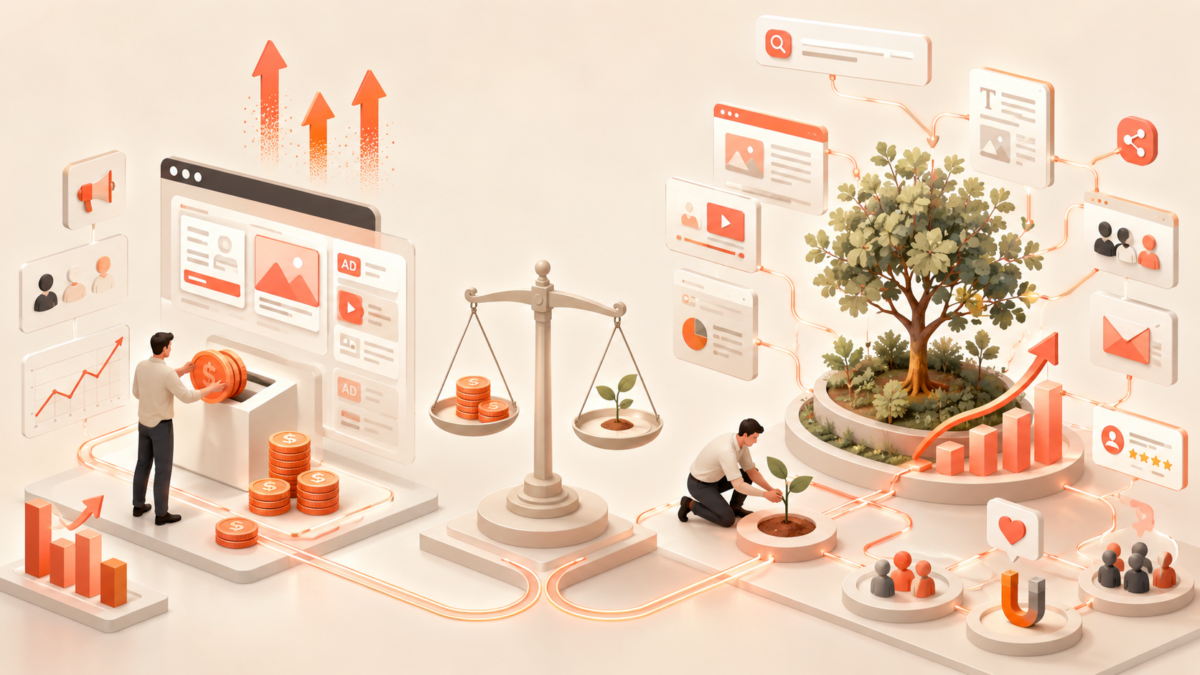
  • Paid growth is a tap. Turn it on, lead the flow. Turn it off, and they stop. Your cost per lead stays roughly constant (or rises) forever.
  • Organic growth is an asset. It starts slow, but every blog post, every ranking keyword, every follower, and every backlink compounds. Your cost per lead falls over time, and results persist even in months when you spend less.

This is exactly why organic growth cannot be rushed. You are not buying attention; you are building trust with search engines, with algorithms, and most importantly, with people. Trust has a minimum construction time.

Why Organic Growth Takes Time: The 4 Structural Reasons

1. Search engines need time to trust you

Google does not rank new or newly optimized websites immediately, even when the content is excellent. It needs to crawl your pages, evaluate engagement signals, compare you against established competitors, and verify consistency over months. A domain with weak authority may take 2 to 3 times longer to rank for the same keyword than an established one.

2. Content compounds; it does not spike

A single blog post rarely changes anything. Fifteen well-targeted posts, internally linked, covering a topic cluster your buyers actually search for that changes everything. But publishing, indexing, ranking, and climbing positions are sequential processes. Each stage takes weeks.

3. Social algorithms reward consistency, not bursts

Instagram, LinkedIn, and YouTube algorithms measure whether you show up predictably and whether audiences retain interest in your content over time. Thirty days of posting tells the algorithm very little. Six months of consistent, engagement-worthy content tells it everything.

4. Buyers need multiple touchpoints

Research consistently shows that buyers need somewhere between 7 and 20 brand interactions before they act. Organic growth is the machinery that creates those touchpoints, but the touchpoints themselves must accumulate before conversions follow.

The Realistic Organic Growth Timeline: Month by Month

Here is the honest roadmap we walk clients through at Social 101, built on experience across 300+ brands in real estate, jewelry, BFSI, manufacturing, and D2C.

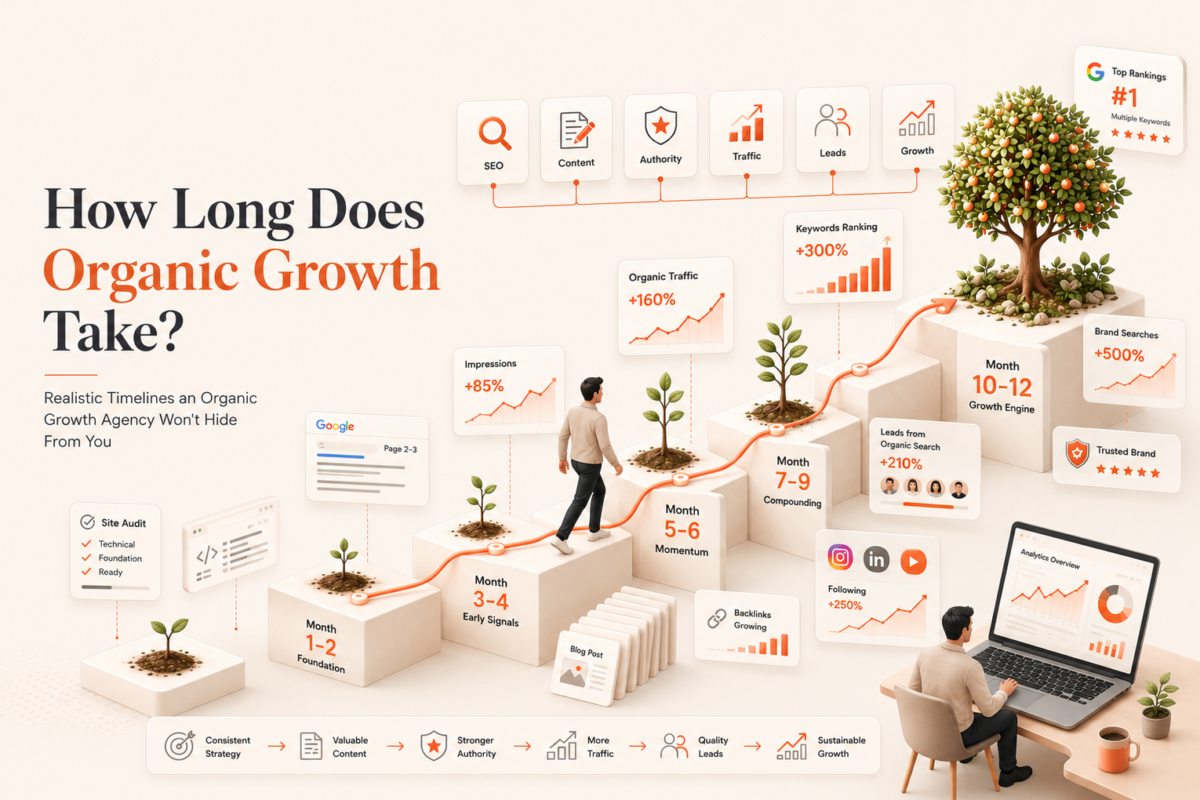
Months 1–2: Foundation (Expect: Almost No Visible Results)

This is the phase agencies love to skip and the phase that determines everything after it.

  • Technical SEO audit and fixes (site speed, indexing, mobile experience)
  • Keyword and audience research mapped to actual buying intent
  • Content strategy, topic clusters, and editorial calendar
  • Social media positioning, content pillars, and brand voice
  • Baseline analytics setup so growth can actually be measured

What you should see: Cleaner website health metrics, a documented strategy, and content production beginning. Not traffic. Not leads.

Months 3–4: Early Signals (Expect: Small, Measurable Movement)

  • Long-tail keywords begin ranking on pages 2–3 of Google
  • Impressions in Search Console rise noticeably, even if clicks are modest
  • Social engagement rate improves as content-market fit sharpens
  • The first organic enquiries may trickle in from low-competition terms

What you should see: Growth in impressions of 50–150%, early keyword rankings, and rising social reach. This is the “leading indicator” phase the metrics that predict future revenue move before revenue does.

Months 5–6: Momentum (Expect: The Curve Starts Bending)

  • Priority keywords enter page one for less competitive terms
  • Organic traffic typically grows 2–4x against the baseline
  • Social following growth accelerates as the algorithm rewards consistency
  • Organic leads become a regular, countable occurrence rather than a surprise

What you should see: This is the point where most businesses either quit (right before the payoff) or double down. The data at month 6 should clearly justify continuing.

Months 7–9: Compounding (Expect: Meaningful Business Impact)

  • Competitive, high-intent keywords start ranking on page one
  • Content published in months 1–4 hits its ranking maturity
  • Cost per organic lead drops sharply as volume rises against fixed effort
  • Brand searches (people Googling your name directly) begin climbing

Months 10–12: The Asset Phase (Expect: Organic Becomes a Growth Engine)

  • Organic channels often rival or beat paid channels on lead volume
  • Older content keeps producing leads with zero incremental spend
  • Authority earned makes every new piece of content rank faster
  • You now own a compounding asset instead of renting attention

The compounding truth: most brands see more organic results in months 10–12 than in months 1–9 combined. The curve is exponential, not linear, which is precisely why quitting at month four destroys nearly all the value.

6 Factors That Speed Up (or Slow Down) Your Timeline

No two brands grow at the same pace. These are the variables that matter most:

  1. Domain age and authority. An established website with existing backlinks moves faster than a brand-new domain, often by 3–6 months.
  2. Industry competitiveness. Ranking for “luxury flats in Vesu” is a very different battle from ranking for “insurance.” High-competition verticals like BFSI and real estate demand longer runways and sharper strategy.
  3. Content velocity and quality. Brands publishing 8–12 genuinely useful pieces per month compound faster than those publishing 2 generic ones.
  4. Starting point. A site with technical debt, thin content, or past penalties needs a repair phase before a growth phase.
  5. Consistency. Organic growth punishes stop-start execution more than any other channel. Three consistent months beat six erratic ones.
  6. Strategic clarity. Effort pointed at the wrong keywords or the wrong audience produces activity, not growth. This is where an experienced organic growth agency earns its fee by making sure every hour of effort compounds in the right direction.

Red Flags: What a Dishonest Agency Will Promise You

If you are evaluating an organic growth agency, treat these claims as immediate warning signs:

  • “Page one rankings in 30 days” Only possible for keywords nobody searches, or through black-hat tactics that invite Google penalties.
  • “Guaranteed #1 position.” No agency controls Google. Guarantees on rankings are guarantees of dishonesty.
  • “10,000 followers in a month.” Purchased followers destroy your engagement rate and algorithmic reach, the exact assets organic growth is supposed to build.
  • No mention of a strategy or research phase. If execution starts on day one without an audit, they are running a template, not a strategy.
  • Vague reporting. If they cannot tell you which keywords, which content, and which channels are producing movement, they are hiding the absence of it.

The uncomfortable truth is that shortcuts in organic growth do not just fail they actively damage the asset. Recovering from a Google penalty or a dead engagement rate takes longer than building correctly from day one.

How to Measure Progress Before the Leads Arrive

The biggest mistake businesses make is measuring organic growth by leads alone in the first quarter. Leads are a lagging indicator. In the early months, track the leading indicators instead:

PhaseWhat to MeasureWhat It Predicts
Months 1–2Site health, indexing, content outputWhether the foundation is real
Months 3–4Impressions, keyword positions, engagement rateWhether momentum is building
Months 5–6Organic traffic, page-one keywords, follower qualityWhether leads are imminent
Months 7–12Organic leads, cost per lead, brand searchesWhether the asset is compounding

A transparent organic growth agency will report on the right metric for the right phase and will tell you plainly when something is not working, so strategy can be corrected early rather than disguised for months.

The Real Question Is Not “How Long”; It Is “How Durable”

Paid ads deliver in week one and disappear the day you stop spending. Organic growth delivers in month five and keeps delivering in year three. The question is not which channel is faster; it is which channel builds something you own.

The brands that dominate their categories organically today are simply the ones who started 12 months before their competitors and refused to quit at month four.

Frequently Asked Questions

How long does organic growth take for a new website?

Typically 6 to 12 months for meaningful traffic, since a new domain must build authority from zero. Early wins come from long-tail, low-competition keywords in months 3–5.

Can organic growth work without paid ads?

Yes but the smartest approach is often hybrid: paid ads generate leads in months 1–6 while organic builds, then organic gradually takes over lead volume and paid budgets shrink or refocus.

Is 3 months enough to judge an organic growth agency?

Not on leads but yes on process. By month 3 you should see a clear strategy, consistent execution, rising impressions, and early keyword movement. The absence of all four is a legitimate reason to exit.

How much content is needed for organic growth?

Quality-adjusted consistency matters more than raw volume. For most SMBs, 6–10 strong, search-targeted pieces per month, sustained for 9–12 months, outperforms any short burst.

What does an organic growth agency actually do?

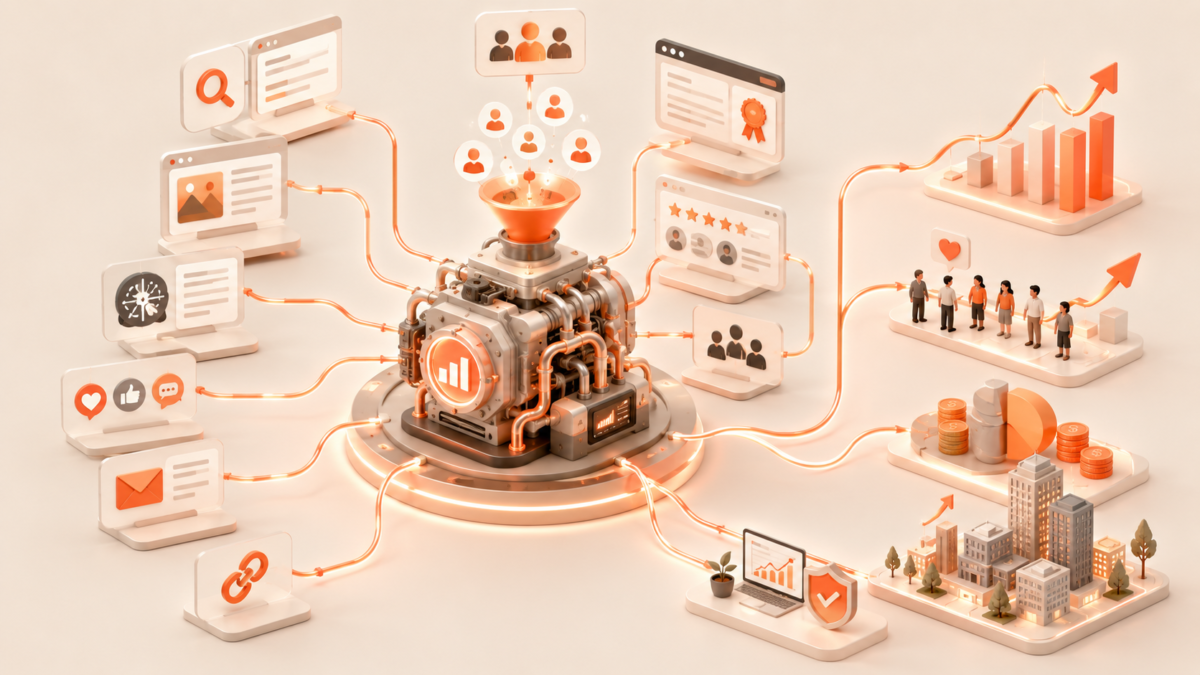
It builds and executes the full system: SEO, content strategy, social media management, and brand positioning and connects them so each channel compounds the others rather than working in silos.

Ready for Growth That Compounds?

Social 101 is a full-service digital marketing and organic growth agency in Surat, trusted by 300+ brands across real estate, jewellery, BFSI, manufacturing, and D2C. We will not promise you page one in 30 days. We will show you a realistic roadmap, report honestly at every phase, and build an organic engine your business owns for years.

Talk to our team at social101.in or read more insights on the Social 101 blog.

7 Signs Your Business Needs an Organic Growth Agency

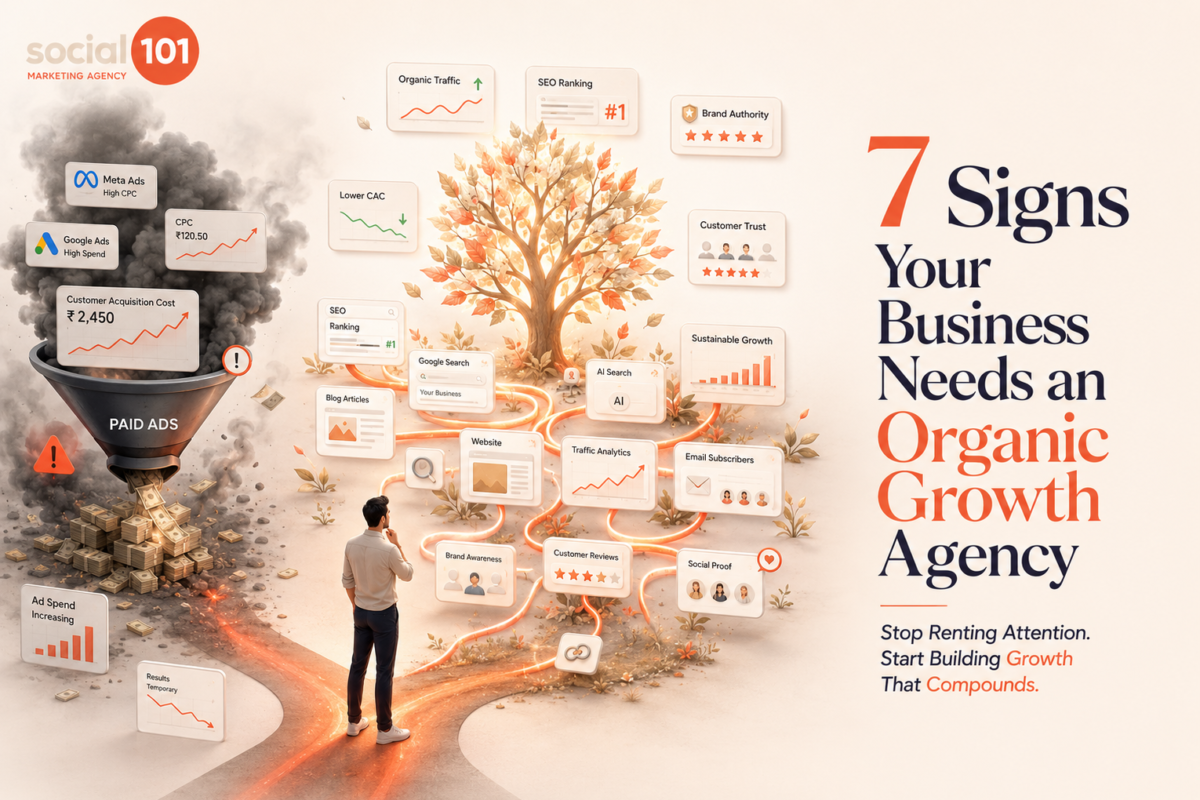
Every quarter, the same conversation happens in boardrooms across India. Revenue is flat, so the marketing team asks for a bigger ad budget. The budget increases, results improve for a month, and then the numbers slide back to where they started. If this cycle sounds familiar, the problem is not your ad spend. It is your growth model.

Paid advertising rents attention. An organic growth agency helps you own it. The difference decides whether your customer acquisition costs rise every year or fall as your brand compounds.

At Social 101, we have worked with over 300 brands across real estate, BFSI, manufacturing, jewelry, and e-commerce, and we see the same pattern repeatedly: businesses over-invested in paid channels and under-invested in the assets that generate demand without a daily bill. Here are the seven signs it is happening to you.

1. Your Customer Acquisition Cost Rises Every Quarter

The clearest warning sign is in your own dashboard. If your cost per lead or cost per acquisition has increased for three or more consecutive quarters while your targeting and creative quality stayed constant, you are experiencing paid media inflation. Ad platforms are auctions, and every year more advertisers bid for the same audience. An organic growth agency attacks this problem from the other side. Search-optimized content, a strong brand presence, and owned audiences bring in leads whose marginal cost approaches zero over time. The first blog post costs money to produce. The five hundredth lead it generates costs nothing.

2. Traffic Stops the Moment You Pause Campaigns

Run a simple test: pause your ad campaigns for one week and watch your website traffic. If it drops by 70 to 90 percent, your business does not have a marketing engine. It has a marketing faucet, and the platform controls the tap.

Healthy businesses have a base layer of organic traffic from search, direct visits, referrals, and social discovery that continues whether or not ads are running. Building that base layer is precisely what an organic growth agency in Surat or anywhere else is structured to do: SEO, content systems, and brand-led distribution that keep working while you sleep.

3. You Rank Nowhere for the Searches Your Buyers Actually Make

Open an incognito window and search for your core product or service the way a customer would. If your competitors, marketplaces, and directories fill page one while your website appears nowhere, you are surrendering the highest-intent traffic on the internet.

People searching for a solution are already in buying mode. Ads can intercept them, but organic rankings capture them at a fraction of the long-term cost, and with higher trust. Buyers know the difference between a sponsored result and an earned one. With AI-driven search results now answering queries directly, brands that are absent from organic results are also absent from AI recommendations, which makes the gap even more expensive.

4. Your Brand Generates No Demand of Its Own

Check your search console data for branded searches, meaning people typing your company name directly. If branded search volume is negligible, your brand is not creating demand. You are only capturing demand that platforms serve to you, at auction prices.

Strong brands enjoy a structural advantage: customers seek them out, referrals arrive unprompted, and conversion rates on every channel improve because familiarity does half the selling. Building this kind of brand gravity through consistent content, thought leadership, and community is slow work, and it is exactly the work an organic growth agency is built for.

5. Your Content Is a Calendar, Not a System

Many businesses technically “do content.” They post three times a week, publish an occasional blog, and share festival greetings. But when asked what business outcome any of it drives, there is silence.

Content without strategy is decoration. A proper organic growth system connects every piece of content to a stage of the buyer journey: awareness content that ranks and gets discovered, consideration content that builds trust, and decision content that converts. Each piece is mapped to keywords, distribution channels, and measurable outcomes. If your content plan is just a posting schedule, you are spending effort without building an asset.

6. You Depend on One Channel for More Than Half Your Revenue

Concentration risk is not just an investing concept. If Meta ads, Google ads, or a single marketplace drives the majority of your revenue, one policy change, algorithm update, or account suspension can cut your business in half overnight. Businesses across India experienced exactly this when ad accounts were flagged during festive seasons or when organic reach on a platform collapsed.

Organic growth diversifies you by default. Search traffic, an email list, a strong LinkedIn presence, referral systems, and direct traffic each act as independent revenue streams. No single company can switch them off.

7. Your Competitors Are Winning Deals Before You Even Enter the Room

The most painful sign is the quietest one. Prospects arrive at sales conversations having already read your competitor’s case studies, watched their founder’s videos, and seen their name ranked first on Google. The deal is 70 percent decided before your pitch begins.

This is what organic dominance looks like from the losing side. Your competitor is not necessarily outspending you on ads. They invested early in visibility assets that now shape buyer perception at scale. The only response is to start building your own, and the best time to start was two years ago. The second-best time is now.

Ads and Organic Are Not Enemies, But the Ratio Matters

None of this means paid advertising is wrong. Ads are excellent for testing offers, scaling proven messages, and driving time-sensitive campaigns. The problem is a portfolio that is 90 percent rented attention and 10 percent owned assets. Mature businesses gradually invert that ratio, using organic growth to lower acquisition costs and paid media to amplify what already works.

Why Businesses Choose an Organic Growth Agency in Surat

For businesses in Gujarat’s fastest-growing commercial hub, working with an organic growth agency in Surat brings an added advantage: local market understanding. Consumer behaviour in textiles, diamonds, jewellery, real estate, and manufacturing here follows patterns that a generic playbook misses. An agency that knows the region can build organic strategies around local search intent, regional language content, and the trust dynamics that drive B2B and D2C buying in this market.

Social 101 has spent over seven years building organic growth systems for brands across these exact verticals, combining SEO, content strategy, brand building, and AI search optimization into one integrated engine.

The Bottom Line

If three or more of these signs describe your business, the answer is not a bigger ad budget. It is a structural shift toward growth you own. Audit your channel mix, measure your organic baseline, and start building the assets that compound.

Ready to see where your organic gaps are? Get in touch with our team for a growth audit, or explore more insights on our blog.

FAQ

What does an organic growth agency do?

An organic growth agency builds marketing systems that generate leads and revenue without continuous ad spend, using SEO, content strategy, brand building, social media, and owned audience channels like email.

How is organic growth different from paid advertising?

Paid advertising delivers instant but temporary traffic that stops when spending stops. Organic growth builds compounding assets such as search rankings, content libraries, and brand recognition that continue producing results long after the initial investment.

How long does organic growth take to show results?

Most businesses see early traction within 3 to 6 months and significant results within 9 to 12 months. Unlike ads, results accelerate over time rather than plateau.

Why hire an organic growth agency in Surat?

A local agency understands regional market dynamics, buyer behaviour, and industry verticals specific to Surat and Gujarat, allowing organic strategies that outperform generic national playbooks.