
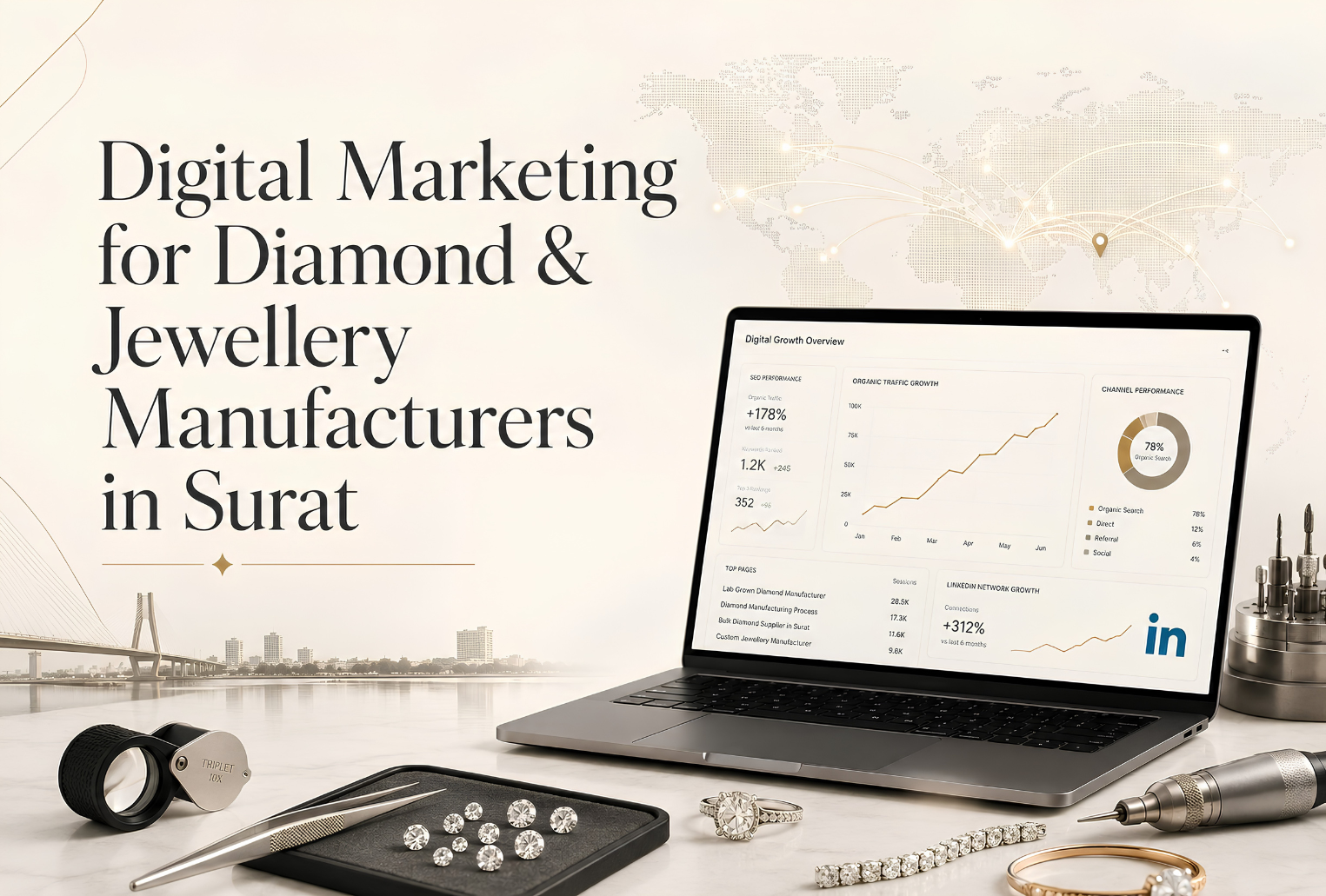
Surat polishes roughly 90% of the world’s diamonds, yet most manufacturers here still win business the way they did twenty years ago: through brokers, family networks, trade-show handshakes, and word of mouth. That model isn’t broken, but it is shrinking. International buyers, retail chains, and large wholesalers now run supplier due diligence online before they ever reply to an email. If a manufacturer can’t be found and verified digitally, it quietly loses deals it never even knew existed.
This guide lays out exactly how diamond and jewelry manufacturers in Surat can build a B2B digital marketing engine that generates qualified buyer inquiries, shortens sales cycles, and positions the company as a credible, export-ready supplier.
Why B2B Jewellery Marketing Is Different (and Why Most Agencies Get It Wrong)
Most marketing advice you’ll find online is built for B2C jewelry brands selling rings to brides. That advice actively hurts a manufacturer. The buyer is not an individual; it’s a procurement manager, a retail buyer, an importer, or a wholesaler placing repeat orders worth lakhs to crores.
The differences that matter:
- Long sales cycles. A single export relationship can take months to close and years to mature. Marketing has to nurture, not just capture.
- Trust over aesthetics. Buyers care about certifications, consistency, capacity, and compliance far more than a pretty Instagram grid.
- Smaller, higher-value audience. You’re not trying to reach a million people. You’re trying to reach a few thousand of the right decision-makers.
- Relationship-led conversion. The deal closes in a meeting, a factory visit, or a video call, not a checkout cart. Digital’s job is to get you into that room.
If your current agency keeps pushing festival-themed reels and discount posts, they’re treating your manufacturing business like a jewelry showroom. That’s the wrong playbook.
The Foundation: Your Website Is Your Factory’s First Impression
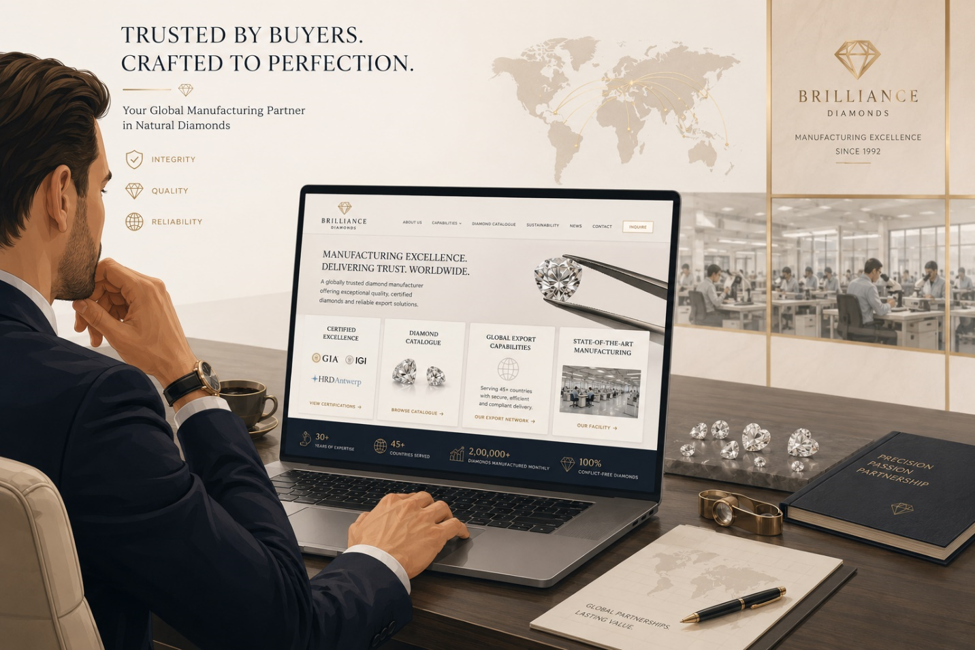
Before any campaign, your website needs to do for an online buyer what a factory tour does in person — prove you are serious, capable, and trustworthy.
A B2B-ready manufacturer website should include:
- Clear capability statement: what you cut, polish, or manufacture, in what range, at what volume.
- Certifications front and center: GIA, IGI, BIS Hallmark, Kimberley Process, RJC, and ISO. These are trust signals buyers actively search for.
- Capacity and infrastructure: number of machines, monthly output, in-house vs. outsourced processes.
- Product catalog or range even without prices: buyers need to see what you produce.
- Export-ready countries served, logistics partners, packaging, and documentation support.
- A real “About” story: family heritage, years in operation, leadership. Buyers buy from people.
- Frictionless inquiry paths: WhatsApp, inquiry forms, and a direct line, in that order of speed.
If your website needs a credibility overhaul before you spend a rupee on ads, that’s the right place to start. You can see how we approach B2B website and brand positioning for manufacturers and consulting-led businesses.
SEO: Get Found by Buyers Searching Right Now
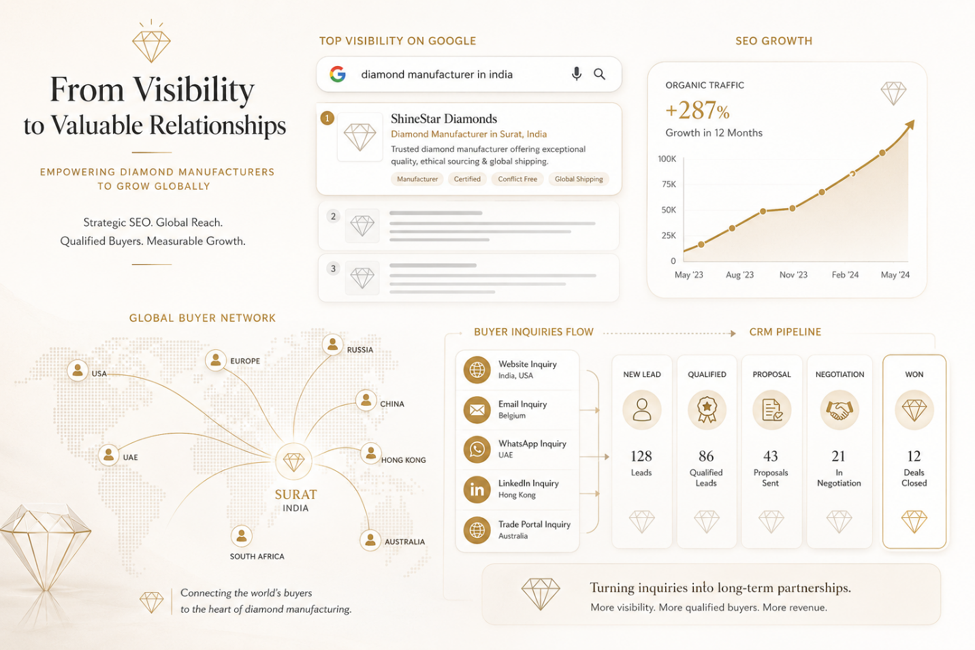
There are real buyers typing “diamond manufacturer in Surat,” “CVD diamond supplier India,” and “lab-grown diamond wholesaler” into Google and increasingly into AI search tools like ChatGPT and Perplexity. If you don’t appear, a competitor does.
What B2B jewellery SEO actually involves
- Keyword targeting around buyer intent, not vanity terms. “Loose diamond manufacturer Surat” converts; “beautiful diamonds” does not.
- Dedicated pages per capability and per market: a page for natural diamonds, one for lab-grown/CVD, one for specific cuts, and one per key export geography.
- Technical SEO: fast load speed, mobile readiness, clean structure, and schema markup so search engines understand you’re a manufacturer.
- Local SEO: A fully optimized Google Business Profile so you show up in “diamond manufacturer near me” and map searches.
- GEO (Generative Engine Optimization) structuring content so AI assistants cite you when a buyer asks them to recommend suppliers. This is the newest and least-contested edge available right now.
SEO is a compounding asset: unlike ads, the inquiries keep coming after you stop paying. We’ve written more on building search visibility on our Social 101 blog, where we break down SEO and content strategy for businesses in and around Surat.
LinkedIn: The Single Highest-Leverage Channel for B2B Jewellery
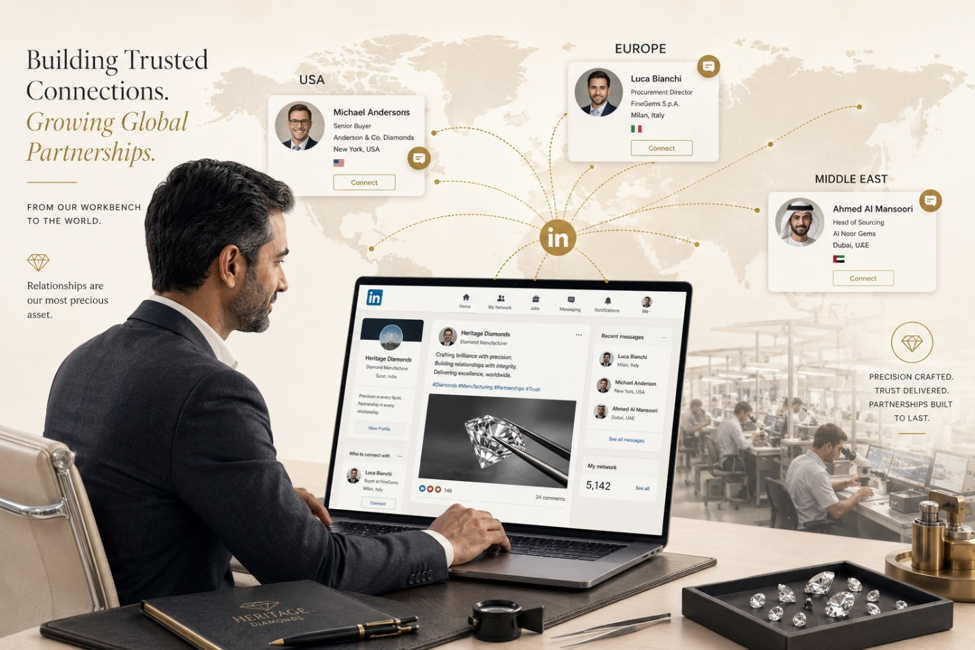
If you do only one thing from this guide, make it LinkedIn. This is where retail buyers, importers, brand sourcing heads, and distributors actually spend professional attention. Instagram builds awareness; LinkedIn builds pipeline.
How manufacturers should use LinkedIn
- Optimize the founder/owner profile, not just the company page. People trust people. A credible personal profile from the MD or director outperforms a faceless brand page.
- Post insight, not inventory. Share market commentary on diamond pricing, lab-grown trends, export shifts, GST changes, and Surat’s industry developments. Position yourself as someone who understands the market.
- Document the factory. Behind-the-scenes process content, quality checks, and craftsmanship build enormous trust with international buyers who can’t visit in person.
- Target and connect deliberately. Use LinkedIn to identify and reach buyers, sourcing managers, and distributors in your target countries, then nurture them with consistent, valuable content.
- Use outreach + content together. Cold outreach alone gets ignored. Outreach backed by a credible, active profile and useful content gets replies.
This founder-led, narrative approach is exactly the kind of positioning that wins high-value B2B relationships.
Instagram & Video: Awareness and Craft, Not Discounts
Instagram still matters for manufacturers, but for a specific purpose: showcasing craftsmanship and scale to build top-of-funnel awareness and trust. Think process reels, precision cutting, quality control, and finished product showcases that signal capability. The goal is to make a buyer think “these people are serious,” then route them to LinkedIn or your website to take the relationship forward.
Avoid the B2C trap of discount posts, festival templates, and consumer-style giveaways. They attract the wrong audience and dilute your positioning as a manufacturer.
Lead Generation: Turning Attention Into Inquiries
Visibility without a capture-and-nurture system just creates traffic, not revenue. A working B2B lead engine for a jewellery manufacturer looks like this:
- Attracting SEO, LinkedIn content, and targeted ads bring the right buyers into your orbit.
- Capturing inquiry forms, lead magnets (a catalogue, a capability deck, and a pricing guide), and WhatsApp entry points convert interest into contact details.
- Qualify separate serious buyers (volume, geography, repeat potential) from time-wasters early.
- Nurturing email and LinkedIn follow-ups, catalogs, and case studies keep you top-of-mind through a long cycle.
- Convert the sales team’s closes via call, meeting, or factory visit.
- Retain & expand repeat orders and referrals are where manufacturer profitability really lives.
Paid ads (Google Search and LinkedIn) can accelerate the “attract” stage, but only once the foundation website, positioning, and capture system is in place. Running ads before that is pouring water into a leaking bucket.
A Realistic 90-Day Starting Plan
Days 1–30 Foundation. Fix the website for B2B credibility, set up and optimize the Google Business Profile, and rebuild the founder’s LinkedIn profile. Define your target buyer and target geographies clearly.
Days 31–60 Visibility. Publish foundational SEO pages (capabilities, lab-grown/CVD, key export markets). Begin consistent LinkedIn posting (2–3 times a week) and start deliberate buyer-side connection building.
Days 61–90 Pipeline. Launch a lead-capture system (catalogue/capability deck + inquiry forms + WhatsApp). Begin targeted LinkedIn outreach backed by your now-credible profile. Test a small Google Search ad budget on high-intent buyer keywords.
By day 90, you should have measurable inbound inquiries and a repeatable system, not just “more posts.”
Common Mistakes Surat Manufacturers Make
- Treating B2B marketing like B2C jewelry retail.
- Relying entirely on brokers and trade shows with no digital presence to back them up.
- Hiring an agency that posts consistently but generates zero qualified inquiries.
- Ignoring LinkedIn because “our buyers aren’t there.” They are; you just haven’t shown up.
- Spending on ads before the website and positioning are ready.
- Measuring vanity metrics (likes, followers) instead of inquiries and pipeline.
The Bottom Line
Surat’s manufacturers don’t have a quality problem; the world already trusts the city’s craftsmanship. What many have is a visibility and positioning problem in a market where buyers now research and shortlist digitally. The manufacturers who win the next decade will be the ones who show up credibly online, lead with insight on LinkedIn, get found in search, and run a real lead system behind it all.
That’s not a campaign. It’s an engine, and building it is exactly the kind of B2B growth work we focus on.
Social 101 is a full-service marketing and business consulting agency based in Surat, helping manufacturers, B2B brands, and high-value businesses build positioning, visibility, and lead-generation systems that actually convert. Explore how we work or read more strategy guides on our blog.
Ready to build a B2B marketing engine for your jewelry or diamond business? Talk to Social 101.

