
Surat’s business landscape—textiles, diamonds, real estate, manufacturing has long relied on traditional advertising: a hoarding here, a newspaper ad there, and a festive campaign once a year. It worked when attention was scarce and competition was local. It doesn’t work anymore.
A growth marketing agency in Surat approaches the same business problem, “get more customers,” with a completely different operating model than a traditional ad agency. This post breaks down exactly what that difference looks like, so you know what to expect before you sign a retainer.
1. Traditional Agencies Sell Creative. Growth Agencies Sell Outcomes.
A traditional ad agency’s deliverable is usually a campaign: a video, a print ad, a set of banners. Once it’s delivered and approved, the job is done. Success is measured by whether the client liked the creative, not by what it did for the business.
A growth marketing agency starts from the opposite end. Before a single asset is made, the question on the table is: what number are we trying to move? Leads, site visits, cost per acquisition, revenue per customer. Creativity is one lever among many alongside targeting, funnel design, pricing tests, and retention, all pointed at that number.
2. Data Drives the Strategy, Not Just the Report
Traditional agencies typically report data after a campaign runs: impressions, reach, and a vanity engagement chart at month-end. Growth agencies use data before and during the campaign to decide what to build next.
That means:
- Weekly performance reviews, not just monthly recaps
- A/B testing on creative, copy, and audience segments as a default practice, not an add-on
- Attribution tracking that connects an ad click to an actual sale or site visit, not just a “like”
For sectors like real estate and jewelry, where a single lead can be worth lakhs, this difference alone can determine whether a marketing budget is profitable or wasted.

3. Full-Funnel Thinking vs. Top-of-Funnel Noise
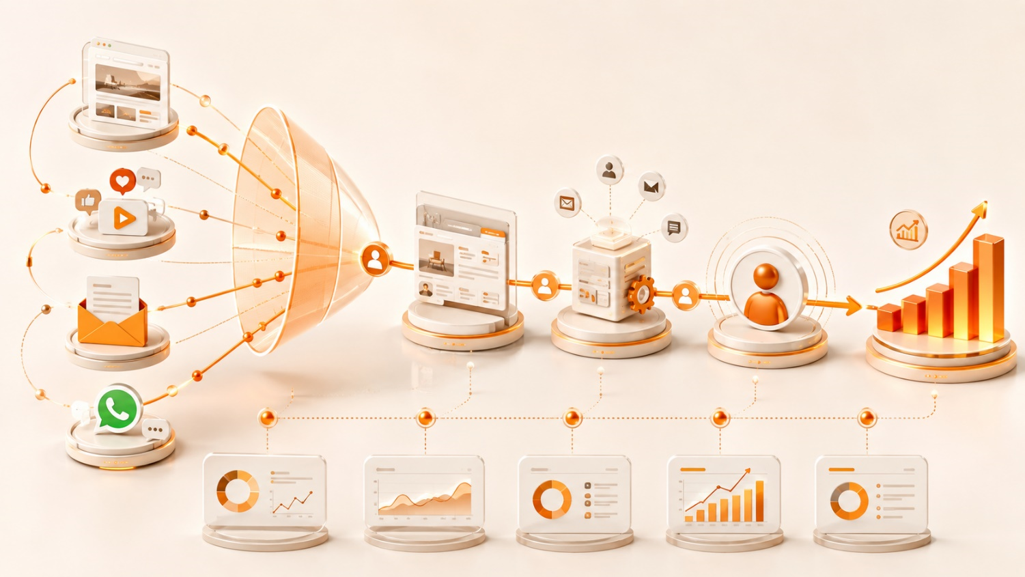
Most traditional campaigns stop at awareness, getting the brand seen. A growth marketing agency maps the entire buyer journey: awareness, consideration, conversion, and repeat purchase or referral. Each stage gets its own content, channel, and message, because a first-time visitor and a warm lead need very different things said to them.
This is particularly relevant for Surat’s core industries:
- Real estate: nurturing a lead from “just browsing” to a site visit and booking, often over weeks or months
- Textiles and manufacturing: building B2B trust and technical credibility, not just brand recall
- Jewellery and fashion: moving from Instagram discovery to an in-store or WhatsApp conversation
4. Retainers Built Around Business Goals, Not Deliverable Counts
Ask a traditional agency what you’re paying for, and the answer is usually a list: “X posts, Y reels, Z ads per month.” Ask a growth agency, and the conversation is about a target: “reduce cost per lead by 20% this quarter,” or “generate 50 qualified site visits a month.”
This changes the incentive structure entirely. A deliverable-based agency is paid whether or not the deliverable works. A growth-based agency’s retainer is justified by the result it produces,, which pushes both parties toward tracking, iterating, and course-correcting instead of just producing more content.
5. Technology and AI as Working Tools, Not Buzzwords
Traditional agencies have been slow to fold AI and automation into day-to-day execution; it’s often bolted on as a talking point in a pitch deck. Growth marketing agencies increasingly use AI for the following:
- Faster creative testing and variant generation
- Audience segmentation and predictive targeting
- Automated reporting so strategists spend time on decisions, not spreadsheets
For an MSME-heavy market like Surat, this matters because it closes the resource gap between a large brand’s marketing team and a mid-sized manufacturer or jeweler working with a lean in-house team.
6. Vertical Expertise Over Generalist Execution
A traditional ad agency often applies the same playbook across every client. A template for a jeweler looks a lot like the template for a builder, just with different colors. A growth marketing agency operating in Surat has the advantage of deep, repeated exposure to the city’s core verticals: real estate, BFSI, manufacturing, FMCG, textiles, fashion, and jewelry.
That repetition builds pattern recognition. What messaging actually moves a real estate buyer in Vesu versus a wholesale textile buyer in Ring Road that a generalist simply can’t replicate campaign to campaign?

The Bottom Line
A traditional ad agency asks, “What should we create?” A growth marketing agency asks, “What result are we accountable for, and what’s the fastest, most measurable path to it?” That shift from creative-first to outcome-first is the real difference, and it’s why more Surat businesses are moving their budgets toward growth-focused partners.
If you want to see how this approach plays out across different industries, browse more breakdowns on the Social 101 blog, or get in touch through social101.in to talk through your specific growth goals.

