Most Surat businesses don’t have a marketing problem. They have a marketing fragmentation problem.
One agency runs the Instagram page. A freelancer manages Google Ads. Someone’s cousin handles the website SEO on the side. Nobody owns the customer’s actual journey from the first time they see your brand to the day they refer a friend. That’s what a full-funnel marketing strategy fixes, and it’s the single biggest difference between brands that scale predictably and brands that just “post content and hope.”
This is a practical breakdown of how a growth marketing agency in Surat actually builds that funnel stage by stage for the industries that define this city: real estate, textiles, diamond and jewelry manufacturing, and D2C.
What “Full-Funnel” Actually Means (Beyond the Buzzword)
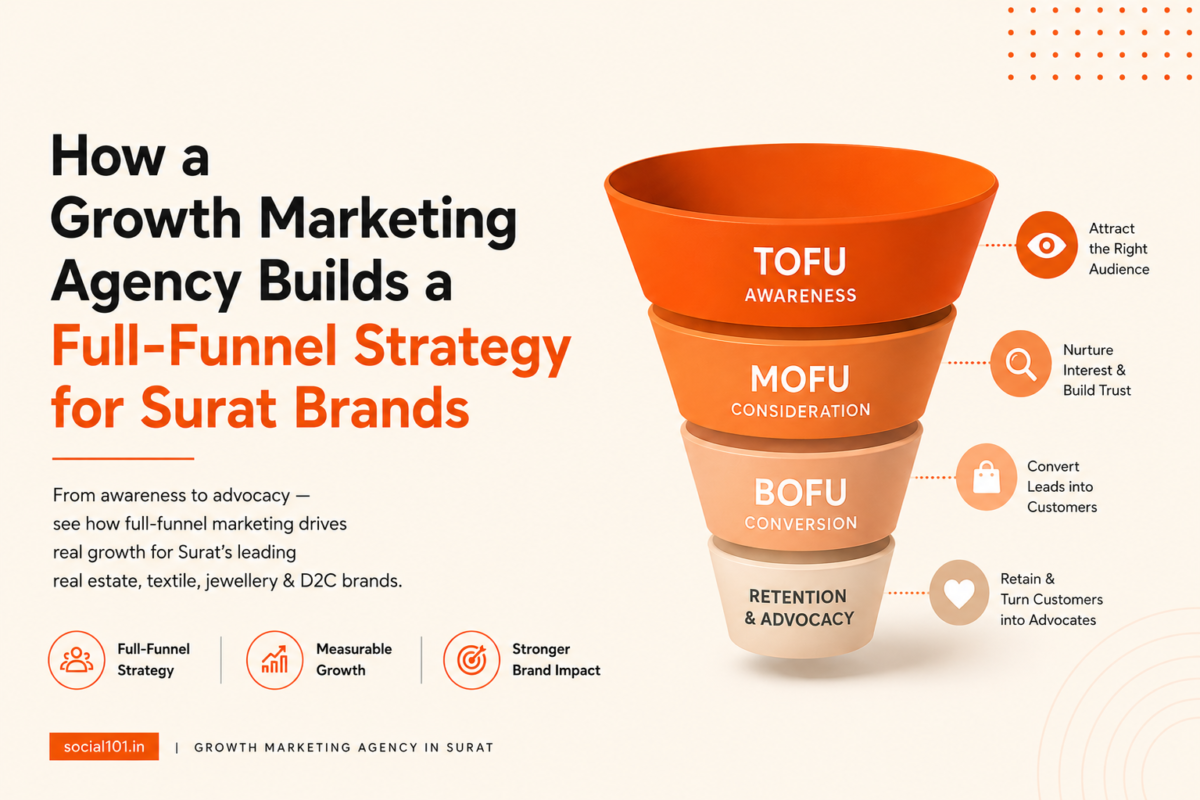
A full-funnel marketing strategy maps every marketing activity to a specific stage of the buyer’s decision instead of running disconnected campaigns:
- TOFU (Top of Funnel): Strangers discover your brand exists
- MOFU (Middle of Funnel): Interested people evaluate you against alternatives
- BOFU (Bottom of Funnel): Warm leads are converted into paying customers
- Retention & Advocacy: Customers stay, repeat-purchase, and refer others
The reason most Surat brands plateau is that they only invest in one stage, usually TOFU (reels, hashtags, and “reach”), while MOFU and BOFU are left to a sales team with no supporting content, retargeting, or nurture sequence. Reach without a conversion path is just noise.
Step 1: Audience Mapping and Funnel Audit
Before any content or ad spend, a proper agency audits three things:
- Where your current customers actually come from (referral, Google, Instagram, WhatsApp forwards, showroom walk-ins)
- Where the funnel currently leaks high traffic but no leads, high leads but no closures
- Who the buyer is at each stage: a real estate buyer researching for six months behaves nothing like a jewellery buyer who decides in a week
This is also where budget allocation gets decided. If you’re evaluating what this costs, our breakdown on performance marketing agency pricing in India is a useful reference point before you commit to a retainer.
Step 2: TOFU Building Awareness in a Crowded Surat Market
At the top of the funnel, the goal isn’t sales; it’s getting found by the right people. For Surat brands, that means two channels working together:
Organic and social content. Reels, carousels, and short-form video that speak to Surat’s specific buyer psychology: textile buyers respond to fabric-in-motion content very differently than a real estate audience responds to project walkthroughs. See our vertical-specific breakdowns for textile and saree businesses and diamond and jewelry manufacturers.
AI search visibility (GEO). In 2026, a growing share of Surat’s affluent buyers are asking ChatGPT and Google AI Overviews “best real estate developer in Surat” before they ever open Instagram. If your brand isn’t structured for AI search, you’re invisible at the exact moment intent is forming. We cover this in detail in how Surat businesses get found on ChatGPT and AI search.
Paid awareness (Meta and Google) supplements this but shouldn’t lead it. Organic builds the trust signal that makes paid perform better later in the funnel.
Step 3: MOFU Turning Attention Into Consideration
This is the stage most Surat businesses skip entirely, and it’s the most expensive gap to leave open. Someone saw your ad, visited your page, maybe even DM’d, and then went quiet. MOFU exists to keep that conversation alive:
- Retargeting campaigns on Meta and Google for anyone who engaged but didn’t convert
- WhatsApp and email nurture sequences with case studies, project details, or product catalogues
- Social proof content: client testimonials, before/after, founder credibility posts
- Comparison and education content that answers the objections a buyer has before they’ll pick up the phone
If you’re running paid ads without a retargeting layer behind them, you’re paying full price for every single lead, every single time. Our comparison of Meta Ads vs Google Ads for Surat businesses breaks down which platform fits which MOFU objective.
Step 4: BOFU Closing the Loop With Sales
At the bottom of the funnel, marketing and sales have to work as one system, not two departments that occasionally talk. This is where a growth marketing agency builds:
- Sales enablement assets: one-pagers, WhatsApp catalogs, and pitch decks the sales team can send instantly
- Founder and leadership personal branding on LinkedIn, which closes B2B and high-ticket deals faster than any ad ever will, especially in BFSI, real estate, and manufacturing
- Time-bound offers and urgency triggers tied to inventory, festive seasons, or limited slots are particularly effective for real estate and jewelry.
- Lead scoring and CRM handoff, so sales knows exactly which leads are warm and why
Real estate developers specifically benefit from structured, always-on lead systems rather than campaign bursts. Our guide on how local Surat businesses generate consistent leads online goes deeper into this.
Step 5: Retention and Advocacy The Stage Everyone Ignores
Full-funnel doesn’t stop at the sale. The cheapest customer to acquire is one you already have. This stage includes:
- Post-purchase email/WhatsApp sequences
- Referral incentive programs
- UGC and review campaigns
- Community building (especially powerful for D2C and jewellery brands with repeat-purchase potential)
D2C brands in particular should treat this as a core strategy, not an afterthought. Our channel-by-channel organic growth playbook for D2C brands in India covers retention tactics that most agencies never mention.
What This Looks Like Across Surat’s Key Industries
| Industry | TOFU Focus | MOFU Focus | BOFU Focus |
| Real Estate | Project reels, AI search visibility | Retargeting, site-visit nurture | Urgency offers, sales collateral |
| Textiles & Sarees | Fabric/process content, catalogues | WhatsApp catalogue nurture | B2B trade show follow-up, bulk offers |
| Diamonds & Jewellery | Craftsmanship storytelling, GEO | Retargeting, certification trust content | Personalized consultations, limited editions |
| D2C / E-commerce | Influencer + organic content | Email/SMS flows, retargeting | Cart recovery, loyalty programs |
Common Mistakes Surat Brands Make With Their Funnel
- Running only TOFU big reach, no system to convert it
- No retargeting budget, treating every ad click as a one-shot opportunity
- Sales and marketing operating separately leads go cold in the handoff
- Ignoring AI search while competitors get cited by ChatGPT and Google AI Overviews
- No retention layer spending entire budgets on new acquisition, none on repeat business
If any of these sound familiar, it’s worth reading our checklist on how to choose the right performance marketing agency in Surat before signing another retainer that only covers half the funnel.
How Social 101 Builds Full-Funnel Strategies for Surat Brands
We’ve built and run this exact framework for 300+ brands across real estate, BFSI, textiles, jewelry, and D2C combining organic growth, performance marketing, and AI search optimization under one strategy instead of three disconnected vendors. If you want to see the full methodology behind our organic-first approach, our 2026 organic growth strategy guide is a good starting point, or explore our full services.
FAQs
What is a full-funnel marketing strategy?
It’s a marketing approach that maps content, ads, and sales activity to every stage of the buyer’s journey awareness, consideration, conversion, and retention instead of focusing only on one stage like social media reach.
Why do Surat brands need this more than a generic strategy?
Surat’s core industries (real estate, textiles, diamond and jewelry, and D2C each have very different buyer timelines and trust triggers. A one-size-fits-all campaign wastes budget; a funnel built around local buyer behavior converts it.
How long does it take to see results from a full-funnel strategy?
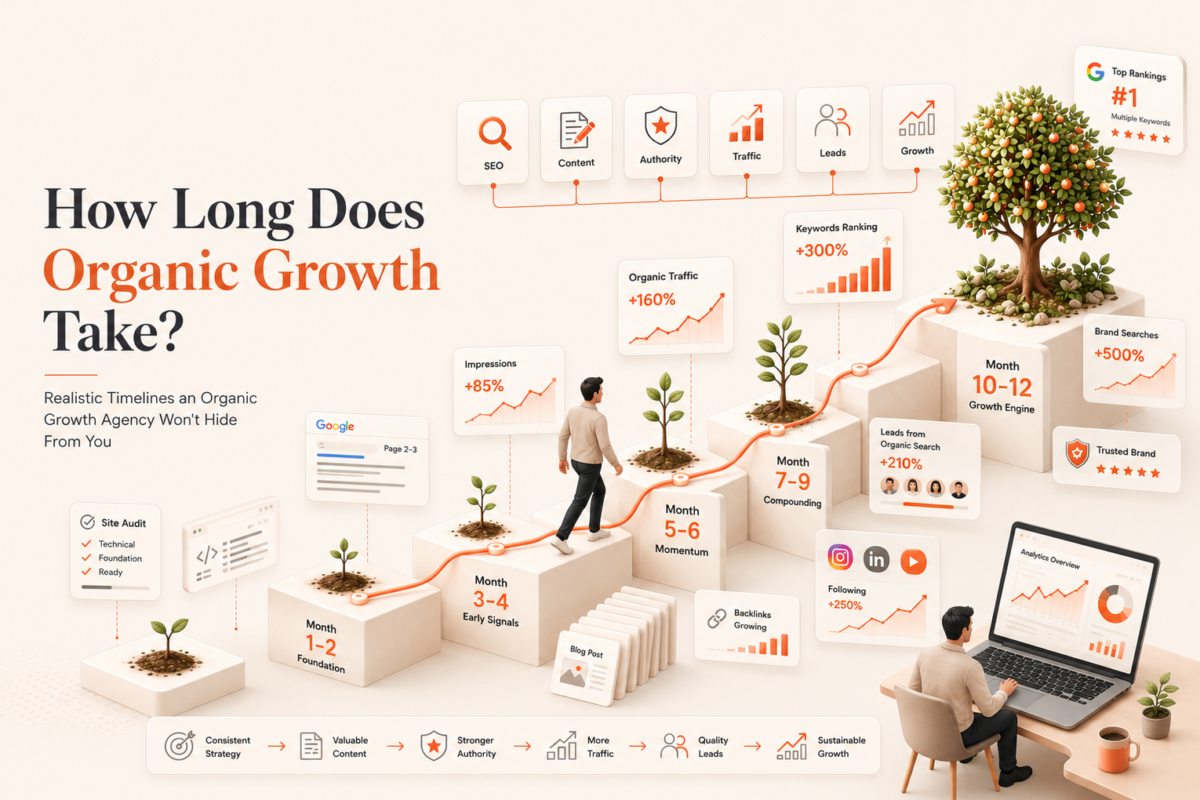
TOFU visibility can show movement in 4–6 weeks. MOFU and BOFU improvements (higher lead-to-close rates) typically show measurable impact within 90 days once retargeting and nurture sequences have enough data.
Is full-funnel marketing only for big brands?
No, the framework scales down. A local jewelry showroom needs the same four stages as a large real estate developer; the channels and budget just look different.
Ready to build a full-funnel strategy for your brand? Talk to Social 101 about a growth audit for your business.