
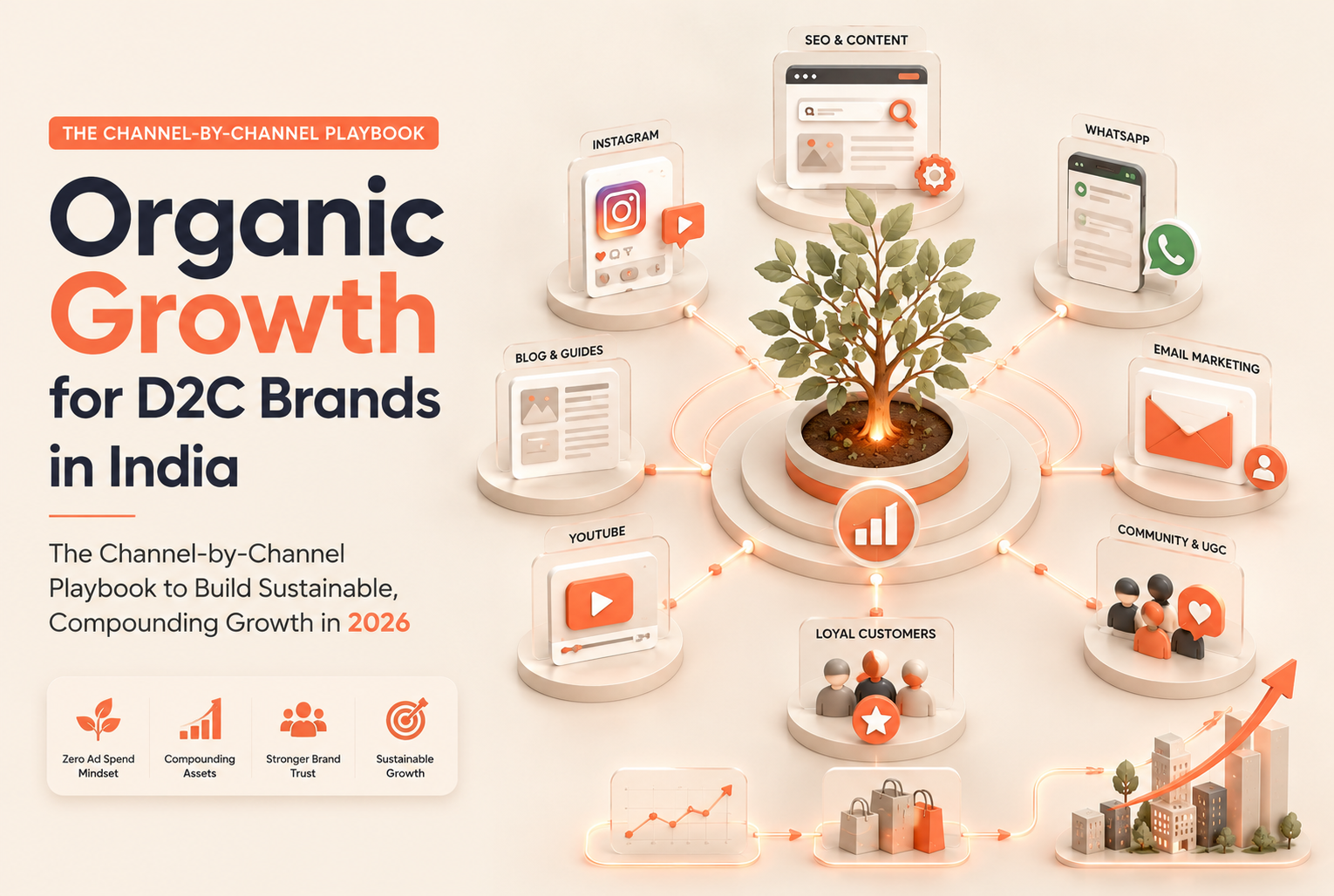
India’s D2C market is projected to cross USD 100 billion by 2027, and yet the single biggest killer of young direct-to-consumer brands is not competition; it is customer acquisition cost. When Meta and Google CPMs climb every quarter, brands that depend entirely on paid ads are effectively renting their growth. The moment the ad account is paused, revenue collapses.
Organic growth is the opposite of renting: it is owning. It compounds. A blog post written today can bring buyers for three years; a WhatsApp community built this quarter can drive repeat orders every festive season. This playbook breaks down every major organic channel available to Indian D2C brands in 2026 what it is good for, how to execute it, and the realistic timeline to results. It is the same framework we use at Social 101 with our D2C and e-commerce clients across fashion, jewelry, FMCG, and lifestyle.
Why Organic Growth Matters More in India Than Anywhere Else
Three structural realities make organic channels unusually powerful in the Indian market:
- Rising paid CAC: Customer acquisition costs on Meta and Google in India have risen sharply as more D2C brands, quick-commerce players, and marketplaces bid for the same audiences. Blended CAC only stays healthy when a meaningful share of orders comes in free.
- Trust-first buying behavior: Indian consumers research heavily before purchase, looking at reviews, YouTube unboxings, and WhatsApp forwards from friends. Organic content is exactly where these trust signals live.
- Language and Bharat expansion: the next 300 million online shoppers come from Tier 2 and Tier 3 cities and prefer vernacular content. Paid targeting struggles here; organic regional content thrives.
The goal is not “zero ad spend.” The goal is a business where paid media accelerates growth instead of being life support. With that framing, here is the channel-by-channel playbook.
Channel 1: SEO & Content Marketing The Compounding Asset
Why it works for D2C
Every product you sell has hundreds of buying-intent searches around it: “best sterling silver earrings under 5000,” “Kanjivaram vs. Banarasi saree,” and “whey vs. plant protein for beginners.” Brands that answer these questions capture buyers at the exact moment of intent without paying per click. According to Google’s own research on the messy middle of purchase behavior (thinkwithgoogle.com), shoppers loop between exploration and evaluation repeatedly before buying; SEO content lets your brand appear at both stages.
The playbook
- Product-led keyword research: Map keywords into three buckets: category terms (high volume), comparison terms (high intent), and problem terms (top of funnel). Tools like Ahrefs, Semrush, or even Google Search Console’s query report are enough to start.
- Collection page SEO first: for e-commerce, optimized collection pages (unique intro copy, FAQs, internal links) usually outrank blog posts for commercial terms. Fix these before writing a single article.
- Buying guides and comparisons: publish 2–4 in-depth guides per month targeting comparison and “best X” keywords. Include real product photos, honest pros and cons, and schema markup.
- GEO optimizes for AI search: a growing share of product discovery now happens inside ChatGPT, Gemini, and Google’s AI Overviews. Structure content with clear entities, direct answers, FAQs, and factual density so AI engines can cite you. This is one of the fastest-moving opportunities we cover regularly on the Social 101 blog.
Timeline to results: 4–9 months for meaningful traffic; compounding thereafter. This is your slowest channel and your most valuable one.
Channel 2: Instagram Organic Discovery and Desire
Instagram remains the default shop window for Indian D2C. But the algorithm in 2026 rewards watch time and shares, not follower count. Small brands beat big ones here every single week.
The playbook
- Reels as the discovery engine: 3–5 Reels per week built on repeatable formats behind-the-scenes making of the product, founder storytelling, before/after transformations, and “packing your order” content. Formats beat one-off virality.
- The 4:1 content ratio: four value/entertainment posts for every direct sales post. Audiences in India punish feed-jacking hard-sell accounts with silent unfollows.
- Founder-led content: Indian buyers connect with faces, not logos. A founder speaking honestly about margins, failures, or sourcing builds more trust than any studio shoot.
- Broadcast channels & Stories: Use Instagram broadcast channels for drops and restocks; use Stories polls and questions to co-create products with your audience. This doubles as free product research.
- Vernacular experiments: test Hindi, Gujarati, Tamil, or Marathi Reels. Regional content routinely gets 2–3x the reach of English content for mass-market products.
Timeline to results: 30–90 days for reach; 3–6 months for consistent sales attribution via DMs and link clicks.
Channel 3: WhatsApp India’s Highest-ROI Retention Channel
With over 500 million users in India, WhatsApp is not a channel; it is infrastructure. For D2C brands, its open rates (routinely above 90%) dwarf email. The organic play has two layers:
- WhatsApp Communities and groups: build an opt-in community around your niche, a skincare brand running a “Glow Circle,” or a fitness brand running a challenge group. Communities create repeat purchase behavior and word-of-mouth loops.
- Post-purchase flows via WhatsApp Business API: order updates, care instructions, replenishment reminders, and review requests. A simple “Your saree ships tomorrow. Here’s how to drape it” message turns a transaction into a relationship. Official documentation for the platform is available at business.whatsapp.com.
- Referral mechanics: WhatsApp is India’s native sharing layer. Design share-worthy moments, referral codes, festive greetings with the customer’s name, and unboxing-worthy packaging, and forwards do the acquisition for you.
Timeline to results: immediate for retention metrics; 2–4 months for referral-driven acquisition.
Channel 4: YouTube & YouTube Shorts Search Meets Storytelling
YouTube is India’s second-largest search engine and its most trusted product research platform. Long-form video builds authority; Shorts builds reach.
- Answer-the-buyer videos: “How to identify real vs fake silver jewelry” and “5 mistakes when buying your first office chair” educational videos that rank in both YouTube and Google search results and pre-sell your product.
- Shorts repurposing: every Instagram Reel should live on Shorts too. Zero extra production cost, an entirely different discovery audience.
- Creator collaborations (barter-first): micro creators (10k–100k subscribers) in India frequently work on product barter or small fees. Ten honest micro reviews outperform one celebrity integration for both trust and search presence.
Timeline to results: 3–6 months; videos rank and convert for years.
Channel 5: Email & SMS The Owned List
Email is unfashionable and outrageously profitable. For mature D2C brands globally, owned channels like email drive 25–30% of revenue at near-zero marginal cost. The Indian caveat: email works best for premium and urban audiences; pair it with SMS/WhatsApp for mass segments.
- Capture on-site: exit-intent and first-order discount popups should convert 3–5% of visitors into subscribers. Below that, your offer or copy needs work.
- The core four flows: welcome series, abandoned cart, post-purchase, and win-back. Set these up once in Klaviyo, Mailchimp, or Shopify Email, and they run forever using Shopify’s own resources at shopify.in cover the basics well.
- A weekly editorial email: not a promo blast a genuinely useful note: styling tips, founder updates, customer stories. This is what keeps open rates above 30%.
Timeline to results: flows convert from day one; list-driven revenue becomes meaningful in 3–6 months.
Channel 6: Community, UGC & Reviews The Trust Layer
- Systematize reviews: automate review requests 7–10 days post-delivery with a small incentive. For Indian buyers, photo and video reviews are the deciding factor; feature them on product pages prominently.
- UGC engine: create a branded hashtag, repost customer content weekly, and run monthly UGC contests. Customer content is both free creativity and social proof.
- Niche communities: be genuinely useful (not promotional) in relevant subreddits, Facebook groups, and Discord servers. One helpful founder answer in a niche community often outperforms a week of posting on your own handle.
Timeline to results: reviews impact conversion within weeks; community compounds over quarters.
Channel 7: Marketplace SEO Amazon, Flipkart, Myntra, Nykaa
If you sell on marketplaces, their internal search is an organic channel in its own right. Optimise titles with high-volume keywords, load all image slots with infographic-style creatives, answer every customer question, and maintain review velocity. Marketplace ranking improvements are free traffic that also lifts your brand searches on Google.
Channel 8: Digital PR & Founder LinkedIn Authority and Backlinks
- Founder-led LinkedIn: the Indian startup ecosystem lives on LinkedIn. Founders sharing real numbers, lessons, and category insights attract press, partnerships, retail buyers, and talent and drive high-intent brand searches.
- Digital PR for backlinks: pitch data stories and founder journeys to publications like YourStory, Inc42, and Economic Times Brand Equity. Every earned mention is a backlink that strengthens the SEO channel. The channels reinforce each other.
How to Sequence It: The 12-Month Organic Roadmap
Months 1–3 Foundations: fix collection page SEO, set up the four email flows, start 3 Reels a week, automate review collection, and launch WhatsApp post-purchase flows.
Months 4–6 Content engine: publish 2–4 SEO guides monthly, start YouTube with two videos a month, and begin barter collaborations with micro creators, creators, and the WhatsApp community.
Months 7–12 Compounding: double down on the two channels showing traction, add vernacular content, invest in digital PR and founder LinkedIn, and layer GEO optimisation so AI search engines cite your brand.
Measured honestly, assisted conversions, branded search growth, repeat rate, and share of revenue from owned channels, most brands see organic contributing 30–50% of revenue within 12–18 months of disciplined execution.
Five Mistakes That Kill Organic Growth
- Treating organic as free paid ads, posting promotional creatives, and expecting reach.
- Channel-hopping every month instead of committing to formats for a quarter.
- Measuring organic on last-click attribution, which structurally undercounts it.
- Ignoring retention channels (WhatsApp, email) while obsessing over new followers.
- Publishing thin AI-generated content with no original data, photos, or point of view: both Google and human readers now filter it out.
FAQs: Organic Growth for D2C Brands in India
How long does organic growth take for a D2C brand?
Retention channels (WhatsApp, email, reviews) show results in weeks. Social reach takes 1–3 months. SEO and YouTube take 4–9 months but compound for years. Plan for a 12-month horizon.
Can a D2C brand grow with zero ad spend in India?
Yes, many niche brands have, but the smarter goal is reducing paid dependency to 50–70% of acquisition, so ads become an accelerant rather than a lifeline.
Which organic channel should a new D2C brand start with?
Instagram Reels for discovery plus WhatsApp for retention. Add SEO from month one because of its long lead time, even if it is just optimizing collection pages.
What is GEO, and why does it matter for D2C SEO?
Generative engine optimization is structuring your content so AI tools like ChatGPT, Gemini, and Google AI Overviews cite your brand when users ask for product recommendations. It is the fastest-emerging organic opportunity in 2026.
The Bottom Line
Paid media buys attention; organic builds an asset. The brands winning India’s D2C decade are the ones treating content, community and search as core infrastructure not as an after thought when ad costs spike.
If you want a channel-by-channel organic audit of your D2C brand, what to fix first, what to ignore, and a 90-day execution plan, the team at Social 101 works with 300+ brands across fashion, jewelry, FMCG, and e-commerce. Explore more growth frameworks on our blog, or reach out for a consultation.

