
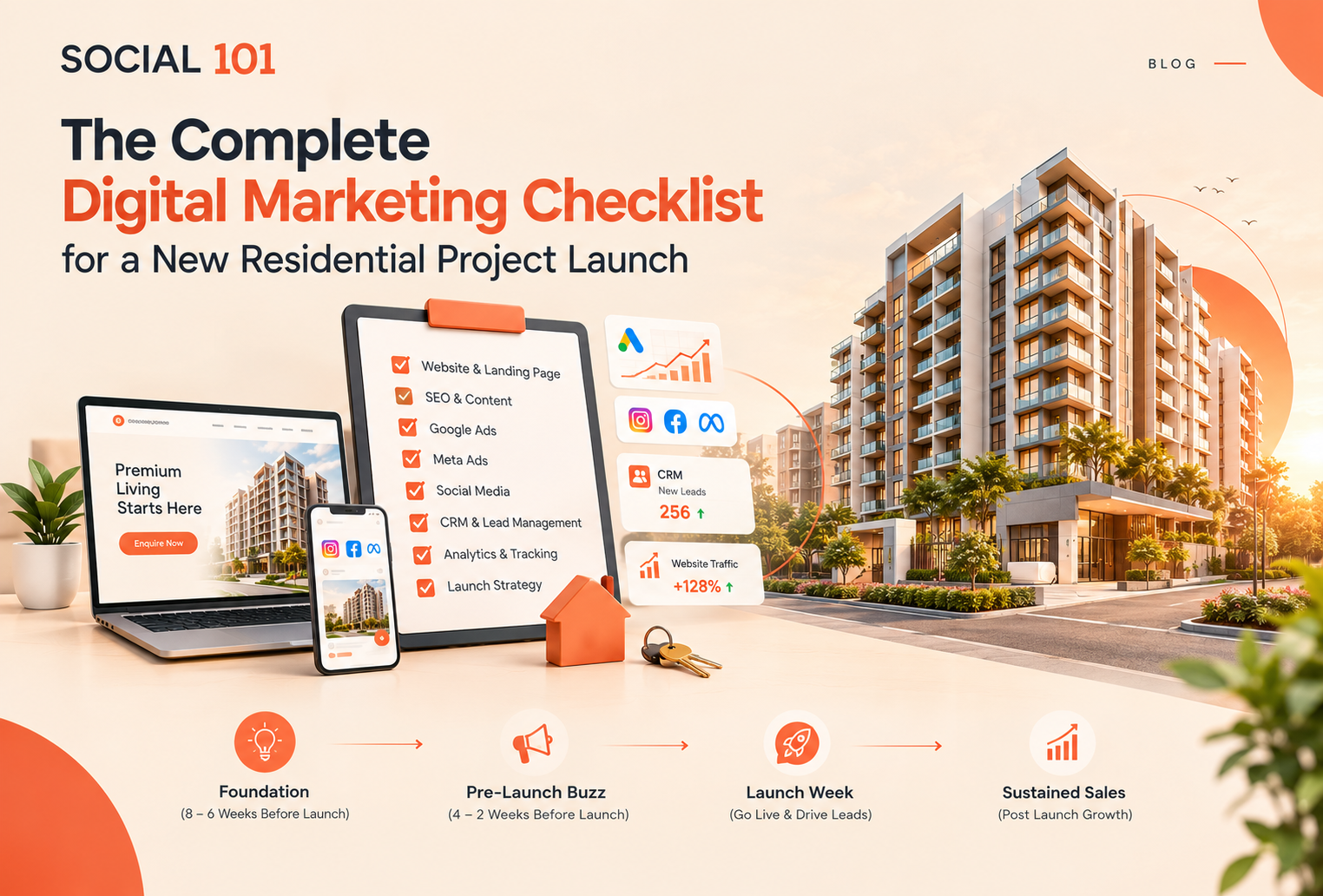
Most residential launches don’t fail because the product is weak they fail because the marketing plan is assembled in pieces, two weeks apart, with no one owning the sequence. A website goes live before the ad campaigns are ready. Ads go live before the CRM can handle the leads. By the time everything is finally connected, the launch-week momentum is gone.
This checklist lays out everything a developer or marketing team needs in order from eight weeks before launch to the weeks after possession begins. It’s the same framework Social 101 uses when we run performance marketing for residential launches, alongside our detailed comparison of Google Ads vs Meta Ads for property launches if you want to go deeper on the paid media side.
Phase 1: Foundation (8–6 Weeks Before Launch)
This is the phase most launches rush or skip. Everything built here is what the ad campaigns, sales team, and site visits will depend on later.
Website & Project Microsite
- ☐ Dedicated project microsite (not just a page on the corporate site) with a clean URL, fast mobile load time, and a single primary call-to-action
- ☐ Configuration-wise pages (1 BHK / 2 BHK / 3 BHK / commercial) with pricing ranges, floor plans, and carpet area details
- ☐ RERA registration number and disclaimers visible on every page non-negotiable for legal compliance
- ☐ Click-to-WhatsApp and click-to-call buttons fixed on mobile view
- ☐ An interest/enquiry form connected directly to the CRM, not just an email inbox
Creative & Content Assets
- ☐ Professional photography of the site, sample flat, and location landmarks
- ☐ Drone footage of the site and surrounding infrastructure
- ☐ A 60–90 second walkthrough or lifestyle film for use across ads and the website
- ☐ Configuration-wise carousel creative for Meta Ads
- ☐ A downloadable brochure (PDF) optimized for mobile viewing, not a scanned print file
Tracking & Systems Setup
- ☐ Google Analytics 4 and Google Tag Manager installed on the microsite
- ☐ Meta Pixel and Conversions API set up for accurate ad attribution
- ☐ Call tracking numbers assigned so every enquiry source is measurable
- ☐ CRM or lead management sheet ready with a same-day calling SLA defined for the sales team
Phase 2: Pre-Launch Buzz (4–2 Weeks Before Launch)
The goal here is to build an interest database before pricing is even public, so the sales team has warm leads to call the moment the project opens for booking.
Organic & Social
- ☐ Teaser posts and reels revealing the project without giving away full pricing
- ☐ A countdown campaign across Instagram and Facebook Stories
- ☐ An SEO-optimized blog post or press-style article on the project announcement
- ☐ Local influencer or community page collaborations for reach in the target locality
Paid Media
- ☐ Meta Ads running lead-form campaigns to capture early interest; see our full breakdown of when to lean on Meta vs Google during a launch
- ☐ Google Display and YouTube in-stream ads for brand recall in the target catchment area
- ☐ Retargeting audiences created from microsite visitors and video viewers, ready for launch week
Sales Enablement
- ☐ The sales team is briefed and trained on configurations, pricing logic, and payment plans before the first lead arrives
- ☐ A WhatsApp Business catalogue set up with a brochure, floor plans, and pricing sheet ready to share instantly
Phase 3: Launch Week
project is public.
- ☐ Google Search campaigns switched on for branded terms, competitor terms, and locality + configuration keywords
- ☐ Meta Ads shifted from awareness to conversion objective, retargeting the pre-launch database with pricing and offers
- ☐ Press release and local media coverage timed to the launch date
- ☐ Site-visit scheduling opened via WhatsApp and the microsite, with slots visible in real time
- ☐ Daily lead-response audit: every enquiry called within the SLA window, no exceptions during launch week
- ☐ Launch-day offer (early-bird pricing, waived charges, or a limited-unit incentive) clearly communicated across every channel
Phase 4: Sustained Sales (Ongoing)
Once the launch spike settles, the campaign shifts from creating urgency to steady, efficient lead generation.
- ☐ Budget rebalanced every two weeks toward whichever channel shows the lower cost-per-site-visit
- ☐ Fresh creative rotated every 10–14 days to avoid ad fatigue on Meta
- ☐ Google Performance Max introduced once enough conversion data exists for automated bidding
- ☐ Testimonial and site-progress content published monthly to sustain organic reach
- ☐ A referral program promoted to existing bookers, since real estate referrals convert at a very high rate
- ☐ Retargeting maintained for every site visitor who hasn’t booked, right through to possession
What to Track at Each Phase
| Phase | Primary Metric | Secondary Metric |
| Foundation | Site speed & tracking accuracy | Asset completion rate |
| Pre-launch | Database size (leads captured) | Cost per lead |
| Launch week | Cost per site visit | Lead response time (SLA) |
| Sustained sales | Cost per booking | Retargeting recall rate |
Mistakes That Derail a Launch Checklist
- Building the website in parallel with ad campaigns. If the microsite isn’t tested and tracking-verified before ads go live, launch-week data is unreliable from day one.
- No calling SLA. A lead called after six hours converts far worse than one called in six minutes; this single fix often moves the conversion rate more than any ad optimization.
- Treating the checklist as one-time. Creative, budget allocation, and messaging all need to keep evolving through the sustained sales phase, not just during launch week.
- Skipping compliance details. Missing RERA numbers or disclaimers on ad creative and landing pages can get campaigns rejected or, worse, invite regulatory issues.
How Social 101 Runs This Checklist for Developers
We’ve used versions of this checklist with developers featured in our guide to Surat’s top real estate developers, pairing it with a media plan that follows the sequencing in our Google Ads vs Meta Ads for property launches guide. Every engagement is scoped around the benchmarks in what results to expect from a performance marketing agency in 90 days, so there’s a clear read on progress at every phase above.
FAQs: Residential Project Launch Marketing
How many weeks before launch should marketing start?
Start foundation work (website, tracking, creative) at least six to eight weeks before launch, and pre-launch buzz campaigns two to four weeks before. Starting later compresses everything into launch week, which is the least efficient time to be building basics.
What’s the biggest lever for lead quality in a launch?
A fast, disciplined lead-response process. Even a well-targeted campaign underperforms if leads sit uncalled for hours this matters more than most creative or targeting tweaks.
Do I need both a website and social media for a launch?
Yes. The microsite is where paid traffic converts and where tracking lives; social media (especially Meta) is where awareness and retargeting happen. For how to split ad budget between search and social, see our Google Ads vs Meta Ads breakdown.
How much should a residential project launch budget for marketing?
This varies by ticket size, city, and unit count, but for typical retainer and ad-spend ranges, see our guide on performance marketing agency costs in India.
Planning a Residential Launch?
Social 101 builds and executes the full digital marketing checklist for residential and commercial launches across the Surat website, including creative, Google Ads, Meta Ads, and CRM setup. Get in touch to plan your launch timeline, or explore our full performance marketing services.
Related Reading
- Google Ads vs Meta Ads for Property Launches
- What Does a Performance Marketing Agency Actually Do?
- How Much Does a Performance Marketing Agency Cost in India?
- What Results Should You Expect From a Performance Marketing Agency in 90 Days?
- How to Choose the Right Performance Marketing Agency in Surat
- Top Real Estate Developers of Surat: The Complete 2025–26 Guide

