
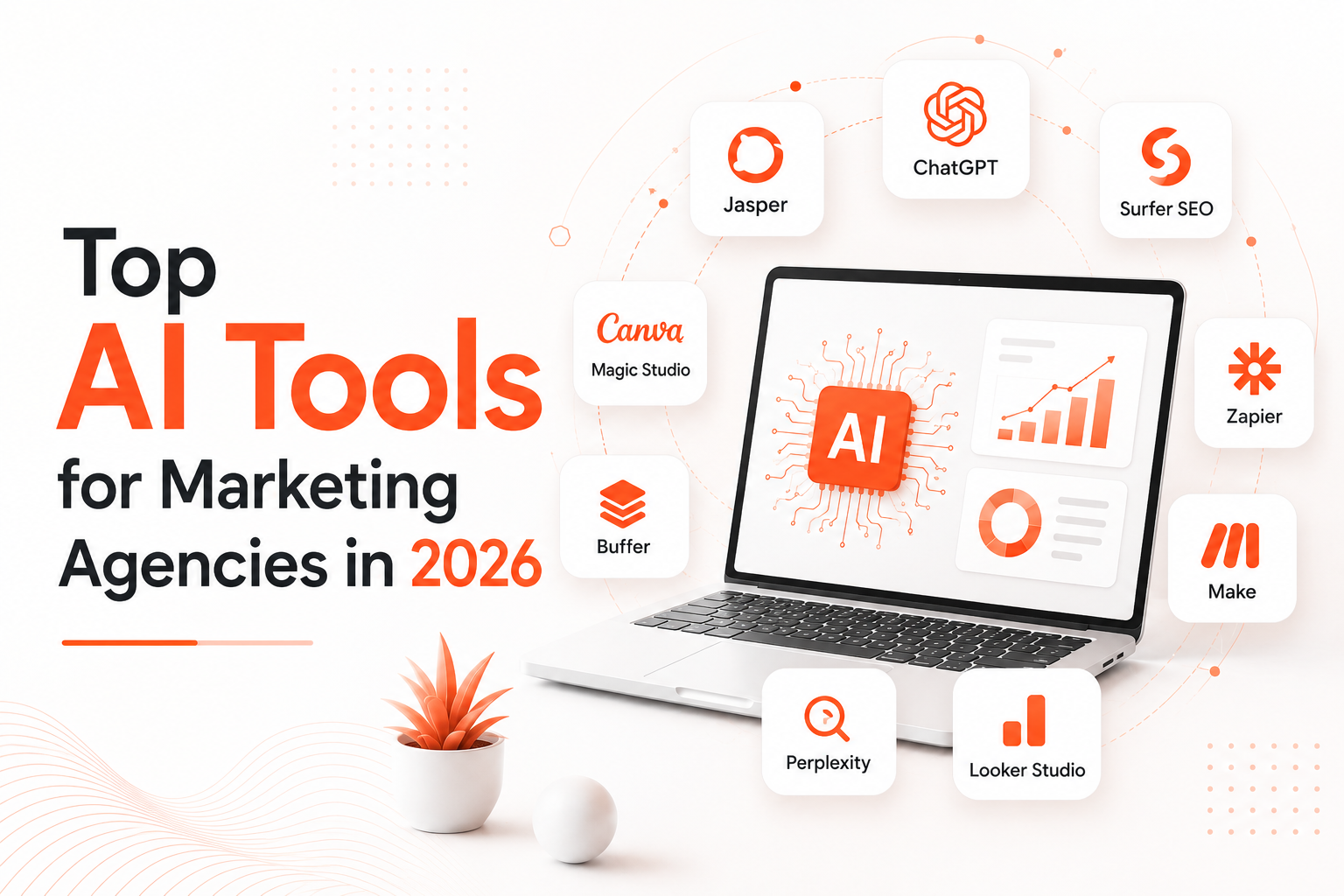
Marketing agencies aren’t choosing whether to use AI anymore; they’re choosing which AI tools actually move the needle for clients. Between content creation, SEO, design, automation, and the newer challenge of showing up inside AI answers on ChatGPT and Gemini, the modern agency stack looks nothing like it did even two years ago.
At Social 101, a full-service digital marketing and social media agency in Surat, we test and use these tools daily across branding, social media, performance marketing, and organic growth campaigns. Here’s our honest breakdown of the AI tools that actually earn a seat in an agency’s workflow in 2026 and how to think about building your own stack.
Why AI Tools Matter for Marketing Agencies Right Now
Three shifts are forcing agencies to rethink their toolkits:
- Client expectations have changed. Brands want faster turnarounds, more personalized creative, and proof of ROI without paying for a bigger team.
- Search itself has changed. A growing share of discovery now happens inside AI answer engines, not just Google’s blue links, which means agencies need to optimize for AI search visibility as much as traditional SEO.
- Execution has become the bottleneck. Strategy hasn’t gotten easier, but AI has made the repetitive parts, drafting, scheduling, and reporting, dramatically faster, freeing agency teams to focus on strategy and client relationships.
With that context, here’s the toolkit worth knowing.
1. AI Content Creation & Copywriting Tools
Agencies producing content across multiple clients need consistency at scale, not just speed.
- Jasper Built specifically for marketing teams, Jasper lets agencies set brand voice profiles per client so blog posts, ad copy, and landing pages stay on-brand even when different writers use it. It’s particularly useful for agencies running content for several accounts at once.
- Copy.ai leans into repeatable workflows: feed it a brief or offer, and it generates blog drafts, social captions, and ad variants in a structured process rather than one-off outputs.
- ChatGPT / Claude general-purpose AI assistants remain the backbone for research, outlining, and first-draft writing before a human editor refines it for tone and accuracy.
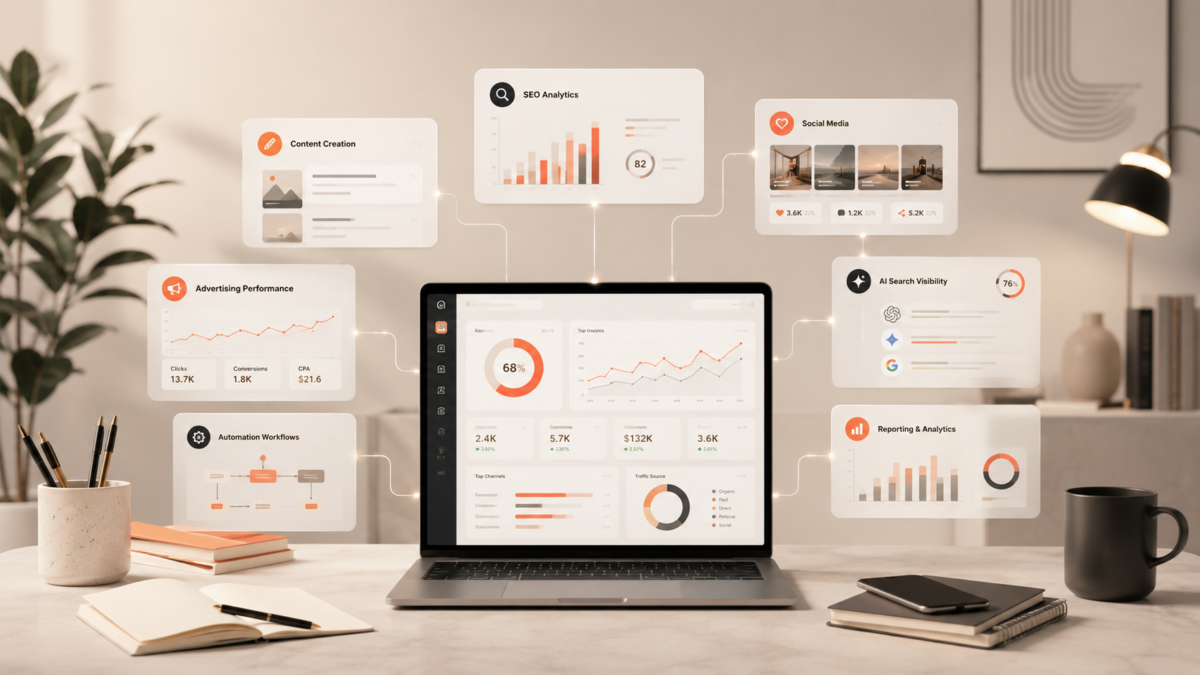
Where it fits at Social 101: we use AI drafting tools to speed up first drafts for content marketing work, then apply our own editorial and brand-voice review before anything ships to a client.
2. AI SEO & Keyword Research Tools
SEO tools have moved from keyword lists to full content-scoring engines.
- Surfer SEO scores content in real time against top-ranking competitors for a target keyword, factoring in keyword density, semantic terms, and heading structure. Its keyword clustering feature also helps agencies build topical content hubs instead of one-off blog posts.
- Semrush AI combines keyword research, technical audits, and competitor tracking, now layered with AI-assisted recommendations for what to fix first.
Why it matters: ranking a single blog post isn’t the goal anymore; building topical authority around a service (like “organic growth agency” or “performance marketing”) is what actually compounds traffic over time.
3. AI Design & Creative Tools
- Canva (Magic Studio) Remains the fastest way for agencies to produce on-brand social creative, presentation decks, and ad variations without looping in a designer for every small asset.
- AI image and video tools (for reels, product shots, and quick creative testing) are increasingly bundled into design suites, cutting production time for high-volume social content.
4. AI Social Media Scheduling Tools
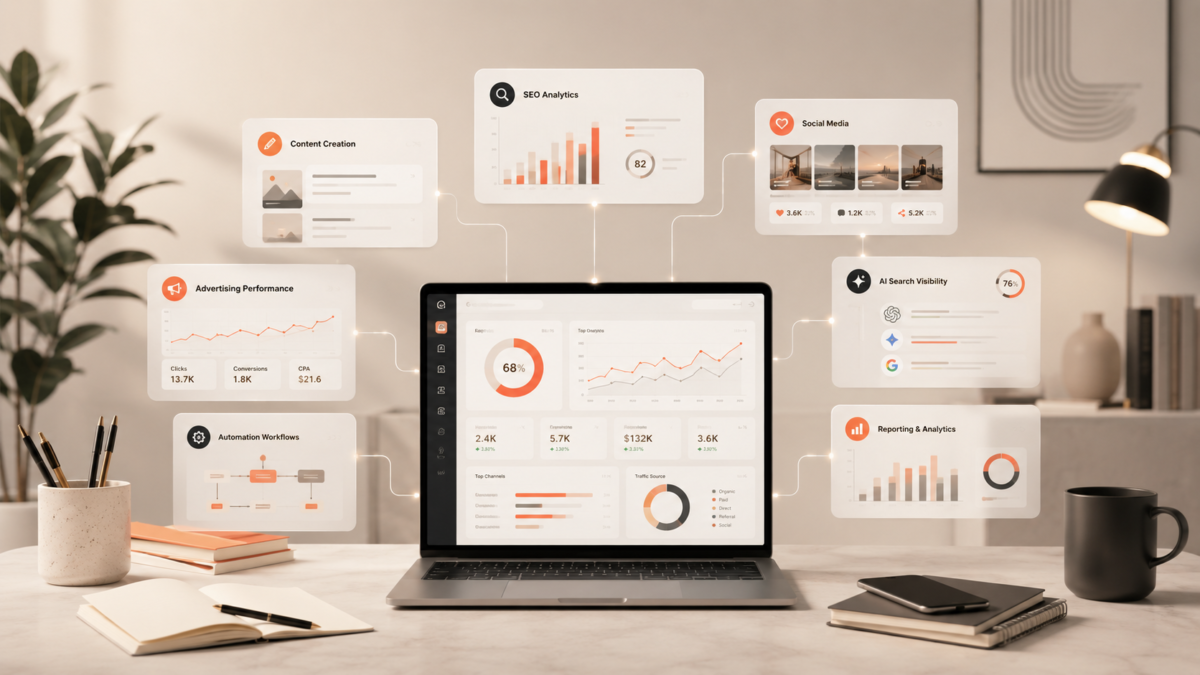
- Buffer and Later Both now offer AI-assisted caption generation and optimal-time scheduling, which is useful for agencies managing posting calendars across several client accounts simultaneously.
For agencies running social media management at scale, this is less about replacing strategy and more about removing the manual grind of scheduling and caption variations.
5. AI Research & Strategy Tools
- Perplexity: A research assistant with citations, useful for competitor research, market data, and fact-checking claims before they go into client decks or blog content.
- ChatGPT / Claude (again) used for structured strategy work: campaign briefs, audience personas, and messaging frameworks, especially when given detailed context to work from.
6. AI Automation Tools
Zapier and Make Connect the rest of the stack together: new lead forms trigger CRM updates, content approvals move automatically between tools, and reporting steps run without manual copy-pasting. For agencies juggling multiple client accounts, this is often the highest-ROI category because it saves account management hours every week, not just content hours.
7. AI Search Visibility (GEO) Tools
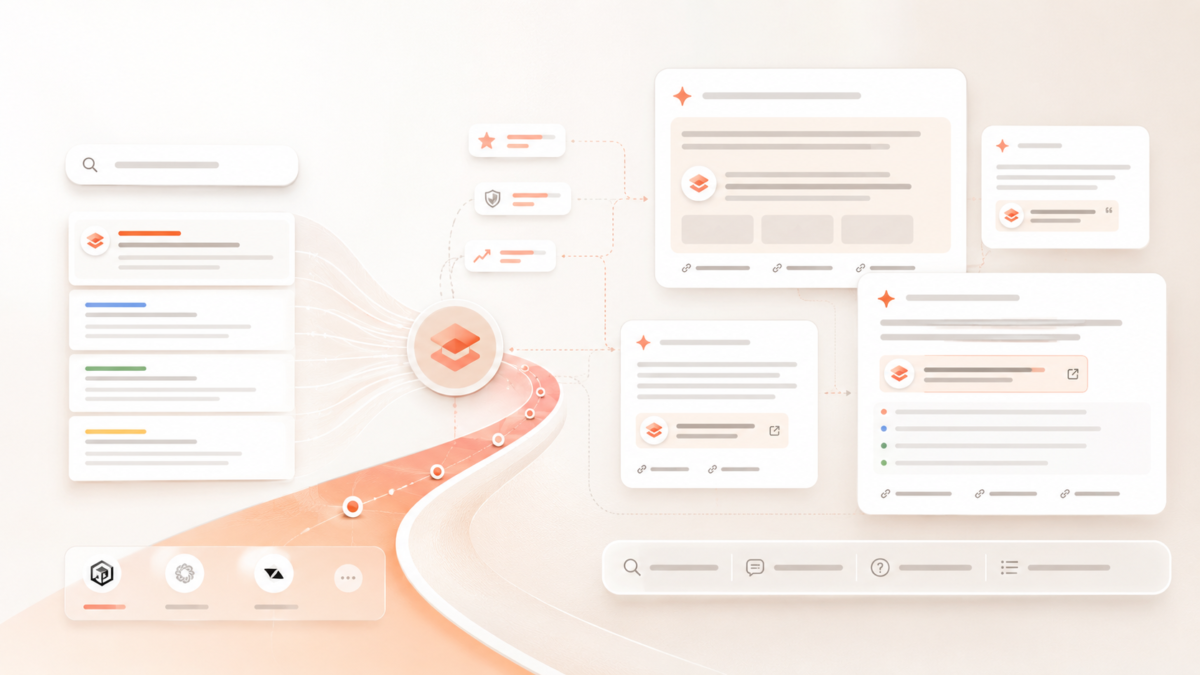
This is the newest and fastest-growing category. As more people ask ChatGPT, Gemini, and AI Overviews for recommendations instead of typing a Google query, agencies need to track whether their clients’ brands actually get cited in those answers not just ranked in search results.
Newer platforms in this space track how often a brand is mentioned across AI engines, which prompts trigger a citation, and how that compares to competitors. This is exactly the discipline we cover in our guide on how Surat businesses can get found on ChatGPT and AI search. Traditional SEO and AI visibility now need to be planned together, not as separate workstreams.
8. AI Reporting & Analytics Tools
- Looker Studio with AI connectors Automates recurring client reports, pulling data from ad platforms, CRMs, and analytics tools into a single dashboard that updates itself instead of requiring manual exports every month.
This matters more than it sounds: agency teams often lose hours each month building reports by hand. Automating that frees up time for actual strategy and optimization.
Quick Comparison: Which AI Tool Category Should You Start With?
| Category | Best For | Example Tools |
| Content creation | Multi-client blog & copy production | Jasper, Copy.ai |
| SEO | Ranking content & topical authority | Surfer SEO, Semrush AI |
| Design | Fast, on-brand social & ad creative | Canva |
| Social scheduling | Managing multiple client calendars | Buffer, Later |
| Research | Fact-checked strategy & competitor insight | Perplexity |
| Automation | Connecting tools, saving admin hours | Zapier, Make |
| AI search visibility | Getting cited in ChatGPT/Gemini answers | Emerging GEO platforms |
| Reporting | Automated, always-updated client dashboards | Looker Studio |
How to Choose the Right AI Stack for Your Agency
Don’t try to adopt every tool at once. A practical approach:
- Identify your biggest time sink. For most agencies, that’s content production or client reporting.
- Pick one tool per bottleneck, master it with your team, and measure hours saved before adding another.
- Set internal governance early rules around what client data can go into which tool, who reviews AI output before it ships, and how brand voice is protected across accounts.
- Keep a human in the loop. AI tools speed up execution, but positioning, offering clarity, and creative judgment still come from strategists who understand the client’s business, not the software.
How Social 101 Uses AI to Deliver Better Results
As a full-service digital marketing and social media agency in Surat, we combine these AI tools with hands-on strategy across branding, social media management, performance marketing, and organic growth. AI helps our team move faster on execution but the strategy, brand judgment, and client relationships behind every campaign are still built by people who know the business. If you’re a brand trying to figure out which AI-powered marketing approach actually fits your goals instead of chasing every new tool, get in touch with Social 101, and we’ll help you build a stack (and a strategy) that fits your business.
FAQs
Do small businesses need all these AI tools, or just an agency?
Most small businesses don’t need to buy and manage a full AI stack themselves that’s exactly the value an agency brings: the right tools, already integrated into a working process, without the learning curve or subscription costs.
Will AI tools replace marketing agencies?
No. AI speeds up execution, drafting, scheduling, and reporting, but strategy, brand positioning, and creative judgment still require human expertise, especially as AI search makes brand differentiation more important, not less.
What’s the difference between SEO tools and AI search visibility (GEO) tools?
Traditional SEO tools optimize for ranking in Google’s search results. AI visibility tools track whether a brand gets cited inside AI-generated answers from tools like ChatGPT and Gemini, an increasingly important, separate discipline.

