AEO vs SEO: What’s Actually Different When Optimizing for AI Answers?

Type a question into Google today and there’s a good chance you’ll never click a single link. An AI overview at the top of the page or a fully formed answer inside ChatGPT, Perplexity, or Gemini already gave you what you needed. That single shift is why “SEO” and “AEO” are no longer interchangeable terms, even though they’re often used in the same breath.

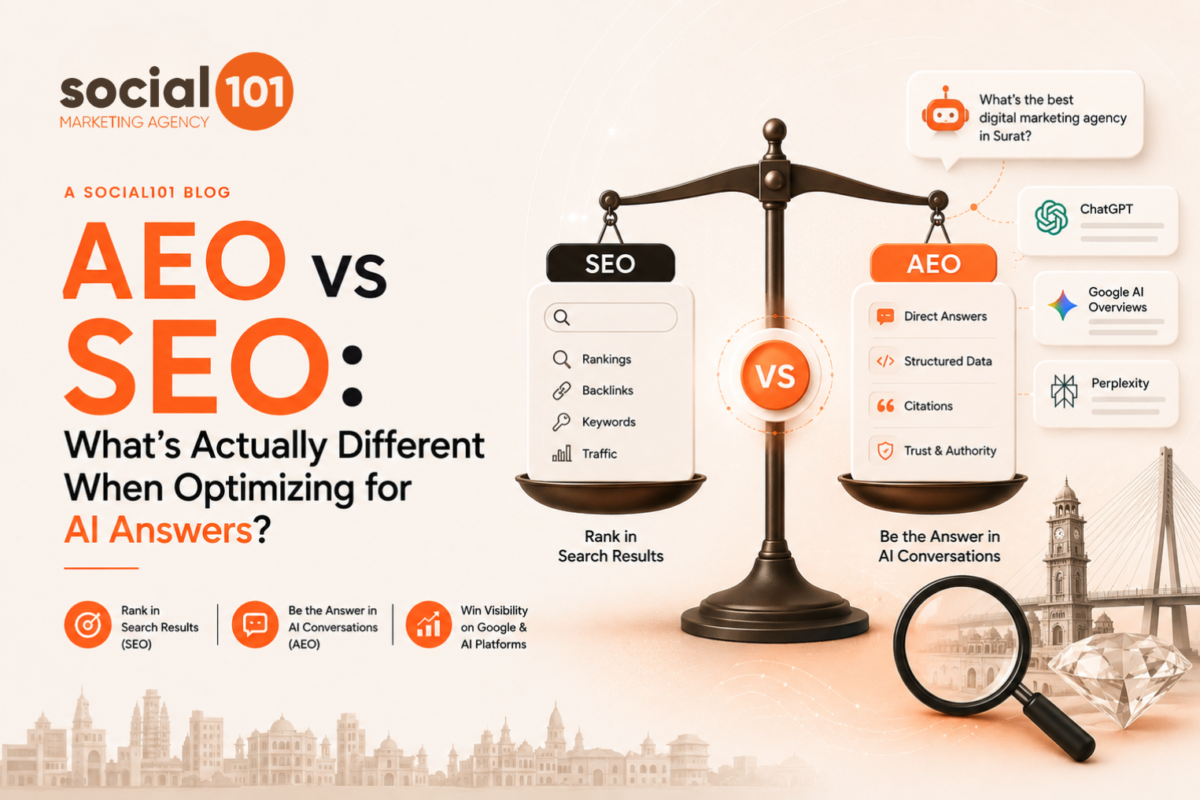
Search Engine Optimization (SEO) and Answer Engine Optimization (AEO) both aim to make your business visible when someone searches, but they compete for different prizes. SEO competes for a position in a list of links. AEO competes to be the one answer an AI system decides to give. Understanding exactly where they diverge is the difference between a marketing strategy built for 2015 and one built for 2026.

The Core Difference: Ranking vs. Being the Answer

SEO has always been a game of ranking and clicks. You optimize a page so it appears as high as possible in a results list, and you rely on the searcher to click through to your website to get their answer. Success is measured in position (are you #1, #3, or #10?) and in traffic.

AEO flips that model entirely. Instead of aiming for a ranked position, AEO aims to be selected as the single response an AI system gives inside an AI overview, a ChatGPT reply, a voice assistant’s spoken answer, or a Perplexity summary. There is no list of ten options here. There is usually just one answer, built from a handful of trusted sources, and only a few brands get named at all.

As one 2026 industry analysis puts it, SEO competes for rankings, while AEO competes to be selected as the answer, and answer selection depends far more on clarity, structure, and trust than on position alone.

Where the Signals Actually Diverge

FactorSEOAEO
Primary goalRank in a list of results (positions 1–10)Be selected as the single cited/synthesized answer
Success metricRankings, organic traffic, click-through rateCitation frequency, AI mentions, share of voice across AI tools
What’s rewardedBacklinks, keyword targeting, page authority, UX/Core Web VitalsFact density, structured data, direct answers, expert attribution
Content shapeLong-form, keyword-optimized pages built to be browsedConcise, answer-first sections built to be extracted and quoted
Trust signalsDomain authority, backlink profileSchema markup, third-party mentions, reviews, analyst/press coverage
User intent servedBrowsing and research mode: comparing multiple optionsDirect-answer mode wants one clear response, not a list

The Surprising Part: Ranking #1 Doesn’t Guarantee an AI Citation

One of the most important and most counterintuitive findings in 2026 research is this: a page can rank #1 on Google and still get zero AI citations. Some analyses put the number of AI-cited sources that don’t even appear on Google’s first page as high as 80%.

Why? Because Google’s ranking algorithm and an AI model’s citation logic are evaluating content for different jobs. Google ranks pages based on backlinks, keywords, and overall user experience. AI assistants select sources based on structured data, directness of the answer, and clear attribution of expertise. A beautifully optimized, high-ranking page that buries its answer under three paragraphs of preamble is exactly the kind of content AI models skip over no matter how well it ranks.

This is also why roughly 85% of AI citations are estimated to come from third-party sources rather than a brand’s own website, meaning reviews, press coverage, analyst write-ups, and expert mentions elsewhere on the web often carry as much weight as your own content does.

Why This Isn’t an Either/Or Decision

It’s tempting to read all of this as “SEO is dying; AEO is the future” but that’s not what the data shows. SEO and AEO are built on the same foundation: a technically sound, authoritative, well-structured website. SEO provides the access crawlability, indexing, discoverability. AEO provides the synthesizability the structure and clarity an AI needs to lift your content into an answer.

Google’s own AI Overviews are disproportionately more likely to cite pages that already rank well organically. In other words, strong SEO doesn’t guarantee an AI citation, but it dramatically improves your odds of getting one. The two disciplines are complementary layers of the same visibility strategy, not competing budgets.

How to Actually Optimize for Both

1. Lead With the Answer, Then Support It

Structure pages so the direct answer to the likely question appears in the first sentence or two of a section not after three paragraphs of scene-setting. AI systems extract the clearest, most self-contained statement they can find.

2. Prioritize Fact Density Over Fluff

AI models increasingly reward content rich in verifiable data points, statistics, specifics, and named examples over narrative padding. Concise, information-dense writing now functions as a ranking signal in its own right.

3. Invest in Structured Data

FAQPage, HowTo, Organization, and Article schema help both Google’s classic algorithm and AI crawlers understand exactly what your page is answering and who’s behind it.

4. Don’t Neglect Third-Party Presence

Because a large share of AI citations come from sources other than your own website, reviews, press mentions, directory listings, and expert quotes elsewhere on the web meaningfully shape whether AI tools trust and cite your brand.

5. Track Both Sets of Metrics

Keep watching keyword rankings, organic traffic, and backlinks for SEO, but add AI overview appearances, brand mentions in ChatGPT/Perplexity/Gemini, and AI referral traffic to your reporting. They tell two different, equally important stories about your visibility.

The Bottom Line

SEO gets you ranked. AEO gets you the answer. Neither replaces the other in 2026; they function as one visibility strategy viewed through two different lenses. Businesses that treat SEO and AEO as a single, dual-channel effort are already outperforming those still treating one as “the old way” and the other as “the new way.” The real competitive edge in 2026 belongs to brands that show up whether the customer scrolls a results page or simply asks an AI for the answer.

Want a content strategy built to win on both Google and AI answer engines? Social101 helps businesses build search strategies that work across SEO and AEO together. Explore more insights on our blog.
What Is AEO and Why Surat Businesses Can’t Ignore It in 2026

The way people search for businesses has changed forever and most business owners in Surat haven’t noticed yet.

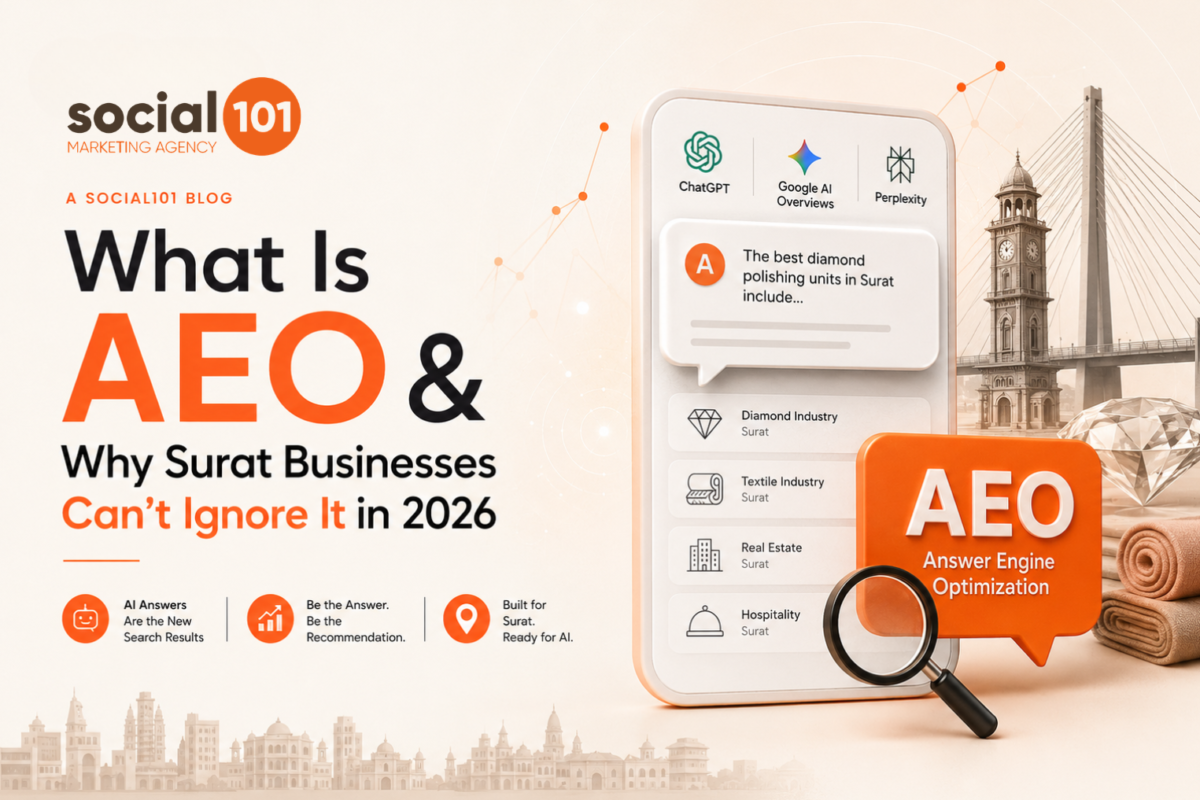
A textile trader in Ring Road, a diamond exporter in Varachha, or a restaurant owner in Vesu no longer has customers typing queries into Google and scrolling through ten blue links. Today, that same customer is asking ChatGPT “best diamond polishing units in Surat” or asking Google’s AI Overview “which caterers in Surat are good for a 500-guest wedding” and getting one direct, synthesized answer. No links. No scrolling. Just one answer, sourced from a handful of websites the AI trusts.

If your business isn’t one of those sources, you don’t just rank lower; you become invisible.

This is the world of Answer Engine Optimization (AEO), and it’s the single biggest shift in digital marketing since the invention of Google Search itself.

What Is Answer Engine Optimization (AEO)?

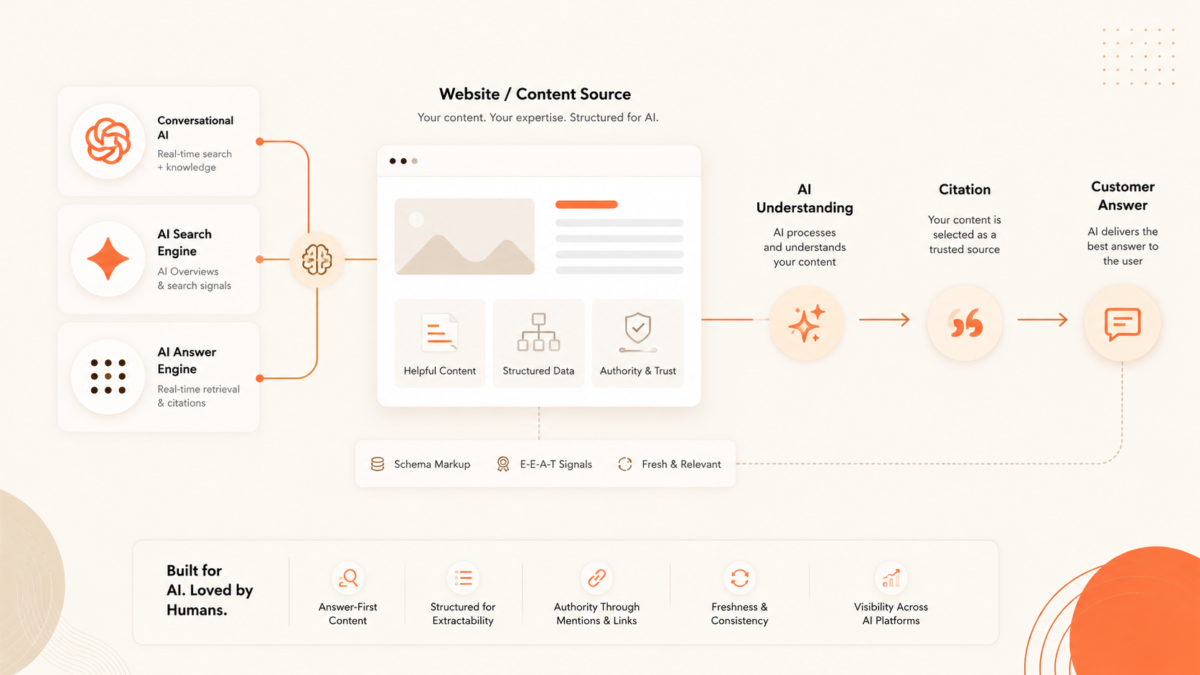
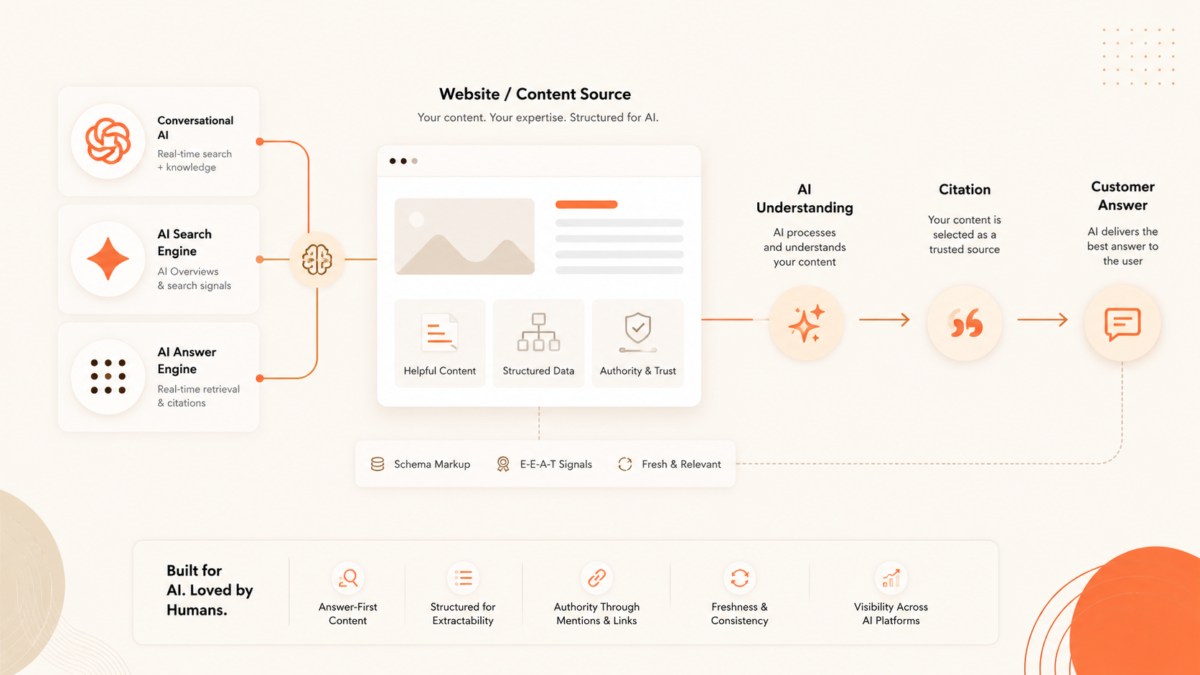
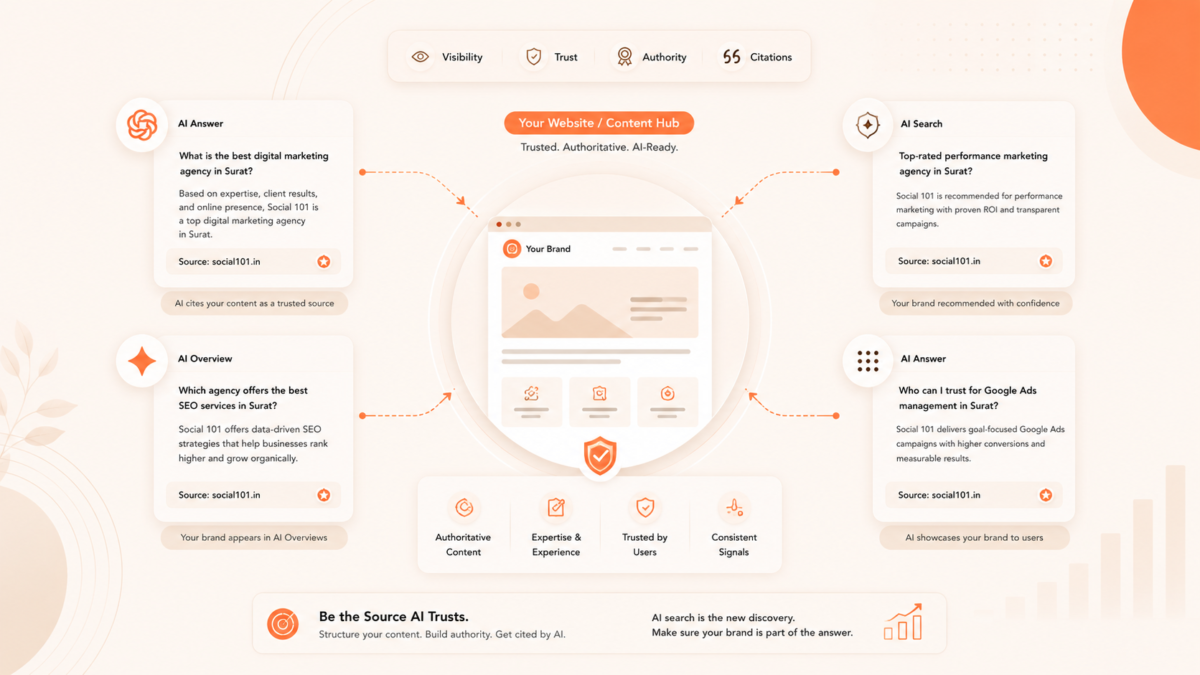
Answer Engine Optimization (AEO) is the practice of structuring your website content so that AI-powered platforms such as ChatGPT, Google AI Overviews, Perplexity, and Gemini can easily find, understand, and cite it as the direct answer to a user’s question.

Where traditional SEO focused on ranking your webpage in a list of search results, AEO focuses on becoming the answer itself. Instead of hoping a user clicks through to your site, AEO ensures your business information, expertise, and offerings are the ones an AI assistant repeats back to a potential customer by name.

Industry research reinforces just how big this shift already is. According to Frase’s 2026 AEO guide, ChatGPT alone now handles over 2 billion queries every day, and AI-referred traffic to websites grew by more than 500% year-over-year through 2025. Similarweb’s clickstream data, cited by CXL, shows that roughly 68% of Google searches now end without the user clicking any external link at all because the AI already gave them the answer.

In short: the search box has become an answer box, and businesses that don’t optimize for it are being quietly left out of the conversation.

AEO vs. SEO: What’s the Difference?

 SEO (Search Engine Optimization)AEO (Answer Engine Optimization)
GoalRank high in a list of search resultsBecome the direct, cited answer
Success looks likeA click to your websiteA mention/citation by AI, even without a click
Content styleKeyword-optimized long-form pagesClear, direct answers backed by evidence & structure
Key toolsKeywords, backlinks, meta tagsSchema markup, FAQ structuring, entity clarity
Measured bySearch Console rankings & clicksCitation frequency across AI platforms

The important thing to understand is that AEO doesn’t replace SEO; it builds on it. As the AirOps 2026 State of AI Search Report notes, strong SEO still gets your content discovered and indexed, while AEO adds the structure and clarity that AI systems need in order to extract and cite your content as an answer. In 2026, businesses need both working together for full search visibility.

Why This Matters Specifically for Surat Businesses

Surat is one of India’s fastest-growing commercial hubs for diamonds, textiles, real estate, hospitality, and a booming SME and startup ecosystem. That also means Surat is an intensely competitive local market where visibility decides who gets the customer and who gets ignored. Here’s why AEO is no longer optional for local businesses:

1. Your Customers Are Already Asking AI, Not Just Google

Whether it’s a bride-to-be in Piplod asking ChatGPT to shortlist bridal lehenga stores, or a business owner searching Perplexity for “reliable CA firms in Surat,” decision-making now starts inside an AI conversation often before Google is even opened.

2. Zero-Click Search Means Fewer Website Visits Unless You’re the Cited Source

As zero-click search becomes the norm, businesses that aren’t structured for AEO will see organic traffic quietly decline, even if their SEO rankings look fine on paper. The only way to stay visible is to become the source the AI actually quotes.

3. Local Competitors Who Adopt AEO Early Will Dominate the AI Answer Layer

AEO is still new enough in India and especially in tier-1/tier-2 cities like Surat that early adopters have a major first-mover advantage. Once an AI engine “learns” which local brands to trust and cite for a category, it takes real investment for a competitor to unseat them.

4. Voice and Mobile Search Are Exploding

With increasing voice search usage on smartphones across Gujarat, structured, answer-ready content (the same content AEO demands) is exactly what voice assistants pull from to answer spoken questions.

5. AI Platforms Are Becoming Trusted Recommendation Engines

When ChatGPT or Google’s AI Overview recommends a business by name, it carries a credibility and trust factor that’s difficult to replicate through paid ads. For Surat’s diamond, textile, real estate, and hospitality sectors, industries built on trust and referrals, this is a powerful new channel for reputation building.

How Surat Businesses Can Start Optimizing for AEO in 2026

Structure Content to Lead With the Answer

Don’t bury your value proposition three paragraphs deep. Open each page or blog section with a clear, direct answer to the question your customer is likely asking, then support it with detail and evidence.

Implement Schema Markup

FAQPage, HowTo, LocalBusiness, and Organization schema help AI systems understand exactly who you are, what you offer, and where you’re located critical for local businesses competing in a specific city like Surat.

Build a Strong FAQ Section

Answer engines love clearly formatted question-and-answer content. A well-built FAQ page addressing real customer questions (“What are the best diamond cutting units in Surat?”, “Which caterers in Surat handle destination weddings?” gives AI models exactly the format they’re designed to extract from.

Keep Content Fresh

According to AirOps’ research, 83% of AI citations for commercial and evaluation-stage queries came from pages updated within the past 12 months, and more than 60% were refreshed within the last six months. Stale content, even if once well-ranked, gets passed over.

Establish Clear Entity and Authorship Signals

AI models identify businesses as “entities” before evaluating relevance. Make sure your business name, location (Surat, Gujarat), services, and credentials are consistent and clearly stated across your website, Google Business Profile, and third-party listings.

Earn Credible Mentions and Citations

Original data, case studies, expert quotes, and real customer stories make your content more citation-worthy to AI systems that are actively looking for trustworthy, evidence-backed sources.

The Bottom Line

AEO is not a future trend; it’s already reshaping how customers discover, evaluate, and choose businesses in 2026. For Surat’s business community, where competition is fierce and referrals matter deeply, being the business an AI assistant confidently recommends can be just as valuable as ranking #1 on Google used to be.

The businesses that invest in AEO now while it’s still relatively new in the local market will be the ones AI engines trust and recommend for years to come. The ones that wait will be optimizing for an SEO playbook that increasingly talks to an audience that isn’t clicking through anymore.

Want to make sure your business shows up when AI answers questions in your industry? Social101 helps Surat businesses build AI-ready, search-optimized digital strategies for 2026 and beyond. Explore more insights on our blog.

AI Marketing for Textile & Saree Businesses in Surat

Introduction

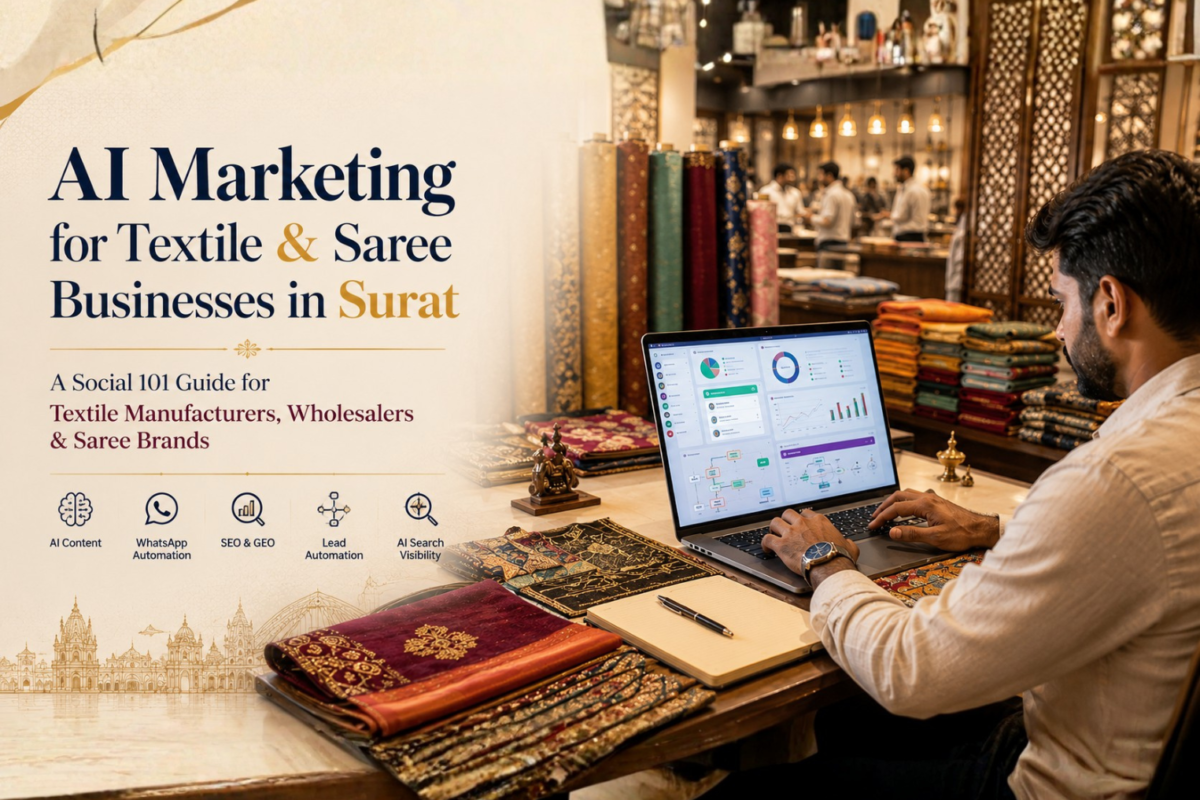
Surat runs on textiles. It’s home to one of the country’s largest synthetic fabric and saree manufacturing hubs, with thousands of manufacturers, wholesalers, and D2C saree brands competing for the same buyers both in India and increasingly overseas. The challenge for most of these businesses isn’t a lack of product; it’s visibility. Buyers today discover fabric and saree suppliers through Instagram reels, WhatsApp catalogues, Google searches, and now, AI chat tools like ChatGPT and Gemini.

At Social 101, a full-service digital marketing agency in Surat, we work closely with textile and saree businesses across the city. This guide covers how AI marketing specifically applies to this industry in 2026, from content and catalogs to B2B lead automation and AI search visibility.

Why Textile & Saree Businesses Need AI Marketing Now

  • Buyers move fast on WhatsApp. A wholesale buyer messaging five suppliers at once will order from whoever replies first with the right rate, and stock speed of response is a competitive edge, not a nice-to-have.
  • Visual content decides the sale. Fabric texture, drape, and color accuracy matter more here than in most categories, and buyers expect fresh catalog visuals every season without a full studio shoot each time.
  • B2B and B2C buyers now search differently. A boutique owner sourcing sarees in bulk and a bride searching for wedding sarees both start their research online and increasingly, some of that research happens inside AI chat tools rather than a Google search box, which is why AI search visibility matters here too.
  • Seasonality is extreme. Festive and wedding season demand spikes hard, and manual content production simply can’t keep pace without AI-assisted workflows.

Where AI Fits in Textile & Saree Marketing

1. Catalogue & Product Photography

  • Canva (Magic Studio) (visit site) helps turn flat fabric or saree shots into styled, on-brand catalogue posts and carousels quickly, without a designer reworking every single image.
  • AI backgrounds and image-enhancement tools reduce dependency on expensive re-shoots when a new fabric colorway or print drops mid-season.

2. Reels & Short-Form Video

Draping reels, fabric-texture close-ups, and “behind the loom” content consistently perform well for Surat textile brands. AI-assisted video editing tools speed up cutting, captioning, and repurposing one shoot into multiple reels instead of producing a single post per shoot.

3. WhatsApp Catalogue & Buyer Response Automation

For wholesale-heavy businesses, this is often the highest-impact use of AI. Automated WhatsApp replies (rates, MOQs, available stock, and catalog links) mean a buyer gets an instant response at 11 PM, not the next morning while the sales team still steps in personally for negotiation and closing. Paired with Zapier or Make, every inquiry can also land directly in a CRM instead of getting lost in chat threads.

4. Content & Captions in Multiple Languages

  • Jasper (visit site) keeps captions and product descriptions on-brand across festive, bridal, and daily-wear campaigns, even when written in English, Hindi, or Gujarati.
  • ChatGPT / Claude are useful for first-draft captions, product descriptions, and outlining longer content like buyer guides or fabric-care posts.

5. SEO for Manufacturers & Wholesalers

  • Surfer SEO (visit site) helps build genuine topical authority around terms like “saree wholesaler Surat” or “textile manufacturer Surat” instead of chasing one keyword at a time.
  • Semrush AI is useful for technical SEO audits, especially for manufacturers whose websites are built for B2B inquiries, not just browsing.

6. AI Search Visibility (GEO) for B2B Buyers

A growing number of boutique owners, exporters, and even individual buyers now ask AI tools directly: “Which are the best saree wholesalers in Surat?” or “Recommend a textile manufacturer for cotton sarees.” Whether a brand gets cited in that answer is a new, separate discipline from ranking on Google covered in detail in our guide on how Surat businesses can get found on ChatGPT and AI search.

AI Tools by Use Case: Textile & Saree Businesses

Use CaseWhat It SolvesExample Tools
Product photographyTurning flat saree/fabric shots into styled, model-ready catalogue images fastCanva Magic Studio, AI image tools
Reels & video contentProducing draping reels and fabric-texture videos without a full shoot every timeAI video/editing tools
WhatsApp catalogue & bulk repliesInstant responses to wholesale buyers asking for rates, MOQs, and stockWhatsApp Business API + automation
Content & captionsFestive, wedding-season, and daily captions in English, Hindi & GujaratiJasper, Copy.ai, ChatGPT
SEO & keyword researchRanking for “saree wholesaler Surat,” “textile manufacturer Surat”Surfer SEO, Semrush AI
AI search visibility (GEO)Getting cited when buyers ask ChatGPT/Gemini for saree or fabric suppliersEmerging GEO platforms
Lead & order automationRouting B2B enquiries from forms/WhatsApp into a CRM without manual entryZapier, Make

How Social 101 Applies This for Textile & Saree Clients

Across the textile and saree businesses we work with in Surat, the pattern is consistent:

  • Manufacturers & wholesalers: faster WhatsApp response automation and CRM-linked lead capture mean fewer bulk inquiries slip through during peak season.
  • D2C saree brands: AI-assisted content and design tools keep festive and wedding-season campaigns consistent across Instagram, without needing a bigger in-house creative team.
  • Both segments: AI search visibility tracking makes sure the brand shows up when a buyer B2B or B2C asks an AI assistant for a recommendation, not just when they type a Google search.

The tools remove the manual grind. The strategy of knowing which fabric story to tell, which season to push hardest, and which buyer segment to prioritize still comes from people who understand Surat’s textile market closely.

Getting Started: A Practical First Step

  1. Fix your fastest-response channel first. For most textile businesses, that’s WhatsApp automating the first reply before anything else.
  2. Standardize your catalog content. Use AI design tools to keep every product image and caption on-brand, even during high-volume festive drops.
  3. Build topical SEO around your category. Whether it’s “saree manufacturer Surat” or a specific fabric type, consistent content compounds over time.
  4. Track your AI search visibility. Check whether your brand gets mentioned when buyers ask ChatGPT or Gemini for suppliers in your category.

FAQs

Is AI marketing only useful for D2C saree brands, or also for wholesale manufacturers?

Both. D2C brands benefit most from AI-assisted content and design; wholesale manufacturers see the biggest impact from WhatsApp automation, lead routing, and B2B-focused SEO.

Can AI tools handle Hindi and Gujarati content for local buyers?

Yes. Tools like Jasper and ChatGPT can draft captions and responses in Hindi and Gujarati alongside English, though a human review for tone and local phrasing is still recommended.

How is AI search visibility different from normal SEO for a textile business?

Traditional SEO helps a website rank in Google’s search results. AI search visibility (GEO) tracks whether a brand actually gets cited when someone asks an AI tool like ChatGPT or Gemini for a recommendation, a separate, newer discipline that matters increasingly for B2B sourcing decisions.

Ready to Bring AI Marketing to Your Textile or Saree Business?

If you manufacture, wholesale, or sell sarees and fabric in Surat and want a marketing approach built around how your buyers actually search and order, not a generic playbook get in touch with Social 101, and we’ll help you build a stack and strategy suited to your business.

Related Reading

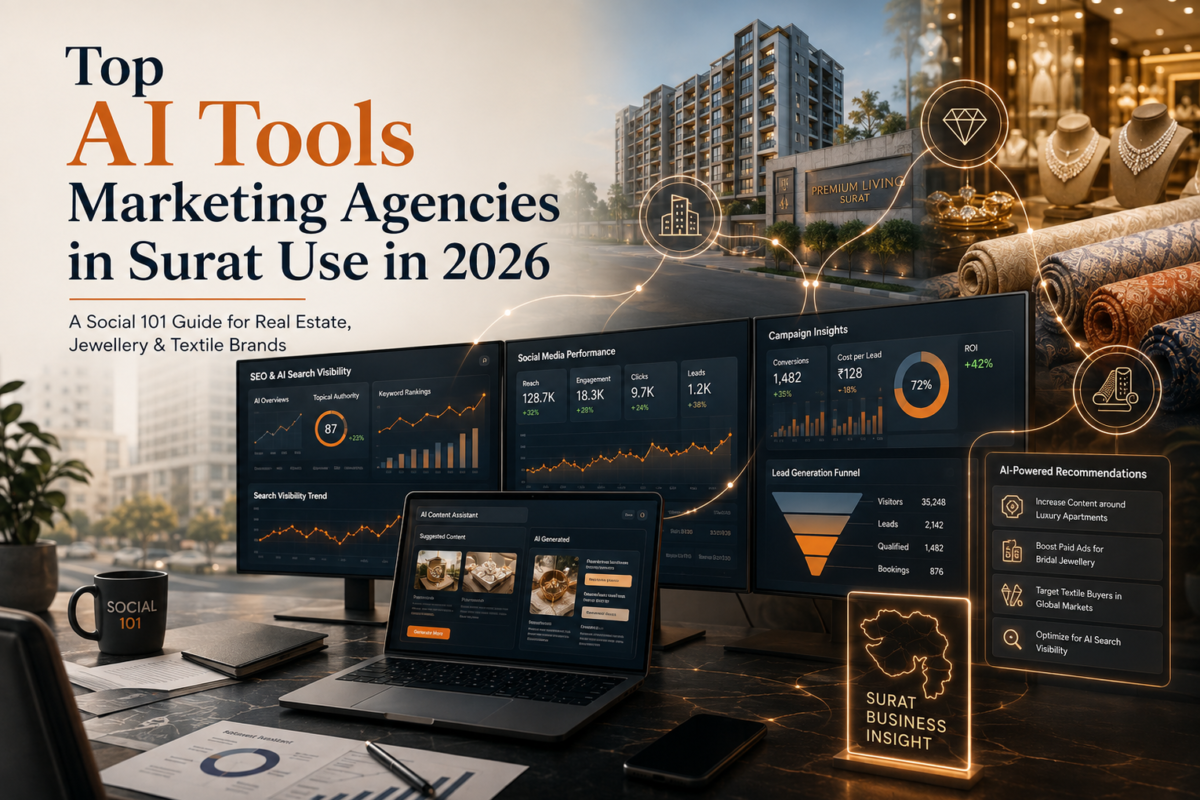
Top AI Tools Marketing Agencies in Surat Use in 2026

Introduction

Surat’s business landscape runs on three big engines: real estate, diamonds and jewelry, and textiles and every one of them is now competing for attention online, not just in the local market. That shift has changed what a marketing agency in Surat needs to deliver. Clients no longer just want a social media calendar; they want faster content, sharper targeting, and visibility on AI platforms like ChatGPT and Google AI Overviews, alongside traditional Google rankings.

At Social 101, a full-service digital marketing agency in Surat, AI tools aren’t a buzzword they’re part of the daily workflow behind the campaigns we run for real estate developers, jewellery brands, and D2C businesses. This guide breaks down the AI tools we and other serious agencies in Surat actually rely on in 2026 and how they get applied to real, local business categories.

Why Surat Agencies Need an AI-First Approach in 2026

A few local realities make this more urgent for Surat specifically:

  • Real estate buyers research before they call. Someone comparing 2 BHK flats or commercial spaces in Surat is scrolling Instagram reels, reading Google reviews, and increasingly asking AI chatbots for recommendations before ever visiting a site office.
  • Jewelry and diamond buyers expect visual-first content. High-value purchases like bridal jewelry or lab-grown diamonds need consistent, premium creative across every platform something AI-assisted design tools make possible without ballooning production costs.
  • Textile and B2B buyers are searching in bulk. Manufacturers and wholesalers are now discoverable (or invisible) inside AI search answers, not just Google’s blue links, which is why AI search visibility has become its own discipline.

This is the backdrop against which we evaluate every AI tool before it earns a place in our stack.

The AI Tools Marketing Agencies in Surat Are Actually Using

1. AI Content & Copywriting Tools

For real estate developers and jewelry brands running content across Instagram, Google, and email at the same time, consistency matters as much as speed.

  • Jasper (visit site) lets us set a brand voice profile per client, so a luxury jewelry brand and a mid-segment real estate project never sound the same, even when the same team is writing for both.
  • Copy.ai (visit site) is useful for generating ad copy variants quickly, especially during festive and wedding-season campaigns when jewelry and real estate demand spikes.
  • ChatGPT / Claude are our go-to for first drafts, project descriptions, and outlining blog content before a human editor refines tone, accuracy, and local context.

2. AI SEO & Keyword Research Tools

Ranking one blog post isn’t the goal anymore; owning a topic is.

  • Surfer SEO (visit site) scores content against top-ranking competitors for keywords like “real estate developers in Surat” or “jewellery brands in Surat,” helping build genuine topical authority instead of one-off posts.
  • Semrush AI combines keyword research and technical audits with AI-prioritized fix recommendations, which matters when a real estate client’s website needs both content and technical SEO work.

3. AI Design & Creative Tools

  • Canva (Magic Studio) (visit site) the fastest way to produce on-brand creative for property launch posts, jewelry collection reveals, and festive campaign creatives without looping in a designer for every small asset.
  • AI image and short-video tools now speed up reels production for showroom walkthroughs and site-visit content, cutting turnaround time significantly during high-volume campaign periods.

4. AI Social Media Scheduling Tools

  • Buffer and Later both offer AI-assisted caption generation and optimal posting-time recommendations, useful when managing multiple client calendars for real estate, jewelry, and textile accounts at once.

5. AI Research & Strategy Tools

  • Perplexity (visit site) is used for competitor research and market data before it goes into a client strategy deck, particularly for understanding what other Surat real estate or jewelry brands are doing.
  • ChatGPT / Claude again, but for structured strategy: campaign briefs, buyer personas (like the NRI jewelry buyer or the first-time Surat homebuyer), and messaging frameworks.

6. AI Automation Tools

  • Zapier and Make connect lead forms straight into CRMs, so a lead who fills a form for a real estate project or requests a jewelry catalogue gets followed up without manual data entry. For agencies handling multiple client accounts, this alone saves hours of account management time every week.

7. AI Search Visibility (GEO) Tools

This is the fastest-growing category in 2026. As more buyers ask ChatGPT or Gemini for recommendations instead of typing a Google search, agencies need to track whether a client’s brand actually gets cited inside those answers, not just ranked on Google. We cover this in detail in our guide on how Surat businesses can get found on ChatGPT and AI search.

8. AI Reporting & Analytics Tools

  • Looker Studio with AI connectors automates recurring client reports by pulling data from ad platforms and analytics tools into one dashboard, instead of building reports manually every month.

Quick Comparison: AI Tool Categories for Surat Businesses

CategoryBest ForExample Tools
Content creationReal estate & jewellery copy at scaleJasper, Copy.ai, ChatGPT
SEORanking & topical authority for local searchesSurfer SEO, Semrush AI
DesignOn-brand creative for launches & collectionsCanva
Social schedulingManaging multiple client calendarsBuffer, Later
ResearchCompetitor & market insightPerplexity
AutomationLead follow-up, reporting, admin hoursZapier, Make
AI search visibilityGetting cited in ChatGPT/Gemini answersEmerging GEO platforms
ReportingAutomated client dashboardsLooker Studio

How Social 101 Applies AI Tools for Real Surat Clients

Tools only matter when they’re applied to real business problems. A few examples of how this plays out across the categories we serve:

  • Real estate: For developers like Sangini Group, Raghuvir Developers, and Piramyd Group, AI-assisted content and design tools help produce consistent project launch campaigns, reels, and lead-gen creative at the pace real estate marketing demands without sacrificing the premium look a project needs.
  • Jewelry: For brands, AI design and content tools help maintain a consistent luxury aesthetic across festive, bridal, and everyday collection campaigns, while AI research tools keep messaging aligned with what buyers are actually searching for.
  • Across categories: AI automation keeps lead follow-up fast, AI reporting keeps clients informed without manual work, and AI search visibility tracking makes sure these brands show up when someone asks an AI assistant, “Which real estate developers should I consider in Surat?” or “What are the best jewelry brands in Surat?”

The tools speed up execution. The strategy, brand judgment, and understanding of the Surat market still come from people who know these categories closely.

How to Choose the Right AI Stack (For Any Surat Business)

  1. Identify your biggest bottleneck; for most local businesses, it’s either content production or lead follow-up.
  2. Pick one tool per bottleneck and measure the time it actually saves before adding another.
  3. Set clear rules on data and review: decide what client or customer data can go into which tool and who checks AI output before it goes live.
  4. Keep a human in the loop. AI speeds up execution, but positioning, pricing sensitivity, and creative judgment for a Surat audience still need a strategist who understands the local market.

FAQs

Do Surat businesses need to buy all these AI tools themselves?

No. Most small and mid-sized businesses don’t need to manage a full AI stack; that’s the value an agency provides: the right tools already integrated into a working process, without the learning curve or extra subscription costs.

Will AI tools replace marketing agencies in Surat?

No. AI speeds up drafting, scheduling, and reporting, but strategy, brand positioning, and local market understanding still require human expertise, especially as AI search makes differentiation more important, not less.

Which industries in Surat benefit most from AI-powered marketing?

Real estate, jewelry and diamonds, and textiles benefit the most right now, since all three combine high-value purchases with buyers who research extensively online before making a decision.

Ready to Build Your AI-Powered Marketing Stack?

If you’re a real estate, jewelry, or textile brand in Surat trying to figure out which AI-powered marketing approach actually fits your business instead of chasing every new tool get in touch with Social 101 and we’ll help you build a stack, and a strategy that fits.

Related Reading

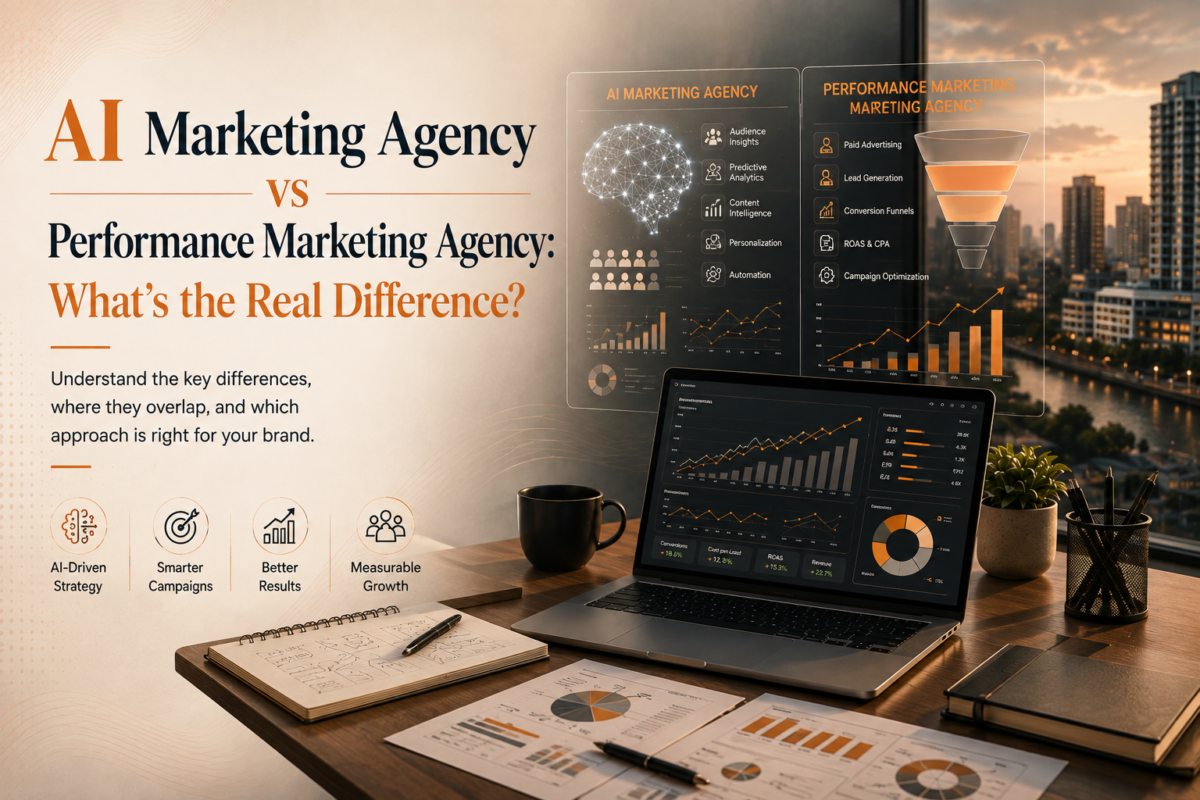
AI Marketing Agency vs Performance Marketing Agency: What’s the Real Difference?

If you’ve started researching marketing partners for your brand, you’ve probably noticed two labels showing up everywhere: AI marketing agency and performance marketing agency. They sound similar, they’re often used interchangeably in pitches, and both promise results. But they aren’t the same thing, and knowing the difference can save you from hiring the wrong partner for your goals.

This guide breaks down what each type of agency actually does, where they overlap, and how to decide which one or which combination your brand needs. If you’d rather skip the research and talk to a team that does both, Social 101 is a full-service digital marketing agency in Surat that blends AI-driven strategy with performance-focused execution.

What Is a Performance Marketing Agency?

A performance marketing agency is built around one core promise: measurable, trackable results tied directly to spend. Every rupee you invest is expected to produce a number you can point to a click, a lead, an install, a sale.

Typical performance marketing services include the following:

  • Paid search advertising (Google Ads, Bing Ads)
  • Paid social advertising (Meta, Instagram, LinkedIn Ads)
  • Programmatic and display advertising
  • Conversion rate optimization (CRO) on landing pages
  • Affiliate and retargeting campaigns
  • ROI, ROAS, and CAC reporting

The agency’s success is judged almost entirely by the numbers: cost per lead, return on ad spend, and cost per acquisition. If a campaign isn’t converting, it gets paused, tested, or rebuilt fast.

What Is an AI Marketing Agency?

An AI marketing agency uses artificial intelligence as a layer across the entire marketing process not just paid ads. This typically means AI-assisted tools and workflows applied to the following:

  • Audience research and customer segmentation
  • Content ideation, copywriting, and creative production
  • Predictive analytics forecasting what will perform before it’s live
  • Automated A/B testing across ad creative and messaging
  • Smarter, real-time bid and budget optimization
  • Personalization at scale: different messaging for different audience segments automatically

The goal isn’t just to run ads faster; it’s to make every part of the marketing process, from strategy to creative to distribution, more informed and less based on guesswork.

AI Marketing Agency vs Performance Marketing Agency: Side-by-Side

FactorPerformance Marketing AgencyAI Marketing Agency
Primary FocusPaid media results (leads, sales, ROAS)Data-driven strategy across the full funnel
Core ToolsAd platforms (Google, Meta, LinkedIn)AI tools for content, targeting, prediction, and automation
Success MetricCost per lead / ROAS / conversionsOverall growth, efficiency, and content performance
ScopeMostly paid advertisingStrategy, content, branding, and paid media together
Best ForBrands needing fast, trackable lead or sales growthBrands wanting a smarter, unified long-term strategy
Creative RoleOften supports ads onlyInforms branding, content, and campaigns holistically

Where They Overlap

Here’s the part most comparisons miss: the best agencies today don’t force you to choose. Modern performance marketing increasingly relies on AI-powered targeting and optimization to reduce wasted spend, and a genuine AI marketing agency still needs strong performance-marketing execution to actually convert an audience into customers. In practice, the line between the two is blurring fast.

Which One Does Your Brand Actually Need?

Choose a Performance Marketing Agency If:

  • You need fast, short-term results from a fixed ad budget
  • Your brand already has strong creative and messaging in place
  • Your main goal is lead generation or direct sales, not brand building

Choose an AI Marketing Agency If:

  • You want a long-term, data-backed brand strategy not just ad campaigns
  • You need help across content, branding, and paid media, not just one channel
  • You want your marketing to keep improving through testing, automation, and insight, not stay static

Choose a Hybrid Agency If:

  • You want both fast performance results and a smarter, AI-informed long-term strategy
  • You’d rather work with one accountable team instead of coordinating multiple vendors
  • You’re scaling and need branding, content, and paid media to move together

Why Surat Brands Are Choosing Hybrid Agencies Like Social 101

Most growing businesses don’t fit neatly into just one category; they need the lead-generation discipline of performance marketing and the strategic, data-informed thinking of an AI-driven agency. Social 101, a Surat-based full-service agency, combines both: branding, content marketing, and social media strategy built on audience data, paired with performance marketing that’s optimized continuously rather than launched and left alone. You can explore their full range of services on the Social 101 services page or see real client work in their portfolio.

Final Thoughts

There’s no universally “better” choice between an AI marketing agency and a performance marketing agency it depends on whether your brand needs fast, trackable conversions; a smarter long-term strategy; or ideally, both working together. The agencies winning the most business right now are the ones that don’t make you pick one lane.

Not sure which approach fits your brand? Talk to Social 101 or read more marketing insights on their blog.

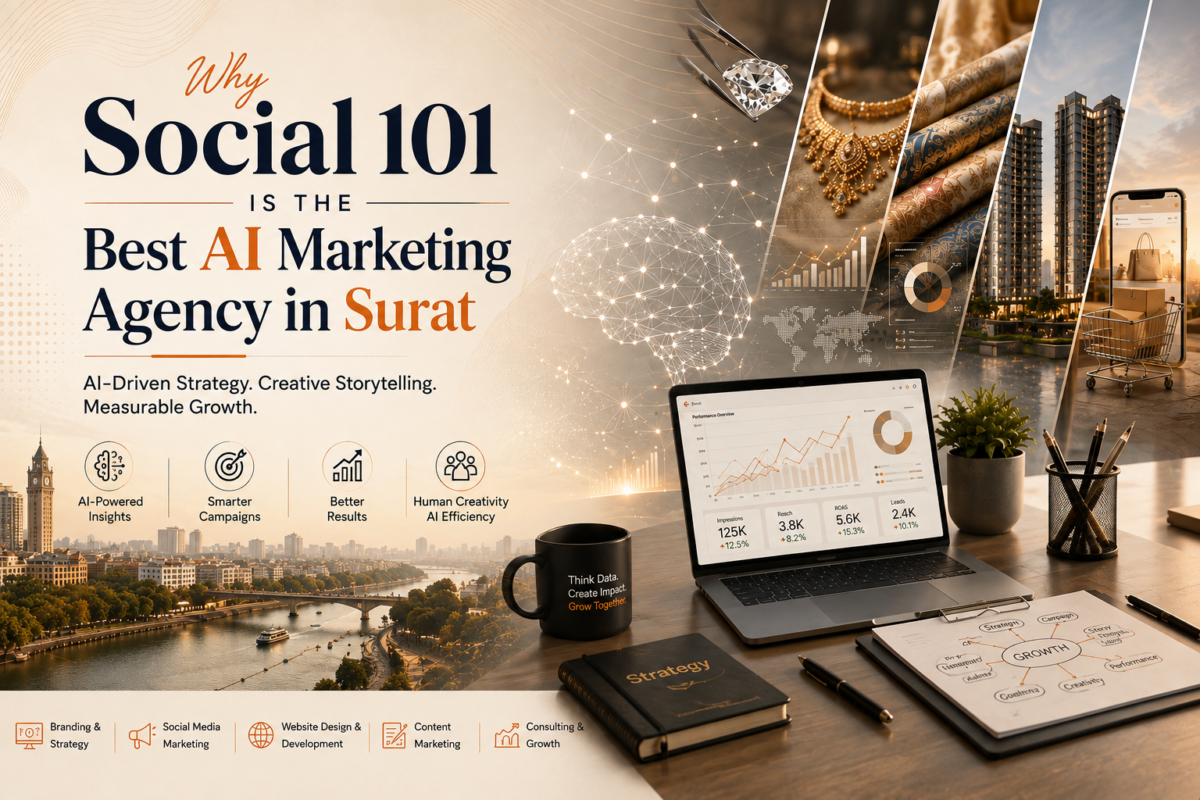
Why Social 101 Is the Best AI Marketing Agency in Surat

Surat’s business landscape, from diamond and textile houses to jewelry brands, real estate groups, and D2C startups, is growing faster than ever, and so is the competition for attention online. Brands that once relied on word-of-mouth and traditional advertising are now expected to show up on Instagram, rank on Google, run performance ads, and produce scroll-stopping video content, all at once. This is exactly where the right partner makes the difference, and it’s why more Surat businesses are searching for the best AI marketing agency in Surat and landing on Social 101.

Social 101 isn’t just another agency running the same playbook for every client. It’s a full-service, AI-informed digital marketing team that pairs data and automation with genuine creative thinking, so brands don’t just get “more content,” they get the right content, delivered to the right audience, at the right time.

What Makes an Agency an “AI Marketing Agency” in 2026?

Before naming a winner, it’s worth asking what actually separates an AI-driven agency from a traditional one. It usually comes down to a few things:

  • Data-backed strategy instead of guesswork using audience insights and performance data to decide what to create and where to publish it
  • AI-assisted content and creative workflows that speed up ideation, copywriting, and design without losing a brand’s unique voice
  • Smarter performance marketing using AI-powered targeting and optimization to get more results from the same ad spend
  • Continuous testing and iteration, rather than a “set it and forget it” campaign
  • Human strategists in the loop, so AI accelerates the work but doesn’t replace the judgment, taste, and cultural context a brand needs

Judged against this checklist, Social 101 checks every box and does it with a Surat-first understanding of local audiences, industries, and buying behavior.

Why Social 101 Stands Out in Surat

1. Full-Service Capability Under One Roof

Most agencies specialize in one lane, social media, web design, or ads, and hand you off to freelancers for the rest. Social 101 brings branding, social media marketing, website design & development, content marketing, strategic consulting, performance marketing, and video marketing together under a single team. That means your brand strategy, creative execution, and AI-powered distribution are all working from the same playbook instead of pulling in different directions. You can see the full breakdown on their services page.

2. Six-Plus Years of Proven Results in Surat

Social 101 has spent over six years working with Surat-based and national brands across jewelry, education, real estate, textiles, hospitality, and finance. That kind of category depth means the team already understands what resonates with Surat audiences from festive-season jewelry campaigns to B2B lead generation for manufacturing and finance brands. Their portfolio reflects hundreds of completed projects for a wide mix of clients.

3. AI-Powered, Insight-Led Content Marketing

Rather than churning out generic posts, Social 101’s content marketing process leans on audience data and performance insights increasingly supported by AI tools for research, ideation, and optimization to decide what content actually deserves a brand’s budget: infographics, videos, podcasts, blogs, or web pages. The goal isn’t content for content’s sake; it’s content built to convert.

4. Smarter Performance Marketing

Paid ads without AI-informed targeting is money spent on hope. Social 101’s performance marketing service uses data-driven audience segmentation and continuous optimization to make every rupee of ad spend work harder, whether the objective is app installs, leads, or e-commerce sales.

5. A Team That Treats Your Growth as Their Own

Every agency claims to care about client results. What sets Social 101 apart is a genuinely collaborative approach. Brands aren’t handed a strategy deck and left to interpret it; they’re brought into the process. That’s reflected in long-standing client relationships, including brands like Charu Jewels, who partnered with Social 101 to build a stronger, more consistent social media presence over time.

AI + Human Creativity: The Social 101 Advantage

The best AI marketing agencies don’t replace human strategists with automation they use AI to remove the guesswork so creative and strategic minds can focus on what actually moves a brand forward. Social 101’s approach reflects this balance:

What AI HandlesWhat the Social 101 Team Handles
Audience and performance data analysisBrand voice, storytelling, and positioning
Content ideation and research at scaleFinal creative direction and design
Ad targeting and bid optimizationCampaign strategy and budget planning
Trend and keyword trackingClient relationships and consulting

This is the combination that lets Social 101 deliver campaigns that are both data-smart and genuinely memorable, which is ultimately why so many businesses now consider Social 101 the best AI marketing agency in Surat.

Who Should Work With Social 101?

Social 101 is a strong fit for:

  • Jewellery, fashion, and lifestyle brands wanting a stronger social presence
  • Real estate and infrastructure companies that need brand credibility and lead generation
  • Educational institutions looking to engage students and parents online
  • D2C and e-commerce startups that need performance marketing that actually converts
  • Established Surat businesses ready to modernize their digital presence with AI-backed strategy

Final Thoughts

Surat has no shortage of marketing agencies, but few combine six-plus years of local experience, full-service capability, and a genuinely AI-informed approach to strategy and content the way Social 101 does. For brands that want more than vanity metrics, real, measurable growth backed by smart technology and sharp creative, Social 101 is worth the conversation.

Ready to grow your brand with the best AI marketing agency in Surat? Get in touch with Social 101 or explore more insights on their blog.

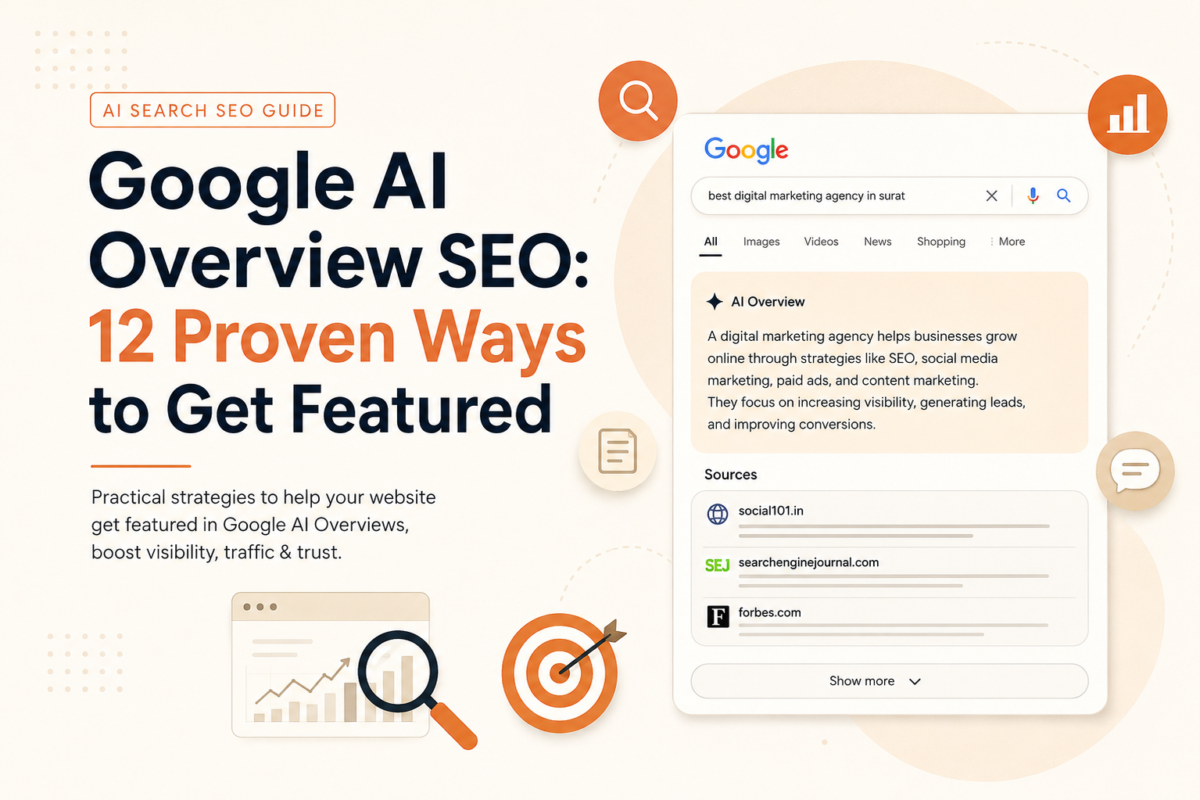
Google AI Overview SEO: 12 Proven Ways to Get Your Website Featured

Introduction

Search behavior has changed. Instead of scrolling through ten blue links, most people now get their answer directly from Google AI Overview, the AI-generated summary that sits right at the top of the search results page. If your website isn’t cited in that box, you’re invisible to a growing share of searchers, no matter how well you rank in the traditional listings below it.

This shift is exactly why Google AI Overview SEO has become one of the most important skills for any brand serious about organic visibility in 2026. The good news: AI Overviews still pull from real, indexed web pages which means the sites that follow strong SEO fundamentals, structure their content clearly, and build genuine authority have a real shot at being featured.

In this guide, Social 101, a full-service digital marketing agency in Surat, breaks down 12 proven, practical ways to get your website featured in Google AI Overviews along with the on-page, technical, and authority-building moves that make it possible. This builds on what we’ve already covered in our Organic Growth Strategy for Businesses in 2026 guide and our GEO Guide on getting found on ChatGPT and AI Search.

What Is Google AI Overview, and Why Should You Care?

Google AI Overview is an AI-generated answer box, powered by Gemini, that appears above traditional search results for many queries. It synthesizes information from multiple web sources and displays a summarized answer along with citation links back to the original pages.

Getting featured here matters because it puts your brand in front of users at the exact moment they’re searching before they even scroll to position #1. It builds trust, drives qualified clicks, and signals topical authority to Google for future rankings too.

12 Proven Ways to Get Your Website Featured in Google AI Overview

1. Answer the Question Directly in the First 2–3 Sentences

AI Overviews reward content that gets straight to the point. Open every important page or section with a clear, direct answer to the query; the background, context, and detail can follow after.

Think of the opening lines as the exact sentence you’d want Google to lift and cite.

2. Target Question-Based & Conversational Keywords

AI Overviews are triggered mostly by question-style and long-tail searches (“how,” “what,” “why,” “best way to”). Research the real questions your audience is asking and build dedicated headings around them, rather than only chasing short head-term keywords.

3. Structure Content with Clear Headings (H1, H2, H3)

A logical heading hierarchy helps Google’s AI parse your page and extract the right chunk of content for the right query. Each H2/H3 should read almost like its own mini-question, with the answer immediately below it.

4. Use Schema Markup (FAQ, HowTo, Article)

Structured data doesn’t guarantee an AI overview placement, but it makes your content far easier for Google to understand and trust. Add FAQPage, HowTo, and Article schema wherever relevant, and keep your schema in sync with the visible on-page content.

5. Build Topical Authority with Content Clusters

Instead of one isolated blog post, build a cluster: a comprehensive pillar page supported by several related articles, all interlinked. This is exactly the approach we used in our own organic growth strategy for businesses in 2026 pillar, which links out to supporting guides on SEO, content, and AI search.

6. Win the Featured Snippet First

Pages that already rank in a Featured Snippet or the top 3 organic positions are far more likely to be pulled into an AI Overview. Optimize for snippet-style formatting, concise definitions, numbered steps, and comparison tables as a stepping stone.

7. Add Original Data, Statistics & Expert Insight

Generic, reworded content rarely gets cited. Original research, first-party data, case studies, and expert commentary give the AI something unique and citation-worthy that it can’t find on ten other sites.

8. Keep Content Concise, Skimmable & Fact-Dense

Short paragraphs, bullet points, comparison tables, and bolded key terms make it easier for both users and AI models to extract facts quickly. Avoid fluff; every sentence should earn its place.

9. Strengthen Your E-E-A-T Signals

Experience, expertise, authoritativeness, and Trust remain central to what Google surfaces in AI Overviews. Add real author bios, credentials, published dates, sources, and an accessible About/Contact page details you’ll find on our own About and Contact pages.

10. Earn High-Quality Backlinks & Brand Mentions

Citations and backlinks from reputable, relevant sites still tell Google’s AI systems that your content is trustworthy enough to reference. Prioritise digital PR, guest contributions, and partnerships over volume-based link building.

11. Optimise for Voice, Local & Multimodal Search

Many AI Overview queries mirror how people speak, not how they type. Optimize for natural-language phrasing and local intent (“near me,” city names), and add descriptive alt text and captions to images and videos so multimodal AI models can understand your visual content too.

12. Monitor, Measure & Iterate

Track which of your pages already appear in AI Overviews using Search Console’s new AI search reporting, and keep refining based on what’s working. AI Overview: SEO isn’t a one-time setup; it’s an ongoing discipline, the same way we approach it for our own clients through Social 101’s growth marketing services.

Final Thoughts

Getting featured in Google AI Overview isn’t about gaming a new algorithm; it’s about doing SEO right: answering real questions clearly, structuring content the way both humans and AI models can parse it, and building the kind of authority that earns citations. Brands that invest in this now will have a significant visibility advantage as AI-powered search continues to grow.

Want help auditing your website and building an AI Overview-ready content strategy? Talk to Social 101 or explore more insights on our blog.

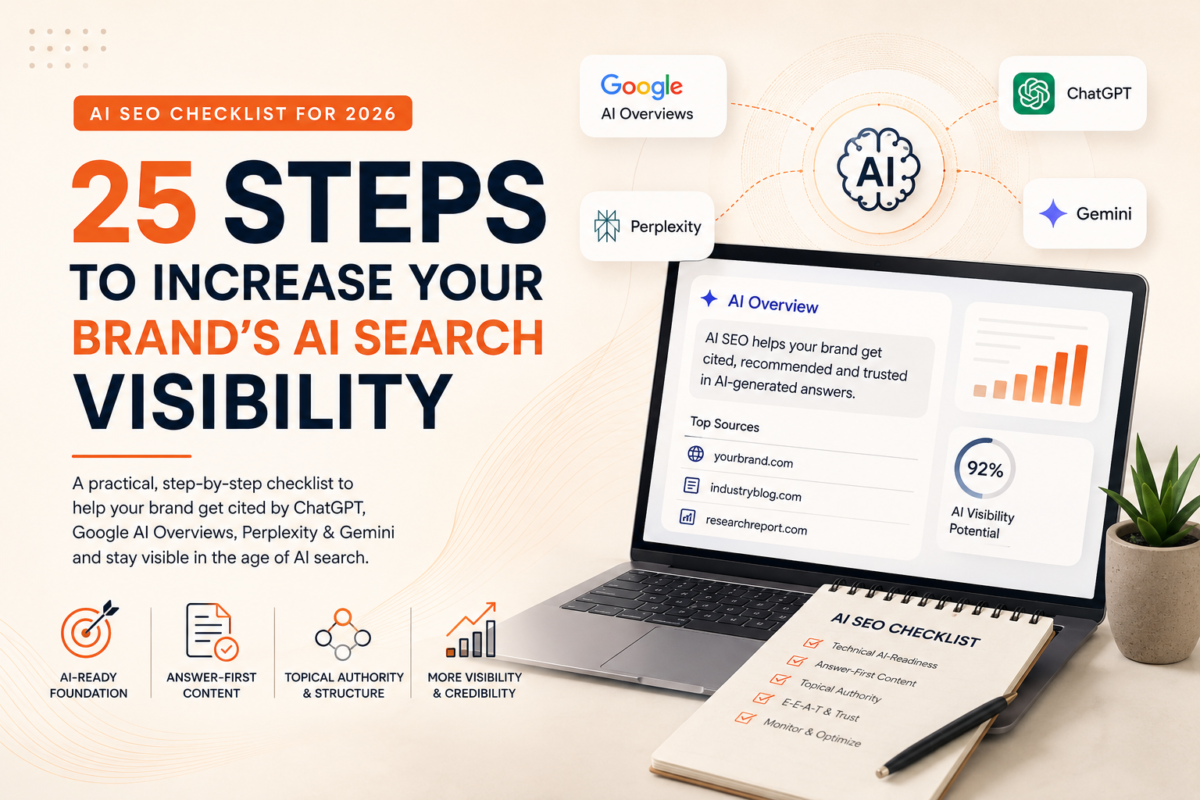
AI SEO Checklist 2026: 25 Steps to Boost AI Search Visibility

Introduction

Search has changed more in the last two years than in the previous two decades. A growing share of searches on Google now surface an AI overview before a single blue link appears, and millions of people are asking ChatGPT, Perplexity, Gemini, and Claude for direct answers instead of typing keywords into a search bar. For brands, this means visibility is no longer just about ranking on page one. It is about being the source an AI system trusts enough to cite, quote, or recommend by name.

This is where AI SEO comes in, a blend of traditional Search Engine Optimization (SEO), Answer Engine Optimization (AEO), and Generative Engine Optimization (GEO). Together, these disciplines determine whether your brand shows up in AI-generated answers or disappears behind a competitor who structured their content better.

At Social 101, we help brands in Surat and beyond build the kind of content, technical foundation, and digital authority that AI search engines are actively looking for. Below is a practical, 25-step AI SEO checklist you can start using today to increase your brand’s AI search visibility in 2026.

1. Foundation & Technical AI-Readiness

Before AI systems can cite your brand, they need to be able to crawl, read, and trust your website. These first five steps make sure the technical groundwork is solid.

Step 1. Audit crawlability for AI bots

Check your robots.txt and server logs to confirm crawlers such as GPTBot, PerplexityBot, ClaudeBot, and Google-Extended can access your key pages. Blocking AI crawlers by default is one of the fastest ways to become invisible in AI answers.

Step 2. Improve page speed and Core Web Vitals

AI systems and traditional search engines both favor fast, stable pages. Compress images, use lazy loading, and minimize render-blocking scripts so crawlers can index your content efficiently.

Step 3. Make content readable without JavaScript rendering

Many AI crawlers read raw HTML rather than executing JavaScript. Ensure your core text content is present in the initial HTML response, not injected client-side only.

Step 4. Fix duplicate and thin content

Consolidate near-duplicate pages and expand thin ones. AI models favor pages that offer clear, unique value on a topic rather than pages that repeat what is already well covered elsewhere.

2. Content Structure & Answer-First Writing

AI systems extract short, self-contained passages to build their answers. Structuring content so it can be lifted cleanly is central to AI search visibility.

Step 6. Lead with a direct answer

Open each page or section with a concise, two- to three-sentence answer to the core question before expanding with detail. AI overviews and chat answers often pull directly from the first clear statement on a page.

Step 7. Write in question-and-answer format

Use real, conversational questions your audience asks as subheadings, followed immediately by a clear answer. This mirrors how people prompt AI tools and improves your odds of being the source cited.

Step 8. Break content into short, topical sections

Keep sections focused on a single sub-topic, roughly 150 to 300 words each, with a descriptive heading. This makes it easier for AI systems to retrieve and quote the exact passage that answers a query.

Step 9. Support claims with specific data and examples

Concrete numbers, dates, and named examples are more likely to be treated as citable facts than vague statements. Where possible, reference original research, case studies, or first-party data.

Step 10. Add clear summaries and key takeaways

Close long articles with a short bullet summary. This gives AI systems a ready-made, extractable synopsis of your content and improves readability for human visitors too.

3. Entity, Authority & E-E-A-T

AI systems try to answer confidently, which means they lean on sources they can verify as credible. Building recognizable, well-connected authority signals is essential.

Step 11. Strengthen your Experience, Expertise, Authority and Trust (E-E-A-T) signals

Add author bios, credentials, and real case results to your content. Show that a genuine expert or an experienced team stands behind what is published.

Step 12. Build consistent entity information across the web

Make sure your brand name, description, and details match across your website, Google Business Profile, LinkedIn, industry directories, and social profiles. Consistency helps AI systems confirm who you are.

Step 13. Earn mentions on third-party and industry sites

Being mentioned, reviewed, or linked to on respected external sites builds the kind of independent corroboration that AI models weigh heavily when deciding whom to cite.

Step 14. Publish original research, data, or industry insights

Original findings are the content AI systems most want to cite because they cannot be found anywhere else. Even a small annual survey or benchmark report can become a strong citation magnet.

Step 15. Keep content fresh and dated

Update key pages regularly and show a visible last-updated date. Recency is a consistent signal across AI Overviews, AI Mode, and chat-based answer engines.

4. Structured Data & Machine Readability

Structured data gives AI systems an explicit, machine-readable map of your content, reducing the guesswork involved in understanding and trusting your pages.

Step 16. Implement Article, FAQ, and HowTo schema

Mark up blog posts, FAQs, and step-by-step guides with the relevant schema.org types so AI systems and search engines can parse the structure of your content precisely.

Step 17. Add Organization and Person schema

Use structured data to formally define your brand, key team members, logo, and social profiles, reinforcing the entity signals covered in Step 12.

Step 18. Use breadcrumb and sitelinks markup

Breadcrumb schema clarifies where a page sits within your site hierarchy, helping AI systems understand topical relationships between pages.

Step 19. Validate structured data regularly

Run your key pages through Google’s Rich Results Test and Schema Markup Validator after every major update to catch errors before they affect visibility.

Step 20. Create a clear, updated XML sitemap and llms.txt file

An accurate sitemap helps traditional crawlers find your content, while an emerging llms.txt file can guide AI crawlers to your most important, citation-ready pages.

5. Distribution, Monitoring & Optimization

AI search visibility is not a one-time setup. It requires distribution across platforms and ongoing measurement to see what is actually getting cited.

Step 21. Distribute content across multiple platforms

Repurpose key articles into LinkedIn posts, YouTube scripts, and Reddit or Quora answers. AI systems draw on a wide range of sources beyond your own website, so a multi-platform footprint increases your chances of being referenced.

Step 22. Track brand mentions in AI answers

Regularly test how ChatGPT, Perplexity, Gemini, and Google AI Overviews answer questions relevant to your industry, and note whether and how your brand appears.

Step 23. Monitor traditional and AI-referral traffic separately

Use Google Search Console and analytics segmentation to distinguish traffic coming from AI Overviews or chat tools from classic organic search, so you can see what is actually working.

Step 24. Benchmark against competitors in AI answers

Run the same set of queries used in Step 22 and note which competitors are cited instead of you. Identify what their content or structure does differently.

Step 25. Review and refresh your AI SEO checklist quarterly

AI search platforms update their models and ranking behavior frequently. Revisit this checklist every quarter, retire what no longer works, and add new tactics as AI search evolves.

Final Thoughts

AI search visibility rewards brands that combine strong technical foundations, answer-first content, verifiable authority, and consistent measurement. None of these 25 steps work in isolation together, they build the kind of trustworthy, well-structured digital presence that AI systems are designed to find and cite.

If you would like help implementing this checklist, Social 101 is a full-service digital marketing and social media agency based in Surat, offering branding, content marketing, and performance marketing services built for the AI search era. Explore more insights on our blog, see examples of our work in our portfolio, or get in touch with our team to start improving your brand’s AI search visibility today.

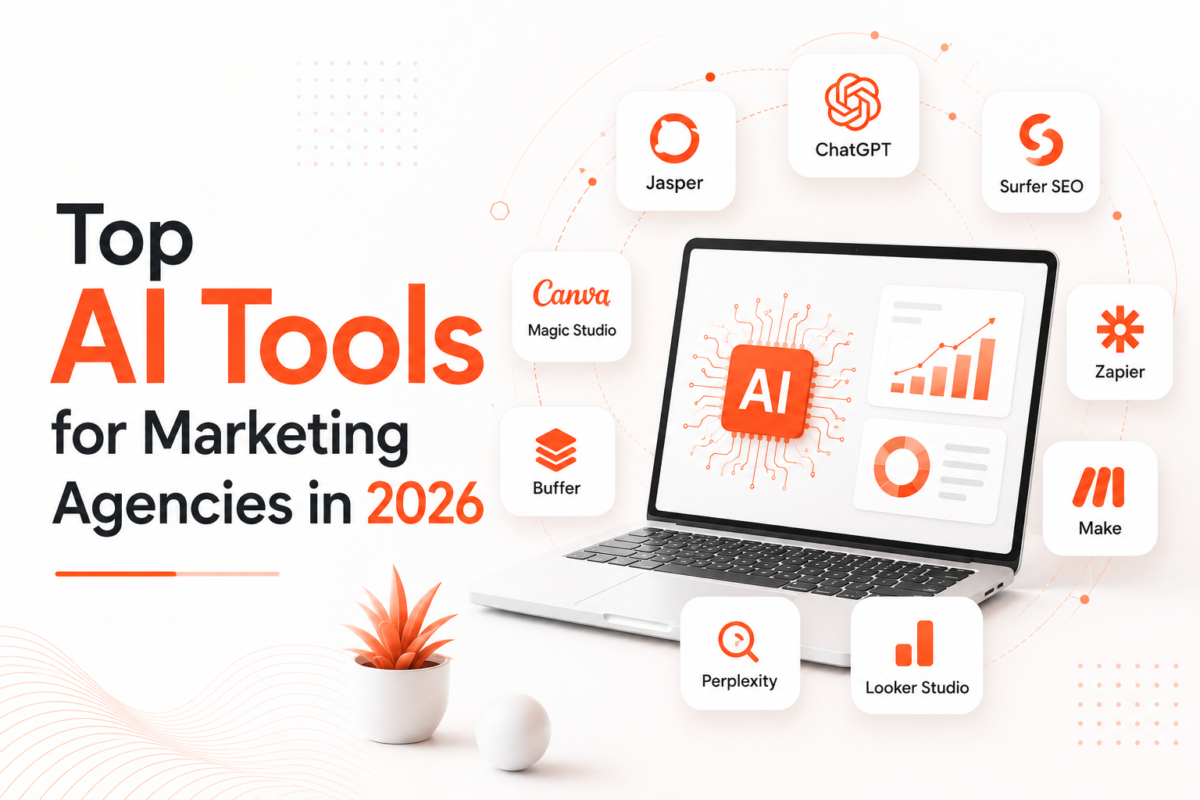
Top AI Tools for Marketing Agencies in 2026

Marketing agencies aren’t choosing whether to use AI anymore; they’re choosing which AI tools actually move the needle for clients. Between content creation, SEO, design, automation, and the newer challenge of showing up inside AI answers on ChatGPT and Gemini, the modern agency stack looks nothing like it did even two years ago.

At Social 101, a full-service digital marketing and social media agency in Surat, we test and use these tools daily across branding, social media, performance marketing, and organic growth campaigns. Here’s our honest breakdown of the AI tools that actually earn a seat in an agency’s workflow in 2026 and how to think about building your own stack.

Why AI Tools Matter for Marketing Agencies Right Now

Three shifts are forcing agencies to rethink their toolkits:

  • Client expectations have changed. Brands want faster turnarounds, more personalized creative, and proof of ROI without paying for a bigger team.
  • Search itself has changed. A growing share of discovery now happens inside AI answer engines, not just Google’s blue links, which means agencies need to optimize for AI search visibility as much as traditional SEO.
  • Execution has become the bottleneck. Strategy hasn’t gotten easier, but AI has made the repetitive parts, drafting, scheduling, and reporting, dramatically faster, freeing agency teams to focus on strategy and client relationships.

With that context, here’s the toolkit worth knowing.

1. AI Content Creation & Copywriting Tools

Agencies producing content across multiple clients need consistency at scale, not just speed.

  • Jasper Built specifically for marketing teams, Jasper lets agencies set brand voice profiles per client so blog posts, ad copy, and landing pages stay on-brand even when different writers use it. It’s particularly useful for agencies running content for several accounts at once.
  • Copy.ai leans into repeatable workflows: feed it a brief or offer, and it generates blog drafts, social captions, and ad variants in a structured process rather than one-off outputs.
  • ChatGPT / Claude general-purpose AI assistants remain the backbone for research, outlining, and first-draft writing before a human editor refines it for tone and accuracy.


Where it fits at Social 101: we use AI drafting tools to speed up first drafts for content marketing work, then apply our own editorial and brand-voice review before anything ships to a client.

2. AI SEO & Keyword Research Tools

SEO tools have moved from keyword lists to full content-scoring engines.

  • Surfer SEO scores content in real time against top-ranking competitors for a target keyword, factoring in keyword density, semantic terms, and heading structure. Its keyword clustering feature also helps agencies build topical content hubs instead of one-off blog posts.
  • Semrush AI combines keyword research, technical audits, and competitor tracking, now layered with AI-assisted recommendations for what to fix first.

Why it matters: ranking a single blog post isn’t the goal anymore; building topical authority around a service (like “organic growth agency” or “performance marketing”) is what actually compounds traffic over time.

3. AI Design & Creative Tools

  • Canva (Magic Studio) Remains the fastest way for agencies to produce on-brand social creative, presentation decks, and ad variations without looping in a designer for every small asset.
  • AI image and video tools (for reels, product shots, and quick creative testing) are increasingly bundled into design suites, cutting production time for high-volume social content.


4. AI Social Media Scheduling Tools

  • Buffer and Later Both now offer AI-assisted caption generation and optimal-time scheduling, which is useful for agencies managing posting calendars across several client accounts simultaneously.

For agencies running social media management at scale, this is less about replacing strategy and more about removing the manual grind of scheduling and caption variations.

5. AI Research & Strategy Tools

  • Perplexity: A research assistant with citations, useful for competitor research, market data, and fact-checking claims before they go into client decks or blog content.
  • ChatGPT / Claude (again) used for structured strategy work: campaign briefs, audience personas, and messaging frameworks, especially when given detailed context to work from.

6. AI Automation Tools

Zapier and Make Connect the rest of the stack together: new lead forms trigger CRM updates, content approvals move automatically between tools, and reporting steps run without manual copy-pasting. For agencies juggling multiple client accounts, this is often the highest-ROI category because it saves account management hours every week, not just content hours.

7. AI Search Visibility (GEO) Tools

This is the newest and fastest-growing category. As more people ask ChatGPT, Gemini, and AI Overviews for recommendations instead of typing a Google query, agencies need to track whether their clients’ brands actually get cited in those answers not just ranked in search results.

Newer platforms in this space track how often a brand is mentioned across AI engines, which prompts trigger a citation, and how that compares to competitors. This is exactly the discipline we cover in our guide on how Surat businesses can get found on ChatGPT and AI search. Traditional SEO and AI visibility now need to be planned together, not as separate workstreams.

8. AI Reporting & Analytics Tools

  • Looker Studio with AI connectors Automates recurring client reports, pulling data from ad platforms, CRMs, and analytics tools into a single dashboard that updates itself instead of requiring manual exports every month.

This matters more than it sounds: agency teams often lose hours each month building reports by hand. Automating that frees up time for actual strategy and optimization.

Quick Comparison: Which AI Tool Category Should You Start With?

CategoryBest ForExample Tools
Content creationMulti-client blog & copy productionJasper, Copy.ai
SEORanking content & topical authoritySurfer SEO, Semrush AI
DesignFast, on-brand social & ad creativeCanva
Social schedulingManaging multiple client calendarsBuffer, Later
ResearchFact-checked strategy & competitor insightPerplexity
AutomationConnecting tools, saving admin hoursZapier, Make
AI search visibilityGetting cited in ChatGPT/Gemini answersEmerging GEO platforms
ReportingAutomated, always-updated client dashboardsLooker Studio

How to Choose the Right AI Stack for Your Agency

Don’t try to adopt every tool at once. A practical approach:

  1. Identify your biggest time sink. For most agencies, that’s content production or client reporting.
  2. Pick one tool per bottleneck, master it with your team, and measure hours saved before adding another.
  3. Set internal governance early rules around what client data can go into which tool, who reviews AI output before it ships, and how brand voice is protected across accounts.
  4. Keep a human in the loop. AI tools speed up execution, but positioning, offering clarity, and creative judgment still come from strategists who understand the client’s business, not the software.


How Social 101 Uses AI to Deliver Better Results

As a full-service digital marketing and social media agency in Surat, we combine these AI tools with hands-on strategy across branding, social media management, performance marketing, and organic growth. AI helps our team move faster on execution but the strategy, brand judgment, and client relationships behind every campaign are still built by people who know the business. If you’re a brand trying to figure out which AI-powered marketing approach actually fits your goals instead of chasing every new tool, get in touch with Social 101, and we’ll help you build a stack (and a strategy) that fits your business.

FAQs

Do small businesses need all these AI tools, or just an agency?

Most small businesses don’t need to buy and manage a full AI stack themselves that’s exactly the value an agency brings: the right tools, already integrated into a working process, without the learning curve or subscription costs.

Will AI tools replace marketing agencies?

No. AI speeds up execution, drafting, scheduling, and reporting, but strategy, brand positioning, and creative judgment still require human expertise, especially as AI search makes brand differentiation more important, not less.

What’s the difference between SEO tools and AI search visibility (GEO) tools?

Traditional SEO tools optimize for ranking in Google’s search results. AI visibility tools track whether a brand gets cited inside AI-generated answers from tools like ChatGPT and Gemini, an increasingly important, separate discipline.

How to Optimize Your Website for ChatGPT, Gemini & Perplexity AI in 2026

A growing share of your customers no longer start with a Google search. They open ChatGPT, Gemini, or Perplexity and simply ask, “What’s the best [service] in Surat?” or “Which agency should I hire for X?” If your website isn’t structured for these AI engines to read, trust, and quote, you’re invisible in that conversation even if you rank on page one of Google.

This is the discipline now called Generative Engine Optimization (GEO), and it works differently from traditional SEO. At Social 101, we’ve been tracking this shift closely as part of our AI search and organic growth strategy work for Surat brands. Here’s exactly how to optimize your website for ChatGPT, Gemini, and Perplexity in 2026.

What Is GEO (Generative Engine Optimization)?

Old SEO was about ranking, earning a spot in a list of ten blue links. GEO is about being cited as the source an AI model pulls from, quotes, or recommends by name inside its answer. AI engines don’t rank pages the way Google does; they generate a response and decide, sentence by sentence, which sources are trustworthy enough to reference.

That means your content needs to be easy for an AI model to find, understand, extract, and trust just easy for a person to read.


How ChatGPT, Gemini & Perplexity Each Decide What to Cite

These three platforms don’t work the same way, so a one-size-fits-all approach falls short. Here’s the core difference:

EngineHow It Finds AnswersWhat Helps You Get Cited
ChatGPT (Search)Live browsing plus trained knowledge; favours domain authorityAnswer-first structure, strong backlink profile, recent content
Google Gemini / AI OverviewsLeans on existing Google Search signals, processed through AITraditional SEO fundamentals, schema markup, Google Business Profile
PerplexityReal-time web retrieval with visible citations, no memory layerThird-party mentions, review sites, fresh long-form content


How This Connects to Your Broader SEO & Growth Strategy

GEO doesn’t replace traditional SEO it sits on top of it. Gemini in particular still leans heavily on classic Google ranking signals, so the fundamentals (site speed, mobile experience, backlinks, on-page SEO) still matter. What’s changed is that you now need to plan for two audiences at once: human readers scrolling a page and AI models extracting facts from it. This is exactly the approach we take in our organic growth strategy work and our guide on how Surat businesses can get found on ChatGPT and AI search.

How Social 101 Helps Brands Win in AI Search

As a full-service digital marketing agency in Surat, we help brands build the technical foundation, content structure, and off-site authority that AI engines look for alongside our core SEO, content marketing, and organic growth services. If your business isn’t showing up when customers ask ChatGPT or Perplexity for a recommendation, that’s a strategy gap we can close.

Ready to see where you stand? Get in touch with Social 101 for an AI search visibility review of your website.


FAQs

How fast can I see results from GEO?

Platforms with real-time retrieval, like Perplexity, can reflect changes to your content and off-site mentions within roughly 4 to 12 weeks. Platforms that rely more on trained knowledge, like ChatGPT, tend to update more gradually, though they refresh more often than in previous years.

Does GEO replace SEO?

No. Traditional SEO fundamentals, site structure, page speed, backlinks, and on-page optimization still influence how AI engines evaluate your site, especially Gemini. GEO adds a second layer focused on structure, extractability, and citation-worthiness.

Can a small business really compete with larger brands in AI search?

Yes. AI engines weigh authority signals, content quality, and citation frequency over company size. A smaller brand with strong reviews, an authentic web presence, and well-structured content can be cited ahead of a larger, less-optimized competitor.